

Mastering the Brown Belt in Jiu Jitsu: The Complete Guide
Belt System Guide | Last Updated: January 16, 2026
The brown belt in Brazilian Jiu-Jitsu represents the penultimate rank before black belt, requiring 5-8 years of dedicated training and marking the transition from technical proficiency to strategic mastery. Practitioners at this level demonstrate advanced guard passing, submission chains, positional dominance, and the ability to mentor lower-ranked students, earning the reputation as “mini black belts” capable of executing high-level techniques with precision.
Brown belt promotion requires meeting IBJJF standards: minimum age 18, at least 18 months at purple belt, and approximately 750+ classes over 5-8 years of training. Beyond time requirements, instructors evaluate technical proficiency across positions, problem-solving ability during sparring, training consistency, and contributions to academy culture through mentorship.
This comprehensive guide covers brown belt requirements, essential techniques, training strategies, competition preparation, common challenges, the brown-to-black transition, drills for progression, and mindset development connecting to complete BJJ belt system understanding and purple belt mastery.
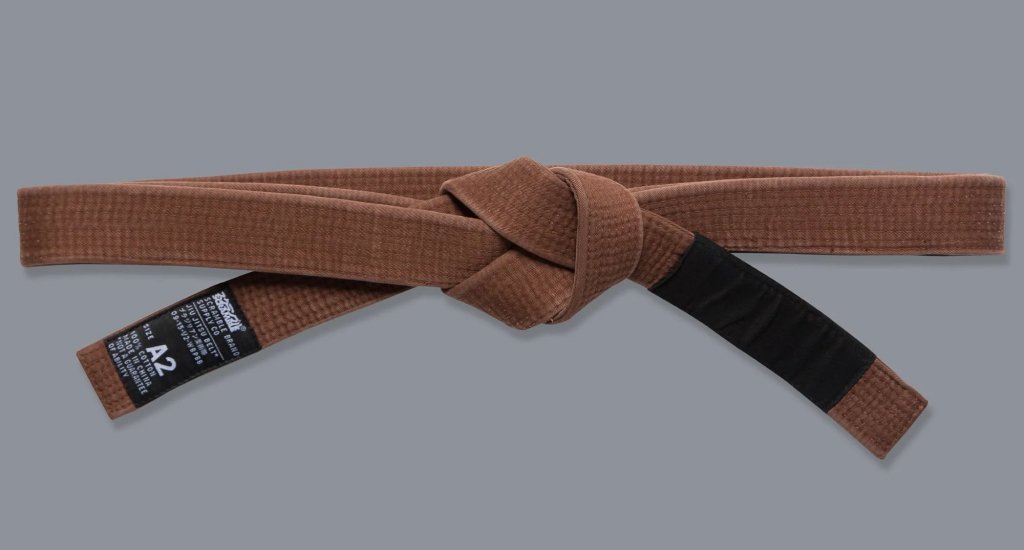
Table of Contents
What is a Brown Belt in BJJ?
Rank Position
Final stage before black belt:
- 5th belt in adult BJJ hierarchy (white → blue → purple → brown → black)
- Represents advanced mastery after 5-8 years total training
- Minimum 1 year at brown belt before black belt eligibility
- Often described as “revision phase” where concepts are re-learned in greater depth
Notable quote: Xande Ribeiro stated that a brown belt could be awarded black belt the next day if the instructor felt so inclined, highlighting how close brown belts are to black belt level .
IBJJF Requirements
Official IBJJF graduation system standards:
Minimum age: 18 years old (adults only)
Time at purple belt: 18 months minimum (can be waived for Adult World Champions at purple)
Time at brown belt: 1 year minimum before black belt eligibility (can be waived for Adult World Champions at brown)
Registration: Must be registered with IBJJF for time requirements to count
Promotion authority: Must be promoted by IBJJF-affiliated black belt professor
Reference: IBJJF belt system (complete hierarchy)
Typical Timeline
Average progression to brown belt:
| Belt | Typical Time | Cumulative Total |
|---|---|---|
| White belt | 1-2 years | 1-2 years |
| Blue belt | 2-4 years | 3-6 years |
| Purple belt | 2-3 years | 5-9 years |
| Brown belt | Achieved | 5-9 years |
- Minimum 750 classes over 5-8 years
- Typically 2-5 training sessions per week
- More frequent training (5+ sessions/week) can accelerate timeline
- Competition experience often speeds progression
Elite timeline example: Gordon Ryan achieved black belt in approximately 5 years through 30+ hours weekly training (far above average) .
Reality: Most practitioners take 7-8 years to reach brown belt, with wide variation based on training frequency, athletic ability, and instructor standards.
Reference: How long to get black belt (complete timeline)
Brown Belt Test Requirements
Technical Demonstration
Brown belt test curriculum (typical standards):
From top positions:
- 40+ attacks from mount, side control, knee-on-stomach, north-south, headlock
- 15+ guard passes (pressure passing, leg pummeling, knee cuts, toreandos, etc.)
- Smooth transitions between dominant positions
- Weight distribution and pressure control
From guard (bottom):
- 40+ attacks or sweeps from closed guard, open guards, half guard
- Guard retention against advanced passers
- Submission setups from guard
- Guard recovery techniques
Sparring test:
- 3-8 minute rounds demonstrating technique application
- Ability to control pace and transitions
- Problem-solving against different body types/styles
- Staying calm under pressure
Note: Test requirements vary significantly by academy, but all emphasize well-rounded technical proficiency.
Promotion Evaluation Criteria
Instructors evaluate brown belt candidates on:
Technical proficiency (40%):
- Mastery over positions, submissions, escapes, transitions
- Ability to execute techniques with precision and timing
- Well-rounded game (not overly specialized)
Training consistency (25%):
- Regular attendance over multiple years
- Sustained effort in skill development
- Overcoming injuries and plateaus
Problem-solving ability (20%):
- Adapting tactics during sparring
- Reading opponents and adjusting strategies
- Calculating when to defend vs attack
Academy contribution (15%):
- Mentoring lower-ranked students
- Fostering positive training culture
- Leadership and maturity
Behavior/character:
- Humility, respect, discipline
- Embodying BJJ values on and off the mat
Essential Brown Belt Skills
Advanced Guard Passing
Pressure passing:
- Over-under pass (controlling hips, driving shoulder pressure)
- Smash pass (flattening guard, stacking opponent)
- Knee slice (cutting through guard systematically)
- Perfect weight distribution and timing
Leg pummeling:
- Clearing opponent’s legs to create pathways
- Hand-fighting to control grips
- Hip positioning to prevent re-guard
Position maintenance after passing:
- Controlling side control with proper frames
- Transitioning to mount without giving space
- Taking back when opponent turns
- Preventing escapes with anticipation
Reference: Guard passing fundamentals (foundational techniques)
Submission Chains & Setups
Choke variations:
- Triangle chokes (from guard, mount, back)
- Rear-naked choke (with proper hand placement, body control)
- Guillotine variations (high-elbow, arm-in, Marcelotine)
- Bow-and-arrow choke (from back control)
- Loop choke, ezekiel, baseball bat chokes
Arm locks:
- Armbar from multiple positions (guard, mount, side control)
- Kimura setups and transitions (to sweeps, back takes)
- Omoplata (finishing, using for sweeps/transitions)
- Americana from side control/mount
Leg locks (allowed at brown belt):
- Straight ankle locks
- Kneebars (from top, bottom)
- Toe holds (IBJJF legal at brown)
- Heel hooks (no-gi only, not IBJJF legal)
- Armbar → triangle → omoplata flow
- Kimura → guillotine → arm triangle transitions
- Back attack combinations (RNC → armbar → bow-and-arrow)
Concept: Brown belts understand conceptual connections between submissions, creating fluid chains that don’t rely on individual technique success.
Reference: BJJ submission guide (comprehensive overview)
Positional Dominance
| Position | Brown Belt Standards |
|---|---|
| Closed guard | Expert at immobilizing opponents; attacks reflect mastery and control; breaking posture systematically |
| Open guard variations | Understanding order and application of different guards (spider, De La Riva, lasso, butterfly); knowing which submissions/sweeps work best from each |
| Half guard | Using half guard offensively (sweeps, back takes); escaping bottom half guard efficiently |
| Mount | Dominating with complete immobilization; maintaining mount against advanced escape attempts; high-mount transitions |
| Back control | Well-developed back attacks considered lethal; pairing different attacks (chokes, armbars); body triangle control; preventing escapes |
| Side control | Effortless submission setups; striking perfect weight distribution; pressure balance; transitioning to mount/north-south |
| Turtle position | Adopting different positions to counter turtle attacks; understanding opponent’s intentions; attacking turtle (clock choke, crucifix) |
- Using frames and pressure to prevent escapes
- Transitioning smoothly between side control variations
- Setting up submissions (americana, kimura, arm triangle)
Strategic Development
High-level tactical thinking:
Controlling transitions:
- Dictating where the match takes place (top, bottom, standing)
- Recognizing transition windows and exploiting them
- Preventing opponent from implementing their game plan
Setting tempo:
- Knowing when to explode and when to conserve energy
- Forcing opponent to react to your rhythm
- Varying pace to create openings
Tactical decisions:
- Balancing offense and defense appropriately
- Calculating risk vs reward for attacks
- Adapting strategy based on time, score, opponent style
Personalized game plans:
- Developing systems adapted to your body type
- Building game around your strengths
- Having backup plans when primary game is shut down
Opponent analysis:
- Reading body language and tells
- Identifying patterns in opponent’s game
- Adjusting mid-match to counter strategies
Training Approaches for Brown Belt
Purposeful Rolling (Sparring)
Every session should have specific goals:
Positional sparring:
- Start from specific positions (guard passing, sweeping, escaping mount)
- Focus on controlling specific positions
- Build confidence in weak positions
Limited attacks (constraint-based training):
- Only use certain submissions (triangles only, kimura only, etc.)
- Narrow focus to sharpen specific skills
- Forces creativity and setup refinement
Transitions and escapes:
- Prioritize fluid position changes
- Refine escape mechanics from bad positions
- Work on timing of transitions
Flow rolling:
- Lower intensity, focus on technique over strength
- Experiment with new techniques
- Useful for injury recovery/prevention
Competition-style rolling:
- Full intensity, simulating tournament conditions
- Practice under fatigue
- Test competition game plan
Smart Training Philosophy
Training efficiency for longevity :
Technique over physicality:
- Rely on leverage, timing, positioning
- Minimize strength-based techniques
- Develop “old man BJJ” mindset early
Partner selection:
- Train with variety (white belts to black belts)
- Choose training partners who challenge without injuring
- Balance hard rolls with technical rounds
Energy conservation:
- Save maximum effort for critical moments
- Recognize when to tap (protect ego, preserve body)
- Don’t “go 100%” every single round
Long-term sustainability:
- Think about training BJJ into 40s, 50s, beyond
- Address injuries promptly (don’t “push through”)
- Incorporate mobility work, strength training, recovery
- 3-5 sessions per week optimal for most brown belts
- Balance mat time with recovery
- Quality over quantity (purposeful training beats mindless drilling)
Reference: BJJ training frequency (optimization guide)
Seeking Advanced Instruction
Accelerating growth through coaching:
Seminars and workshops:
- Attend seminars by high-level black belts
- Exposure to different teaching styles
- Learn techniques outside your academy’s curriculum
Training at multiple academies:
- Visit other gyms when traveling
- Experience different training cultures
- Test your skills against unfamiliar opponents
Private lessons:
- One-on-one instruction for personalized feedback
- Address specific weaknesses
- Fast-track technical refinement
Video study:
- Watch competition footage (World Championships, ADCC, etc.)
- Study elite grapplers with similar body types
- Analyze your own sparring videos
Competition at Brown Belt Level
Difficulty and Intensity
Extremely competitive division:
Brown belt brackets:
- Feature extremely tough, seasoned competitors
- Often more exciting than black belt (high skill + slightly lower stakes)
- Many competitors have 5-8+ years experience
- Everyone has well-developed game plans
Success requirements:
- Clear strategy: Well-structured game plan relying on tactical thinking
- Mental resilience: Toughness to push through intense, high-level matches
- Adaptability: Quick adjustments to diverse opponent styles
- Physical conditioning: Matches can be long and grueling
- Best way to sharpen skills under pressure
- Analyze strengths and weaknesses in real scenarios
- Test what works and doesn’t work
- Build mental toughness required for black belt
Reference: BJJ competition preparation (tournament guide)
IBJJF Rules for Brown Belt
Legal submissions:
- All chokes (including neck cranks with proper control)
- All arm locks (armbars, kimuras, americanas, omoplatas)
- Shoulder locks (including tarikoplata, monoplata)
- Straight ankle locks
- Kneebars
- Toe holds
- Calf slicers
- Bicep slicers
Illegal submissions (IBJJF gi):
- Heel hooks (legal in no-gi at brown)
- Reaping the knee (depending on position)
- Slamming
Preparation: Brown belt opens up almost all submissions, preparing you for full black belt ruleset.
Competition Strategy
Pre-match preparation:
- Scout opponents when possible (watch previous matches)
- Have primary game plan + backup plans
- Visualize different scenarios
During match:
- Control where fight takes place (top/bottom/standing)
- Set tempo that favors your game
- Stay calm, think strategically (don’t just react)
- Manage time/score awareness
Post-match analysis:
- Review match footage objectively
- Identify what worked and what didn’t
- Adjust training based on competition gaps
Common Challenges at Brown Belt
Refining Weaknesses
“Revision phase” for deep learning:
Eliminating bad habits:
- Identify shortcuts or poor technique from earlier belts
- Rebuild fundamentals with proper mechanics
- Address position-specific weaknesses
Continuous adaptation:
- Lower belts constantly improving, trying to “test” you
- Must evolve game to stay ahead
- Can’t rely on techniques that worked at purple belt
Specialized vs well-rounded:
- Balancing deep expertise (guard, top game, leg locks) with being well-rounded
- Filling gaps in game while maintaining strengths
Increased Pressure & Expectations
Mentoring lower belts:
- Expected to help teach and guide white/blue/purple belts
- Answer technical questions
- Demonstrate proper technique
Teaching classes:
- Many brown belts begin teaching when opportunities arise
- Develop teaching philosophy
- Deepens understanding through explaining concepts
Setting example:
- Lower belts look up to brown belts
- Must embody academy values (humility, respect, discipline)
- Behavior on and off the mat matters
Balancing act:
- Continue personal development while helping others
- Don’t sacrifice own training to only teach
- Find time for both coaching and being coached
The “Final Plateau”
Psychological challenges:
Fear of black belt:
- Some brown belts experience anxiety about approaching black belt
- Recognize the significant responsibilities/expectations of black belt
- May unconsciously slow progress
Pressure to perform:
- Everyone expects brown belts to dominate lower belts
- Losses feel more significant
- Competition pressure intensifies
Motivation fluctuations:
- 7-8 years of training can lead to burnout
- Need to rediscover why you love BJJ
- Find new goals to stay motivated
Solution: Many brown belts benefit from “smelling the roses” before black belt—enjoying the journey rather than rushing the destination .
Preparing for Black Belt Transition
Strategic Understanding
Controlling transitions:
- Not just techniques, but controlling when/where transitions happen
- Setting traps (baiting reactions, capitalizing on defensive patterns)
- Thinking multiple steps ahead
Positional chess:
- Understanding position hierarchies deeply
- Recognizing when to abandon position for better opportunity
- Calculating positional exchanges
Strategic depth:
- Having backup plans for every position
- Adjusting game plan mid-match based on opponent reactions
- Developing unique systems difficult for opponents to counter
Self-Reflection & Assessment
Strengths analysis:
- What are your best positions/techniques?
- What makes your game unique?
- How can you build on strengths?
Weaknesses identification:
- What positions do you avoid?
- What techniques consistently catch you?
- Where do you lose matches?
Game refinement:
- Streamline techniques that work
- Eliminate techniques that don’t
- Build cohesive systems (not random techniques)
Competition Experience
Compete regularly:
- Test skills against different styles
- Build mental toughness
- Identify gaps in game under pressure
Seek tough matches:
- Don’t avoid difficult opponents
- Learn more from losses than wins
- Embrace challenge
Mindset development:
- Overcome competition anxiety
- Perform under pressure
- Develop champion mentality
Reference: Competition mindset (mental preparation)
Brown Belt Training Drills
Drill #1: Position Cycling (Mastery Across All Positions)
Objective: Develop comfort in all positions
How to perform:
- Start in position A (e.g., closed guard)
- Work for 2 minutes focusing on control/attacks
- Rotate to position B (e.g., side control top)
- Continue cycling through 8-10 positions
- 20-30 minute total drill
Positions to cycle:
- Closed guard (top and bottom)
- Open guard variations
- Half guard (top and bottom)
- Side control (top and bottom)
- Mount (top and bottom)
- Back control (top and bottom)
- Turtle (attacking and defending)
Benefit: Ensures well-rounded game, no weak positions
Drill #2: Submission Chains (Flowing Between Attacks)
Objective: Build submission chains, don’t rely on single attacks
How to perform:
- Partner offers light resistance
- Attempt submission #1 (e.g., armbar from guard)
- When defended, immediately transition to #2 (triangle)
- When defended, transition to #3 (omoplata)
- Flow between 3-5 submissions continuously
- 5 rounds × 3 minutes each
Common chains to drill:
- Guard: Armbar → Triangle → Omoplata → Back take
- Mount: Americana → Armbar → Ezekiel → Back take
- Back: RNC → Armbar → Bow-and-arrow → Crucifix
- Side control: Kimura → Guillotine → Arm triangle → Mount
Benefit: Develops automatic transitions, keeps opponents defending constantly
Drill #3: Escape Refinement (Getting Out of Bad Positions)
Objective: Perfect escapes from worst positions
How to perform:
- Start in bad position (bottom side control, bottom mount, turtle, etc.)
- Partner applies moderate pressure (60-70% resistance)
- Work only on escaping (no submissions)
- Drill 10 escapes from each bad position
- Focus on efficiency and timing
Bad positions to escape:
- Bottom side control
- Bottom mount
- Bottom knee-on-stomach
- Back control (defending)
- Turtle
Benefit: Confidence in worst positions, ability to recover from mistakes
Drill #4: Guard Passing Marathon
Objective: Develop systematic guard passing under fatigue
How to perform:
- Line up 5-10 partners (various belt levels)
- Start passing guard of partner #1
- Once passed, immediately move to partner #2
- Continue until all guards passed
- Rest 3 minutes, repeat 3-5 rounds
Variations:
- Only pressure passing
- Only leg pummeling/speed passing
- Mix of passing styles
- Partners offer increasing resistance
Benefit: Builds passing stamina, exposes weaknesses in passing game
Drill #5: Situational Sparring (Constraint-Based)
Objective: Develop specific skills through constraints
How to perform:
- Set specific constraint (e.g., “closed guard only” or “no grips on gi”)
- Spar 5-minute rounds with constraint
- Both partners follow same rules
- Rotate partners each round
- 5-8 rounds total
Constraint ideas:
- Closed guard only (can’t open guard)
- No grips allowed (hand-fighting only)
- Sweep or submit only (no passing)
- One arm behind back (simulate injury/disadvantage)
- Must pull guard (no takedowns)
Benefit: Forces creativity, develops weak areas, problem-solving under constraints
The Brown Belt Mindset
Coaching and Mentorship
Teaching responsibilities:
- Many brown belts begin teaching classes
- Develop teaching philosophy
- Deepen understanding through explaining concepts
Mentoring lower belts:
- Answer technical questions
- Provide encouragement and guidance
- Share experiences from your journey
Outward focus:
- Spend considerable time allowing less-experienced students to work their games
- Defend and sharpen escape skills while helping others
- Balance personal training with helping others
Learning through teaching:
- Teaching forces you to understand techniques deeply
- Explaining concepts reveals gaps in your knowledge
- Watching others attempt techniques provides new perspectives
Longevity Focus
Smart training for long-term participation :
Efficiency over intensity:
- Training must be smart for long-term participation
- Rely on technique, not athleticism
- Preserve body for decades of training
Thinking long-term:
- Many brown belts think seriously about training BJJ indefinitely
- How to maintain practice into 40s, 50s, 60s, beyond?
- Adjust training intensity as body ages
Injury prevention:
- Address small injuries before they become major
- Don’t “tough out” pain that signals damage
- Incorporate mobility work, strength training, recovery protocols
Reference: BJJ for older practitioners (age-appropriate training)
Approaching Black Belt
Recognizing responsibility:
- Black belt carries significant expectations
- Represents your instructor and academy
- Lifelong commitment to refinement
“Smelling the roses”:
- Brown belt allows time to enjoy journey before final belt
- Less pressure than black belt
- Freedom to experiment without black belt scrutiny
Preparing mentally:
- Understanding black belt isn’t “end goal” but beginning of deeper journey
- Developing humility and perspective
- Building confidence through consistent performance
Brown Belt in MMA
Grappling advantage in mixed martial arts :
Significant competitive edge:
- Brown belt provides high-level proficiency in ground fighting
- Superior control, transitions, submissions
- Defensive grappling to prevent takedowns, escape bad positions
Notable MMA fighters with elite BJJ:
- Demian Maia (BJJ black belt, world champion)
- Ronaldo “Jacaré” Souza (BJJ black belt, world champion)
- Charles Oliveira (BJJ black belt, most UFC submissions)
- Brian Ortega (BJJ black belt, high submission rate)
Brown belt sufficiency:
- Brown belt grappling skills sufficient for most MMA competition
- Combined with striking, wrestling creates well-rounded fighter
- Allows MMA fighters to defend against elite grapplers
Reference: BJJ vs MMA (sport comparisons)
Choosing the Right Gear for Brown Belt
Brown Belt Selection
IBJJF standards:
- Width: 3.5-4.5 cm (1.38-1.77 inches)
- Solid brown color (no red/white tabs like youth belts)
- Tied with double knot
Degrees (optional):
- Up to 4 degrees at brown belt (some academies use, others don’t)
- 1 degree approximately every 3-6 months (instructor discretion)
- Red tape on one end indicates degree level
Where to buy:
- Academy pro shop (supports your gym)
- Online BJJ retailers (BJJ Fanatics, Fighters Market, etc.)
- Quality brands: Fuji, Venum, Hayabusa, Scramble
Reference: BJJ belt guide (complete overview)
Gi Selection for Advanced Training
Quality gi features for brown belts:
Durability requirements:
- 5-8 years of training = heavy wear on gis
- Reinforced stress points (knees, armpits, collar)
- Quality stitching (pearl weave, gold weave, ripstop)
Multiple gis recommended:
- 2-3 gis minimum for frequent training
- Allows rotation (extends gi lifespan)
- Different weights (light for summer, heavy for winter)
IBJJF legal requirements:
- Jacket must reach thighs, sleeves must reach wrists
- Pants must reach ankles
- Color: white, blue, or black
- Patches follow IBJJF placement rules
Top brands for advanced practitioners:
- Shoyoroll (premium, limited releases)
- Origin (made in USA, high quality)
- Fuji (reliable, affordable)
- Kingz, Tatami, Scramble (solid mid-range)
Reference: Best BJJ gis (buying guide)
Training Equipment
Essential gear for brown belts:
Protection:
- Mouthguard (protect teeth during intense rolls)
- Knee pads/braces (if history of knee issues)
- Compression gear (supports muscles, prevents rashes)
Hygiene:
- Antifungal soap (prevent ringworm, staph)
- Nail clippers (keep nails trimmed)
- Multiple towels (wipe down after training)
Recovery:
- Foam roller (muscle recovery)
- Resistance bands (mobility, warm-up)
- Ice packs (acute injury management)
Reference: BJJ equipment guide (complete list)
Frequently Asked Questions
How long does it take to earn a brown belt in BJJ?
Typically 5-8 years of consistent training, averaging 2-5 sessions per week. Elite athletes training 5+ times weekly may achieve brown belt in 5-6 years, while recreational practitioners training 2-3 times weekly may take 8-9 years.
What are the key skills required for brown belt promotion?
Well-rounded game with advanced guard passing, submission chains, positional control, problem-solving ability during sparring, training consistency over multiple years, and academy contributions through mentoring lower belts.
Do I need to compete to get promoted to brown belt?
While not mandatory at most academies, competition is highly encouraged as it refines skills under pressure, demonstrates technical proficiency against diverse opponents, and builds the mental toughness required for black belt.
Is a brown belt in BJJ considered good?
Yes, it’s outstanding—brown belts are often described as “mini black belts” capable of executing high-level techniques with skill and precision. Xande Ribeiro noted that a brown belt could be awarded black belt the next day if the instructor felt so inclined .
How high is a brown belt in jiu jitsu?
Brown belt is the penultimate rank before black belt in the BJJ adult hierarchy, representing advanced mastery after 5-8 years of dedicated training—only black belt ranks higher.
Can a brown belt teach BJJ?
Yes, many brown belts begin teaching classes and mentoring lower-ranked students, though they should do so under the supervision and approval of their black belt instructor.
What’s the difference between brown belt and black belt?
The primary differences are experience depth (black belts have typically trained 10+ years vs 5-8 for brown), teaching authority (black belts can promote students up to brown belt), strategic refinement (black belts demonstrate mastery of BJJ concepts at the highest level), and leadership responsibilities within the BJJ community.
Final Thoughts: The Brown Belt Journey
Brown belt represents the culmination of 5-8 years of dedication, marking the transition from technical proficiency to strategic mastery and leadership within the BJJ community. This rank requires approximately 750+ classes, mastery across all positions, advanced guard passing, submission chains, and the maturity to mentor lower belts while continuing personal development.
The brown belt period serves as critical preparation for black belt, focusing on refining weaknesses, eliminating bad habits, developing strategic depth, and building the mental resilience required for lifelong BJJ practice. Whether pursuing competition success, MMA applications, or personal mastery, brown belt provides the technical foundation and strategic understanding to excel at the highest levels.
Continue your belt journey:
- Purple belt guide – Previous rank
- Black belt requirements – Next level
- Complete belt system – Full hierarchy
- Competition preparation – Tournament success
OSS! 🥋🤎