
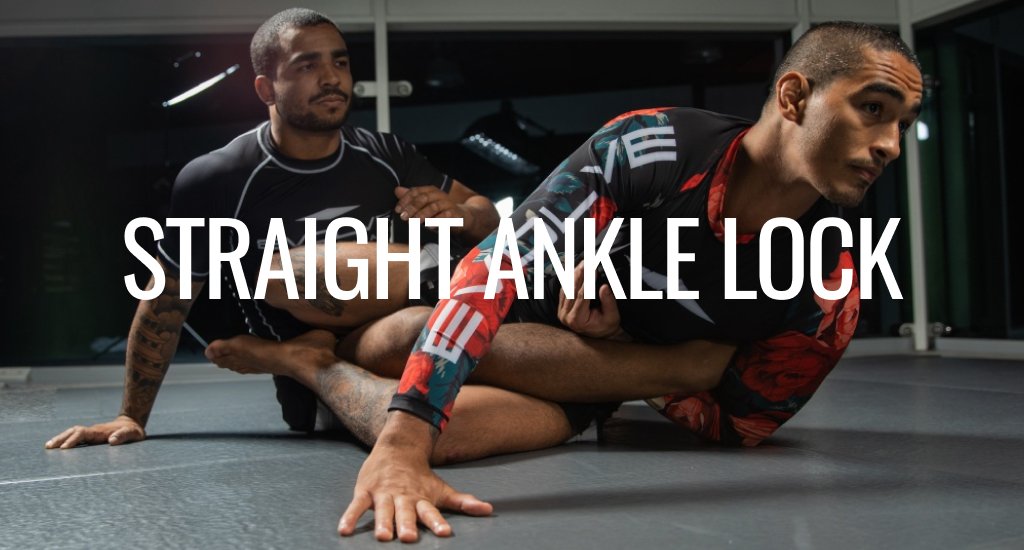
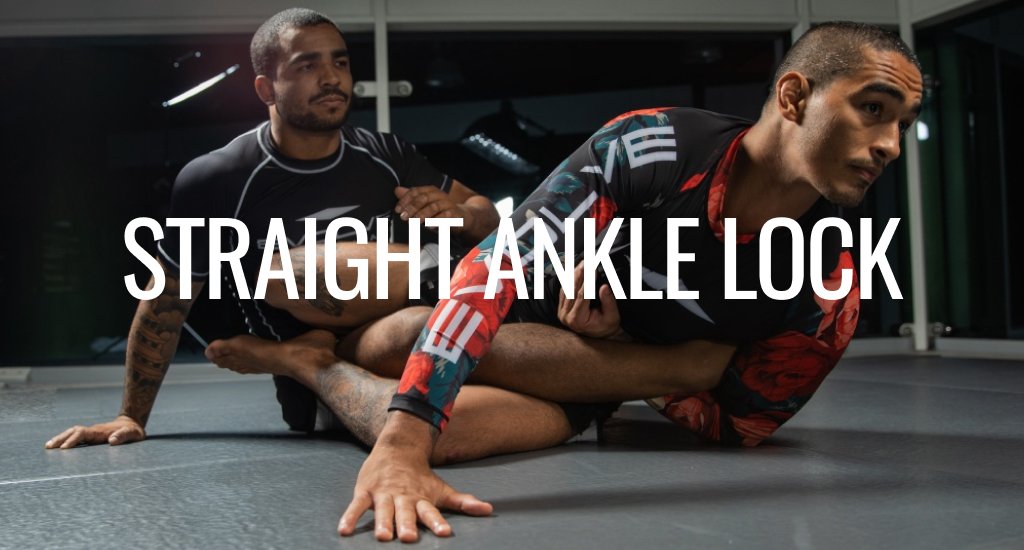
Straight Ankle Lock: The Beginner’s Leg Lock Guide

Straight Ankle Lock: The Beginner’s Leg Lock Guide
By BJJ Sportswear Editorial Team
Reviewed by competitive black belts specializing in leg lock systems and safe training practices | Last Updated: January 12, 2026

The straight ankle lock (also called Achilles lock or straight footlock) is Brazilian Jiu-Jitsu’s fundamental leg submission—a technique that targets the Achilles tendon by hyperextending the ankle joint while controlling your opponent’s leg in ashi garami position. What makes this submission essential is its universal legality: unlike the dangerous heel hook, the straight ankle lock is legal at ALL belt levels in both gi and no-gi IBJJF competition, making it the gateway to leg lock mastery for every practitioner.​

According to Evolve MMA, the ankle lock (also known as the Achilles lock) is typically the first leg submission taught in Brazilian Jiu-Jitsu. It is a leg-based attack that targets the Achilles tendon by pressing it towards the foot. It is a classic submission that is not only taught in BJJ but also in other forms of grappling like Sambo and Judo.

NAGA Fighter emphasizes safety: The ankle lock, or straight ankle lock (also known as the ‘Achilles lock’), is a highly effective leg-based submission in Brazilian Jiu-Jitsu. Despite some rules limiting leg lock use, this technique remains a powerful way to finish a match. Once the player completes the lock, the opponent has no option but to tap out.

After coaching hundreds of students and teaching safe leg lock progressions, I’ve found that the straight ankle lock represents the perfect introduction to leg attacks—it provides clear feedback (pain builds gradually), works from fundamental positions, and teaches the control-before-submission principle that defines safe leg locking.

Whether you’re a white belt learning your first leg lock or a brown belt refining finishing mechanics, mastering straight ankle lock fundamentals gives you the submission that works at every level while building the foundation for advanced leg attack systems.

Straight Ankle Lock

What Is the Straight Ankle Lock?

The straight ankle lock is a leg-based submission where you control your opponent’s leg using ashi garami (leg entanglement), grip their foot with the blade of your forearm against the Achilles tendon, then extend your back to hyperextend the ankle joint.​

Core Straight Ankle Lock Components:

  • Ashi garami position (leg entanglement for control)
  • Blade of forearm against Achilles tendon
  • Grip foot with both hands (cupping or figure-four)
  • Fall to side and extend back
  • Hyperextends ankle joint
  • Targets Achilles tendon (not bones)
  • Legal ALL belt levels (gi and no-gi)
  • Safe when applied with control
  • Gateway to leg lock system

Evolve MMA describes mechanism: The great thing about the ankle lock is its simplicity. It is a fundamentally straightforward submission where you directly apply pressure to the tendon; the pressure is sharp and can cause many opponents to panic if not attended to.

Understanding single leg X guard helps you see the connection—SLX is essentially ashi garami used as a guard position, making it the natural entry to ankle locks.

Why Straight Ankle Lock First?

The Safest Leg Lock

Evolve MMA explains legality: While the heel hook, toe hold, and kneebar are great in their own right, they are deemed “risky” in the hands of lower belts, thus banned in some rulesets. The ankle lock, on the other hand, is allowed in most cases.

Safety Advantages:

  • Pain builds gradually (unlike heel hooks)
  • Attacks tendon (not ligaments)
  • Clear feedback to opponent
  • Tap opportunity before damage
  • Reversible if released quickly
  • Training-friendly submission

Universal Competition Legality

Digitsu confirms rules: In IBJJF competitions, the straight ankle lock is one of the few leg submissions permitted at all belt levels. It’s important that you execute it correctly to avoid disqualification for applying twisting pressure, which is reserved for higher belts.

IBJJF Legality:

  • ✅ White Belt: Legal (gi and no-gi)
  • ✅ Blue Belt: Legal (gi and no-gi)
  • ✅ Purple Belt: Legal (gi and no-gi)
  • ✅ Brown Belt: Legal (gi and no-gi)
  • ✅ Black Belt: Legal (gi and no-gi)

Critical Rule: NO twisting motion allowed at lower belts—straight pressure only!

Foundation for Advanced Leg Locks

Evolve MMA emphasizes progression: Learning the ankle lock signals the start of your journey towards leg lock mastery. Whatever your grappling style is, learning the ankle lock will surely benefit your game. Why would you ignore 50% of the human body?

Progression Path:

  1. White/Blue Belt: Straight ankle lock
  2. Purple Belt: Add kneebars
  3. Brown Belt: Add toe holds
  4. Brown/Black Belt: Add heel hooks
  5. Black Belt: Complete leg lock system

Understanding Ashi Garami (The Control Position)

Evolve MMA teaches fundamentals: It is important to note that leg locks have 2 basic phases: the initial control position using a variety of leg entanglements (also known as ashi garami), and the actual submission itself.

What Is Ashi Garami?

Ashi Garami Components:

  • Your legs entangle opponent’s leg
  • One leg inside (acts like butterfly hook)
  • One leg outside (wraps near hip)
  • Hips elevated
  • Isolates their leg
  • Position before submission!

Brian Glick’s Key Points (from Evolve MMA):

1. Inside/Outside Leg Configuration:

  • One leg ALWAYS inside
  • Other leg ALWAYS outside
  • Creates secure entanglement

2. Tight Connection:

  • Inside leg like butterfly hook
  • Outside leg wraps hip
  • Clamp legs together
  • Minimize space

3. Elevated Hips:

  • Lift hips as you clamp
  • Attaches your body to theirs
  • Makes off-balancing easier
  • Critical for control

4. Mind the Knee Line:

  • Keep their knee close to your body
  • Farther knee = easier escape
  • Control knee line = control position

Ashi Garami = Single Leg X Guard

Evolve MMA notes: The ashi garami when used as a guard is commonly known as the single leg X guard.

Connection:

  • Same leg configuration
  • SLX used for sweeps
  • Ashi garami used for submissions
  • Learn one, understand both

Executing the Perfect Straight Ankle Lock

Step-by-Step Setup

NAGA Fighter teaches setup:

Step 1: Establish Ashi Garami Position

Body Alignment Questions:

  • Is your body aligned with opponent?
  • Can you sit up or fall to side?
  • Is weight evenly distributed?
  • Are palms (not elbows) creating base?

Leg Configuration:

  • One leg inside (butterfly hook position)
  • One leg outside (wrapped near hip)
  • Hips elevated
  • Tight connection

Step 2: Secure the Foot Grip

Evolve MMA emphasizes depth: A common mistake beginners make is that their arms are not deep enough – this will simply not work. A good way to know if your bite is deep is if the blade of your arm is touching the heel.

Proper Grip:

  • Wrap arm around opponent’s leg
  • Blade of forearm against Achilles tendon
  • Other arm cups leg (prevents slipping)
  • Get DEEP (blade touches heel)
  • Figure-four or cupping grip

Step 3: Fall to Your Side

NAGA Fighter describes: Step in and place your foot on your opponent’s leg while falling onto your side. One leg should be on the outside. Extend your back as far as possible, maintaining control of your opponent’s foot.

Positioning:

  • Fall to side (not stay sitting)
  • Chest close to their foot
  • Minimize escape space
  • Control maintained throughout

Step 4: Apply Pressure on Toe

NAGA Fighter teaches detail: Lock the foot in place by applying your weight to the opponent’s toe or toenail area. This prevents them from resisting. Focus on turning the foot sideways rather than pushing it straight back, as curving it outward weakens their ability to defend.

Toe Control:

  • Weight on toe/toenail area
  • Turn foot SIDEWAYS (not straight back)
  • Curves foot outward
  • Weakens defense
  • Critical detail

Step 5: Extend Back and Finish

Evolve MMA describes mechanics: From here, you fall to your side and extend your back, thus hyperextending your opponent’s foot. This is an incredibly powerful movement because you are basically using your whole body against a small part of your opponent’s.

Finishing Mechanics:

  • Extend back (arch spine)
  • Pull foot toward chest
  • Squeeze knees together
  • Remove all space
  • Hyperextends ankle
  • Tap follows quickly

Digitsu adds detail: Aim to arch your back and squeeze your knees together to remove any space that could offer your opponent relief. Follow through by driving your hips into the lock while pulling the foot towards your chest.

Critical Ankle Lock Details

Blade Against Achilles Tendon

Target Precision:

  • Blade of forearm (not wrist)
  • Against Achilles tendon (not ankle bones)
  • Deep penetration critical
  • Heel should touch your elbow crook

Straight Pressure (No Twisting!)

Digitsu warns: It’s important that you execute it correctly to avoid disqualification for applying twisting pressure, which is reserved for higher belts.

Legal Pressure:

  • ✅ Straight hyperextension (legal all belts)
  • ❌ Twisting/rotating foot (illegal white-purple)
  • ❌ Lateral pressure (that’s toe hold)
  • Always check ruleset!

Back Extension, Not Arm Strength

Proper Mechanics:

  • Extend BACK (arch spine)
  • Don’t just pull with arms
  • Use entire body
  • Legs squeeze together
  • Whole body vs. small joint
  • Extremely powerful

Chest to Foot Connection

Digitsu emphasizes: Ensure your chest is close to the foot, minimizing any space where they could potentially escape.

Spacing:

  • Chest tight to their foot
  • No gaps
  • Prevents foot slipping out
  • Maintains pressure
  • Critical for finish

Common Straight Ankle Lock Mistakes

Mistake #1: Shallow Arm Depth

Problem:

  • Arms not deep enough
  • Blade not touching heel
  • Weak pressure
  • Easy to escape

Fix:

  • Drive arm DEEP around foot
  • Blade of forearm against Achilles
  • Elbow crook should cup heel
  • Test depth before extending

Mistake #2: Not Falling to Side

Problem:

  • Staying sitting up
  • Not extending back
  • Minimal pressure generated
  • Weak finish

Fix:

  • Fall completely to side
  • Extend back fully
  • Arch spine
  • Use body weight

Mistake #3: Twisting the Foot

Problem:

  • Rotating foot laterally
  • Illegal at lower belts
  • Can cause disqualification
  • Wrong technique

Fix:

  • Apply STRAIGHT pressure only
  • Pull foot toward chest
  • No lateral rotation
  • Hyperextension, not twist

Mistake #4: Losing Knee Line Control

Problem:

  • Opponent’s knee moves away
  • Leg entanglement loosens
  • Easy escape
  • Lost position

Fix:

  • Keep knee close to body
  • Maintain ashi garami tight
  • Control before submitting
  • Position first!

Straight Ankle Lock Variations

From Ashi Garami (Standard)

Most Common:

  • Standard leg entanglement
  • Inside/outside leg configuration
  • Fall to side
  • Extend back
  • Fundamental version

From Outside Ashi Garami

Reddit discusses positions: Both [ashi garami and outside ashi] can work and both have drawbacks. Ashi garami only lets you use one leg, so you might not get as much power and it is easier to remove. Outside ashi usually doesn’t have feet on the hips.

Outside Ashi:

  • Both legs on outside
  • Different control
  • Still effective
  • Variation for advanced students

From 50/50 Guard

YouTube tutorial notes: The reason why they call it 50/50 is because he has equal opportunity and access to my feet as I do to his.​

50/50 Application:

  • Mirrored leg entanglement
  • Both can attack
  • Whoever controls wins
  • Advanced position
  • IBJJF legal

Defending the Straight Ankle Lock

Early Prevention

NAGA Fighter teaches defense:

Defensive Priorities:

1. Keep Knee Line Clear

  • Don’t let them control your leg
  • Prevent ashi garami entry
  • Keep knee away from their body
  • Stay aware of entanglements

2. Create Distance

  • Make it harder to secure lock
  • Push away with free leg
  • Hip escape
  • Don’t let them fall to side

3. Protect the Grip

  • Grip their hands if caught
  • Prevent deep arm penetration
  • Strip grips early
  • Hand fight aggressively

Escape After Setup

If Caught:

1. Turn Toward Lock

  • Turn knee in (toward their grip)
  • Relieves Achilles pressure
  • Creates escape angle
  • Can unlock position

2. Use Free Leg

  • Push off with free leg
  • Create distance
  • Break their control
  • Kick away

3. Attack Their Balance

  • Come up on top
  • Pressure forward
  • Force them defensive
  • Can reverse position

4. Tap Early

  • Don’t fight ankle locks stubbornly
  • Achilles injuries take months to heal
  • Tap when caught
  • Live to train another day

Training Straight Ankle Locks Safely

Drilling Progression

Evolve MMA emphasizes drilling: Drilling leg locks is a must if you want to be good at them. As with most movements in BJJ, this is not a natural movement, and it also has many intricate steps.

Drilling Phases:

Phase 1: Ashi Garami Entries (Weeks 1-2)

  • Enter from butterfly guard
  • Enter from failed pass
  • Enter from standing
  • Focus: Position only, no submissions

Phase 2: Grip and Fall (Weeks 3-4)

  • Secure foot grip
  • Fall to side properly
  • Maintain control
  • Focus: Mechanics, not finishing

Phase 3: Controlled Finishing (Weeks 5-6)

  • Slow back extension
  • Partner gives feedback
  • Catch and release
  • Focus: Feel the mechanics

Phase 4: Live Application (Week 7+)

  • Positional sparring (legs only)
  • Light rolling with ankle locks
  • Competition application
  • Focus: Timing and control

Communication is Key

NAGA Fighter emphasizes: Always be mindful of your training partners. Many beginners tend to panic when their legs are caught in entanglements. Take it slow and apply the techniques as best as you can.

Training Protocols:

  • Communicate constantly
  • “That’s tight” = ease pressure
  • Tap early, tap often
  • Partner safety over submissions
  • Build trust through control

Competition Strategy

IBJJF Gi and No-Gi

Legal at All Levels:

  • White through black belt
  • Gi and no-gi divisions
  • Straight pressure only (no twisting!)
  • Must release immediately on tap

Integration with Guard Game

Evolve MMA suggests: If you like to play the butterfly or the DLR guard, the ankle lock is an amazing tool to add to your toolbox as it can be used interchangeably with your usual sweeps.

Guard Connections:

When to Use Ankle Locks

NAGA Fighter lists applications:

Primary Uses:

1. Submission Finish

  • From ashi garami or 50/50
  • Well-executed forces tap
  • Quick finish

2. Controlling Opponent

  • Isolate leg during lock
  • Reverse attacks
  • Open counter options
  • Prevent escapes

3. Transition to Other Leg Locks

  • Ankle lock → Kneebar
  • Ankle lock → Toe hold
  • Constant pressure
  • Keep opponent off-balance

The Straight Ankle Lock Legacy

From Judo and Sambo origins to becoming BJJ’s universal first leg lock, the straight ankle lock represents grappling’s safest and most fundamental leg attack. What makes it essential is universal accessibility—while heel hooks remain banned for most belts, the straight ankle lock is legal from day one, teaching position-before-submission principles that define safe leg locking.

Evolve MMA concludes: Leg locks are here to stay whether practitioners like it or not. It teaches you how to attack while fully controlling your opponent first. The ankle lock and its kin have this lethal ability to end matches in a snap. It is a tool that can carry your game even in the higher ranks.

The straight ankle lock proves a fundamental grappling truth: master the basics before advanced techniques. While flashy heel hooks dominate highlight reels, every leg lock specialist began with the straight ankle lock—learning ashi garami control, developing finishing mechanics, and understanding the patience required for safe, effective leg attacks.

Whether you’re building your first leg lock game or refining championship-level details, the straight ankle lock provides the foundation that works at every belt level—from white belt fundamentals to black belt mastery.


How We Reviewed This Article

Editorial Standards: Technical information verified through ashi garami specialists, IBJJF rule documentation, John Danaher leg lock system principles, and contemporary straight ankle lock instruction. Safety protocols reviewed by competitive black belts emphasizing beginner-friendly progressions. Competition legality verified through IBJJF official rules (2024-2026). Drilling progressions based on safe leg lock teaching methodologies.

Sources Referenced:

  • Evolve MMA (ankle lock fundamentals)
  • NAGA Fighter (execution mechanics)
  • Digitsu (competition legality)
  • Reddit BJJ community (position variations)
  • Brian Glick (ashi garami principles)

Last Updated: January 12, 2026

Scroll to Top