

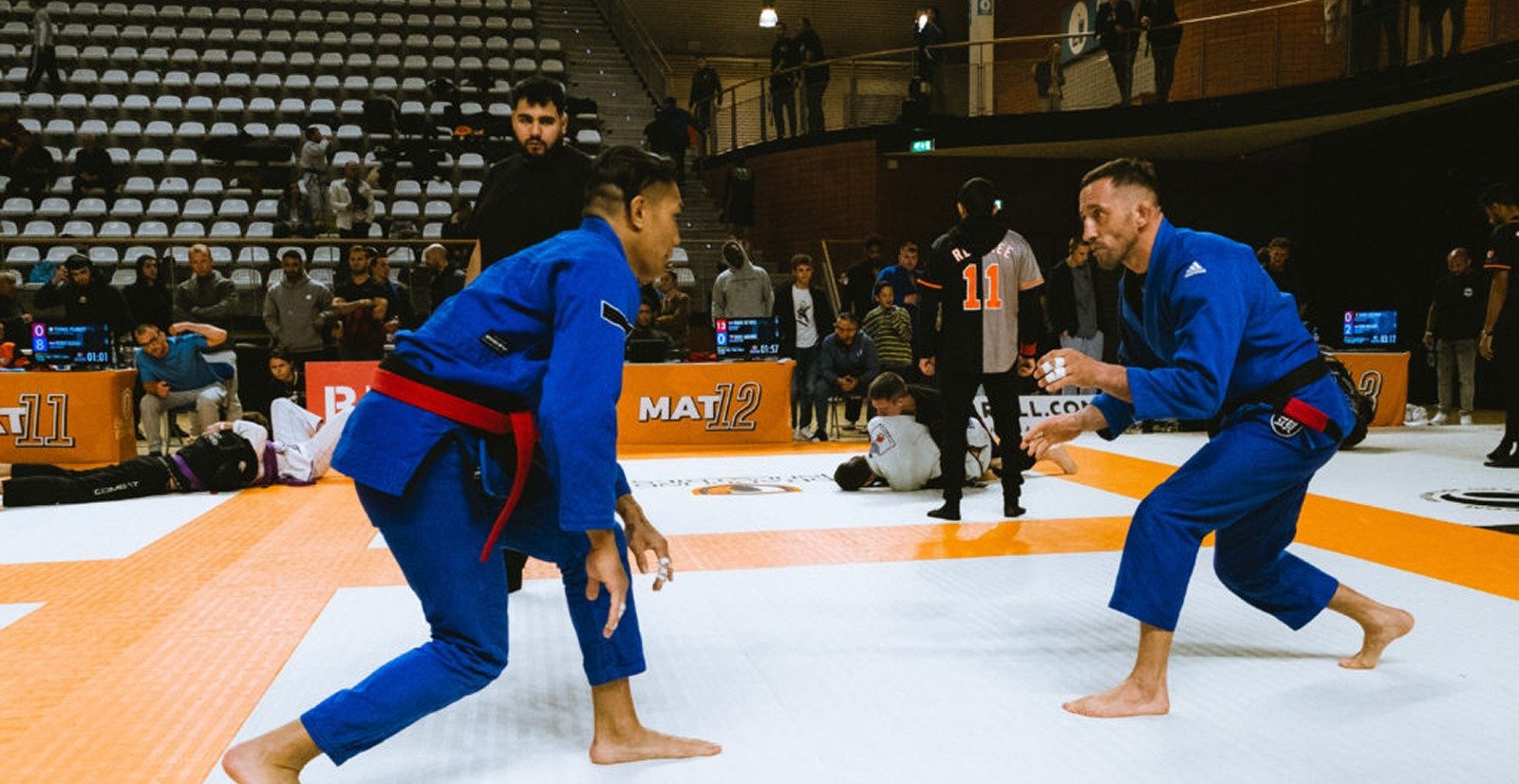
Is It Hard to Learn Brazilian Jiu Jitsu? The Honest Truth
By BJJ Sportswear Editorial Team
Beginner’s Reality Check | Last Updated: January 16, 2026
Yes, Brazilian Jiu Jitsu is hard to learn, particularly because of the steep learning curve requiring 1-2 years to reach blue belt competency, the unnatural movements involving complex hip escapes and body mechanics unfamiliar to most people, the mental challenge of being submitted repeatedly by smaller opponents during the first 6-12 months forcing ego management, the physical demands building strength, flexibility, and cardio endurance simultaneously, and the technical complexity with over 600 documented techniques across positions like guard, mount, side control, and back control requiring years to master.
Elite Sports on why BJJ is tough: “The reason for the steep learning curve is that BJJ training requires a balance between mental and physical strength. Employing submissions, holds, chokeholds, and takedowns will only work if your mind and body are well coordinated”. Gracie Botany difficulty analysis: “Learning Brazilian Jiu-Jitsu can be challenging due to the intricacies of its techniques and strategies. It demands a level of physical fitness, flexibility, and strength. The steep learning curve necessitates consistent practice and dedication”.
However, BJJ remains beginner-friendly and accessible because you don’t need prior athletic experience, training scales to any fitness level, techniques rely on leverage over strength allowing anyone regardless of size to succeed, structured fundamentals classes teach progressively from day one, and supportive academy culture normalizes struggling as essential to growth connecting to white belt journey expectations and complete BJJ introduction understanding martial arts accessibility.
The hardest aspects of learning BJJ include getting submitted constantly (white belts tap 10-30 times per class feeling helpless), close physical contact making beginners uncomfortable with strangers in their personal space, unnatural ground fighting positions causing claustrophobia and panic responses, checking your ego when smaller/younger/less athletic people dominate you, slow visible progress taking 6-12 months to successfully submit anyone in sparring, physical exhaustion leaving beginners gasping for air after 2-minute rounds, complex technique memorization forgetting moves learned last week during live rolling, and plateaus lasting months where skill improvement feels nonexistent despite consistent training.
Brazilian Jiu Jitsu Toronto reality check: “BJJ is known for its steep learning curve. When you start, everything can feel difficult, and progress may feel slow. You might compare yourself to others who are more experienced and wonder why you’re not picking things up faster”. Despite these challenges, 10-15 years to black belt seems daunting but practitioners develop functional self-defense skills within 6-12 months, can compete at white belt level after 3-6 months training, notice significant strength gains and health benefits within first 3 months, and find the challenge mentally rewarding making the difficulty worth pursuing connecting beginner preparation through realistic expectations.
Table of Contents
The Short Answer: Yes, But…
BJJ is Hard Because:
- ❌ Steep learning curve (1-2 years to blue belt)
- ❌ Get submitted constantly (tap 10-30x per class initially)
- ❌ Unnatural movements (shrimping, bridging, inverting)
- ❌ Ego destruction (smaller people dominate you)
- ❌ Slow progress (months to see improvement)
- ❌ Physical exhaustion (cardio + strength + flexibility)
- ❌ Complex techniques (600+ moves to learn)
BJJ is Accessible Because:
- ✅ No prior experience needed (starts from zero)
- ✅ Scales to any fitness level (technique > strength)
- ✅ Beginners class structure (fundamentals-focused)
- ✅ Supportive community (everyone struggles at first)
- ✅ Visible milestones (stripes, belt promotions)
- ✅ Self-defense results (functional in 6-12 months)
- ✅ Life-changing benefits (fitness, confidence, friends)
Bottom line: Hard to master, easy to start, worth the journey.
What Makes BJJ Hard to Learn? (8 Main Challenges)
1. The Humbling White Belt Experience
10th Planet Poway on ego challenges: “You will be submitted by smaller, younger, less athletic people. If your self-worth is tied to ‘winning’ in these practice sessions, you will have a miserable experience”.
What to expect your first 6 months:
- Tap out 10-30 times per class
- Get dominated by everyone (including teenagers)
- Feel helpless in positions
- Forget everything you learned last week
- Question if you’re improving at all
The ego shock:
Former college athlete (200 lbs, fit) vs 150 lb blue belt (2 years training)
Result: Blue belt submits athlete 5+ times in 5 minutes
Why? Technique, timing, leverage > strength, athleticism
Mental shift required:
- Accept losing is learning
- Focus on small improvements (escaped side control today!)
- Don’t compare to others (compare to yourself last month)
- Embrace the beginner’s mind
Reference: White belt survival guide
2. Unnatural Movements & Body Mechanics
Elite Sports on unfamiliar movements: “Unnatural and unfamiliar movements” are a primary reason BJJ feels difficult initially.
Movements you’ve NEVER done before:
Shrimping (hip escape):
- Lying on side, scooting hips back
- Feels awkward, uncoordinated at first
- Essential for escapes, guard retention
- Takes 100+ reps to feel natural
Bridging:
- Explosive hip thrust from bottom position
- Lifts opponent off you
- Requires glute/hamstring power
- Beginners struggle with timing
Inverting:
- Rolling backward, hips over head
- Advanced movement (berimbolo, turtle attacks)
- Requires flexibility, spatial awareness
- Many never master it (optional for most)
Technical stand-up:
- Getting up from ground safely
- Opposite of natural “push up” instinct
- Essential for self-defense
- Feels weird for months
Why it’s hard: Your brain has no reference point. Like learning to ride a bike—awkward until muscle memory develops.
Timeline to natural movement:
- Month 1-2: Everything feels clunky
- Month 3-4: Basic movements smoother
- Month 6-12: Can execute without thinking
- Year 2+: Movements become second nature
3. Mental Demands: The “Human Chess” Challenge
Gracie Botany mental aspect: “The mental aspect of Brazilian Jiu-Jitsu is equally demanding. Staying calm under pressure, anticipating your opponent’s moves, and making split-second decisions requires mental fortitude”.
Mental skills required:
Problem-solving under pressure:
- Opponent on top, crushing you
- Must remember technique while exhausted
- Choose correct escape from 5+ options
- Execute while being choked
Pattern recognition:
- Recognize positions instantly
- Predict opponent’s next move
- Counter before they attack
- Requires 100+ hours mat time
Calm under stress:
- Someone choking you = primal panic response
- Must override fight-or-flight
- Think clearly while uncomfortable
- Meditation-like mental state
Information overload:
- Learn 5-10 new techniques per class
- Remember previous week’s techniques
- Apply during live rolling
- Beginners forget 90% initially
Why it’s hard: Most people never train their brain to problem-solve while physically uncomfortable and exhausted.
4. Physical Demands: Full-Body Conditioning
Brazilian Jiu Jitsu Toronto physical challenges: “Yes! BJJ requires strength, flexibility, endurance, and coordination—all of which can take time to develop”.
What BJJ demands physically:
Cardiovascular endurance:
- 5-minute sparring rounds = sprint intensity
- Beginners gas out in 60-90 seconds
- Heart rate 160-180 bpm sustained
- Takes 3-6 months to last full round
Muscular endurance:
- Grip strength (holding grips 2-5 minutes)
- Core stability (constant rotation, anti-rotation)
- Shoulder endurance (framing, pushing)
- Leg strength (maintaining guard)
Flexibility:
- Hip mobility (guard playing)
- Hamstring flexibility (leg locks, guard)
- Shoulder mobility (submissions, escapes)
- Lower back flexibility (inversions)
Coordination:
- Multi-limb movements (arm drags + level change)
- Timing (explosive when opportunity appears)
- Balance (constant off-balancing)
First 3 months experience:
- Week 1: Can’t breathe after 2 minutes
- Week 4: Lasting 3-4 minutes before exhaustion
- Week 8: Can complete 5-minute round (barely)
- Week 12: Endurance improving significantly
Reference: Does BJJ make you stronger?
5. Steep Learning Curve & Slow Progress
Divine Jiu Jitsu timeline: “Typically, it takes around 10 to 15 years to achieve black belt status, but this can vary greatly depending on factors like personal dedication, training frequency, and natural aptitude”.
Belt progression timeline:
| Belt | Time Required | Skill Level | Competency |
|---|---|---|---|
| White | Starting point | Complete beginner | Survival mode |
| Blue | 1-2 years | Basic competency | Can defend self |
| Purple | 4-5 years total | Intermediate | Dangerous to untrained |
| Brown | 7-9 years total | Advanced | Near mastery |
| Black | 10-15 years total | Expert | Mastery achieved |
Why progress feels slow:
White belt reality:
- Month 1-6: Submit nobody, tapped by everyone
- Month 6-12: Occasional success vs newer white belts
- Month 12-18: Can hold own vs some blue belts
- Month 18-24: Blue belt promotion (finally!)
The plateau phenomenon:
- 10th Planet Poway on plateaus: “Progress in BJJ is not linear. You will experience long periods where you feel you aren’t getting any better. This is a universal experience, even for black belts”
Dealing with slow progress:
- Track small wins (escaped mount today!)
- Video your rolls (see actual improvement)
- Focus on learning, not winning
- Trust the process (everyone plateaus)
6. Close Physical Contact (Personal Space)
Elite Sports on close contact: “Close contact sparring” and “Ground fighting is difficult and uncomfortable” are major challenges.
Uncomfortable realities:
Extreme closeness:
- Face-to-face grappling (6 inches apart)
- Body-on-body pressure
- Sweat in your face (others’ + yours)
- Breathing on each other
Gender/age/size mixups:
- Women grapple with men (normal)
- Teens with adults (skill matters)
- 150 lb vs 220 lb (technique > size)
Initial discomfort:
- Week 1-2: Very awkward, uncomfortable
- Week 3-4: Slightly more normal
- Month 2-3: Becomes routine
- Month 6+: Totally normal (forget it’s happening)
Cultural adjustment:
- Western personal space = 1.5-4 feet
- BJJ personal space = 0 feet (full contact)
- Takes mental adjustment
How to cope:
- Choose training partners consciously (first classes)
- Communicate boundaries if needed
- Focus on technique (distraction from discomfort)
- Improves with exposure (habituation)
Reference: BJJ hygiene importance
7. Information Overload & Technique Memorization
Gracie Botany on technique complexity: “Brazilian Jiu-Jitsu techniques are not meant to be learned overnight. They require months, if not years, of training to truly grasp their complexity”.
How many techniques in BJJ?
- Fundamental techniques: 50-100 (basic survival)
- Blue belt level: 200-300 techniques
- Purple+ level: 400-600+ techniques
- Black belt mastery: 1,000+ variations
Beginner overwhelm:
Week 1 class:
- Learn: Shrimping, technical standup, hip escape, trap and roll escape
- Retain: 20-30% (forget rest)
- Apply in rolling: 5-10%
Week 2 class:
- Learn: Armbar from guard, triangle setup, kimura
- Remember week 1: 50% (already fading)
- Apply: Still 5-10%
Month 3:
- Total techniques learned: 50+
- Can execute reliably: 10-15
- Actually use in sparring: 3-5
Why memorization is hard:
- Each technique has 8-12 steps
- Similar positions, different details
- Must perform under pressure
- Muscle memory takes 100+ reps
Learning strategies:
- Drilling: Repeat 20-30 reps per technique
- Positional sparring: Practice specific scenarios
- Note-taking: Journal after class
- Video review: Watch yourself roll
- Private lessons: Focused instruction
8. High Dropout Rate (80% Quit in Year 1)
Gracie Botany dropout reality: “Learning Brazilian Jiu-Jitsu can be a difficult task that requires both physical and mental fortitude. While it may seem overwhelming at first…”
Why most quit:
Months 1-3 (40% drop):
- Too hard physically (exhaustion)
- Ego can’t handle losing
- Injuries (minor sprains, mat burn)
- Time commitment too high
Months 4-6 (20% drop):
- Plateau (no visible improvement)
- Life gets busy (work, family)
- Frustration (still getting dominated)
Months 7-12 (20% drop):
- Boredom (repetitive drilling)
- Injuries (finger, knee issues)
- Cost ($150-200/month adds up)
Who stays? (20%)
- Embraced long-term journey
- Found training partners/friends
- Enjoy the process (not just winning)
- Set realistic expectations
How to avoid dropout:
- Set 6-month minimum commitment
- Train with friends (accountability)
- Celebrate small victories
- Take breaks when needed (injury, burnout)
- Remember why you started
How Long to “Learn” BJJ? (Realistic Timelines)
Functional Self-Defense
6-12 months (3-4x weekly training):
- Can defend against untrained attacker
- Basic submissions (RNC, armbar)
- Escape bad positions (mount, side control)
- Comfortable on ground
Skills acquired:
- Trap and roll escape (mount)
- Elbow escape (side control)
- Technical standup (ground to feet)
- Rear-naked choke (finish)
- Guard basics (closed guard control)
Compete at White Belt Level
3-6 months:
- Enter local tournaments
- Won’t win (probably)
- Gain experience
- Test skills under pressure
Competition readiness:
- Know IBJJF rules
- Can last 5-6 minute match
- 2-3 reliable techniques
- Basic takedown or guard pull
Reference: Competition preparation
Blue Belt Competency
Divine Jiu Jitsu blue belt timeline: “Blue Belt: Indicates basic competency. Often takes 1-2 years to achieve”.
1-2 years (3-5x weekly):
- Solid fundamentals
- Can submit white belts regularly
- Defend against most blue belts
- Understand positions deeply
Blue belt skillset:
- 3-5 reliable submissions
- Guard passing basics
- Guard retention
- Escape sequences (mount → side → back)
- Competition-ready
Purple Belt (Intermediate)
4-5 years total:
- Dangerous to untrained people
- Compete at intermediate level
- Start teaching beginners
- Deep technical understanding
Black Belt (Mastery)
10-15 years:
- Expert-level skills
- Can beat 95%+ of people
- Teach independently
- Lifetime commitment
Note: Black belt is “beginning of mastery” not end of learning!
Is BJJ Harder Than Other Martial Arts?
Comparison Table
| Martial Art | Learning Difficulty | Time to Competency | Physical Demand | Injury Risk |
|---|---|---|---|---|
| BJJ | ⭐⭐⭐⭐⭐ Very Hard | 1-2 years (blue belt) | High | Medium |
| Boxing | ⭐⭐⭐⭐ Hard | 6-12 months (sparring) | Very High | High (head trauma) |
| Muay Thai | ⭐⭐⭐⭐ Hard | 8-14 months (sparring) | Very High | High |
| Wrestling | ⭐⭐⭐⭐⭐ Very Hard | 1-2 years (varsity) | Extreme | Medium-High |
| Judo | ⭐⭐⭐⭐ Hard | 1-2 years (blue belt) | High | Medium-High |
| Karate | ⭐⭐⭐ Medium | 6-12 months (basics) | Medium | Low |
| Taekwondo | ⭐⭐⭐ Medium | 6-12 months (basics) | Medium | Low |
Why BJJ is hardest:
- Complex technique library (600+ moves)
- Live sparring from day 1 (constant reality check)
- Long belt progression (10-15 years to black)
- Mental + physical demands combined
Why wrestling rivals BJJ:
- Extreme cardio demand
- Brutal training culture
- High injury rate
- But: Simpler technique set (vs BJJ)
Reference: BJJ vs other martial arts (MMA comparison)
Making BJJ Easier: 10 Beginner Tips
1. Find a Beginner-Friendly Academy
Liberdade BJJ beginner focus: “You don’t need to be flexible, strong, or in shape. You just need to be willing to learn”.
What to look for:
- Dedicated fundamentals classes
- Beginners-only sparring sessions
- Patient, encouraging instructors
- Welcoming culture (not alpha male gym)
- Trial class offered (test vibe)
Red flags:
- “Shark tank” first class (thrown to wolves)
- Only advanced classes (no fundamentals)
- Injured students everywhere
- Aggressive, toxic culture
Reference: Finding BJJ gyms (example guide)
2. Set Realistic Expectations
Expect to:
- Suck for 6-12 months (everyone does)
- Get submitted constantly (normal)
- Forget techniques (muscle memory takes time)
- Progress slowly (not linear)
- Question yourself (plateaus happen)
Don’t expect to:
- Submit anyone first month
- Master BJJ in 1 year
- Avoid injuries entirely
- Win first competition
- Understand everything immediately
3. Train Consistently (3-4x Weekly Ideal)
Divine Jiu Jitsu training frequency: “Most practitioners benefit from attending classes 3 to 5 times per week”.
Frequency impact:
| Frequency | Progress Speed | Time to Blue Belt |
|---|---|---|
| 1x week | Very Slow | 3-5 years |
| 2x week | Slow | 2-3 years |
| 3-4x week | Optimal | 1-2 years |
| 5-6x week | Fast (burnout risk) | 12-18 months |
| 7x week | Overtraining (injury) | Not recommended |
Best schedule (3-4x weekly):
Monday: Fundamentals class
Wednesday: Fundamentals + sparring
Friday: All-levels class
Saturday: Open mat (optional)
4. Tap Early, Tap Often
Ego management:
- Tapping = learning (not losing)
- Prevents injuries
- Allows longer training career
- Everyone taps (even black belts)
When to tap:
- Feel joint stress (armbar, kimura)
- Air cut off (chokes)
- Pain anywhere
- Uncomfortable position
- Always err on side of caution
5. Ask Questions (But Not During Rolling)
Good times to ask:
- After technique demonstration
- During drilling (clarify details)
- After class (instructor one-on-one)
- Private lessons (focused learning)
Bad times:
- During live rolling (stop training for whole class)
- When instructor explaining to group
- When partner is waiting
6. Supplement with Strength & Flexibility
Home training (20-30 min, 3x weekly):
- Flexibility: Yoga, stretching (hips, hamstrings)
- Strength: Bodyweight exercises (pushups, pull-ups, core)
- Cardio: Running, biking, rowing (3+ mile runs)
- Drilling: Shadow grappling, solo movement drills
Injury prevention:
- Foam rolling (recovery)
- Mobility work (shoulders, hips)
- Rest days (2-3 weekly)
Reference: BJJ strength training
7. Choose Training Partners Wisely
First 3 months:
- Roll with other beginners (similar skill)
- Choose smaller upper belts (less intimidating)
- Avoid gym “killers” (overly aggressive)
- Find patient blue/purple belts (willing to teach)
As you improve:
- Challenge yourself (bigger opponents)
- Roll with black belts (learn tons)
- Help newer white belts (teach to learn)
8. Record and Review Your Rolls
Video analysis benefits:
- See mistakes you don’t feel
- Notice patterns (always getting swept from X)
- Track improvement over time
- Identify technical gaps
How often: Monthly (not obsessive)
9. Take Care of Your Body
Injury prevention:
- Warm up properly (10-15 min)
- Cool down/stretch (5-10 min)
- Ice/heat (acute injuries)
- Rest when hurt (don’t train through pain)
- Tape fingers (prevent hyperextension)
Common beginner injuries:
- Mat burn (skin abrasions)
- Finger sprains
- Rib soreness
- Neck stiffness
- Minor muscle strains
When to see doctor:
- Sharp, shooting pain
- Joint instability
- Can’t put weight on limb
- Injury not healing (2+ weeks)
Reference: BJJ hygiene & injury prevention
10. Find Your “Why” (Intrinsic Motivation)
Good reasons to train:
- Self-improvement (personal growth)
- Fitness (get in shape)
- Self-defense (feel safe)
- Community (make friends)
- Mental challenge (problem-solving)
- Stress relief (forget work)
Bad reasons (won’t sustain):
- Impress others
- Prove toughness
- Win tournaments immediately
- Become UFC fighter (unrealistic for most)
The Bottom Line: Is BJJ Worth the Difficulty?
Why 20% Stick With It (And Love It)
Benefits outweigh challenges:
- ✅ Life-changing fitness (lose 20-50 lbs common)
- ✅ Real self-defense skills (actually work)
- ✅ Mental toughness (handle adversity better)
- ✅ Deep friendships (training partners = family)
- ✅ Confidence boost (know you can defend yourself)
- ✅ Stress relief (can’t think about work when being choked)
- ✅ Problem-solving skills (chess-like strategic thinking)
- ✅ Lifetime pursuit (never boring, always learning)
Reddit martial arts consensus: “You can definitely learn Jiu jitsu, it’s not easy so don’t expect to be good right away. Like anything it’s going to take practice”.
Reference: 10 Amazing BJJ Benefits
Is BJJ Harder Than It’s Worth?
NO if you:
- Enjoy challenges (growth mindset)
- Can handle frustration (patient personality)
- Want lifelong skill (not quick fix)
- Value community (social aspect)
- Seek fitness + mental benefits (holistic)
MAYBE if you:
- Hate losing (ego-driven)
- Want fast results (impatient)
- Injury-averse (risk-intolerant)
- Time-constrained (can’t commit 3x weekly)
- Prefer striking (BJJ is grappling-only)
Alternatives if BJJ not right:
- Boxing: Faster learning curve, cardio focus
- Muay Thai: Striking emphasis, similar fitness
- MMA: Well-rounded (but even harder than BJJ)
- Wrestling: Similar to BJJ (but more explosive)
- Judo: Throws-focused (shorter ground time)
Reference: Is BJJ MMA? (martial arts comparison)
Your First Class: What to Expect
Beginner class structure (60-90 min):
1. Warm-up (10-15 min):
- Running, movement drills
- Shrimping, bridging, rolling
- Light cardio (get heart rate up)
2. Technique instruction (20-30 min):
- Instructor demonstrates (2-3 techniques)
- Partner drilling (practice on each other)
- Repetitions (10-20 per side)
3. Positional sparring (10-15 min):
- Specific scenario (escape side control)
- Restart each time (controlled practice)
- Lower intensity (learn, not compete)
4. Live sparring/rolling (20-30 min):
- 5-minute rounds
- Full resistance (use all techniques)
- Tap when caught
- Rest between rounds
5. Cool down (5 min):
- Stretching
- Q&A
- Announcements
What you’ll need:
- Athletic clothes (t-shirt, shorts/yoga pants)
- Water bottle
- Open mind
- Equipment: Rashguard guide, Gi options
Yes, BJJ is hard. But you’re tougher.
The journey of 1,000 mats begins with one class.
Take it. 🥋
Related resources:
- What is BJJ? – Complete intro
- White Belt Guide – First steps
- BJJ Belt System – Progression
- Benefits of BJJ – Why it’s worth it
- Find BJJ Gyms – Location guides
OSS! 🙏💪
Sources
Expert Analysis: Elite Sports, Gracie Botany, Brazilian Jiu Jitsu Toronto, 10th Planet Poway, Divine Jiu Jitsu, Liberdade BJJ
Community: Reddit r/martialarts
Last Updated: January 16, 2026