
On This Page
Editorial Standards
Reviewed by the BJJ Sportswear Editorial Team for technical accuracy and kept current.
Is Brazilian Jiu-Jitsu the Same as MMA?
BJJ and MMA get used interchangeably in casual conversation, but they are not the same thing. Here is exactly how they relate to each other.
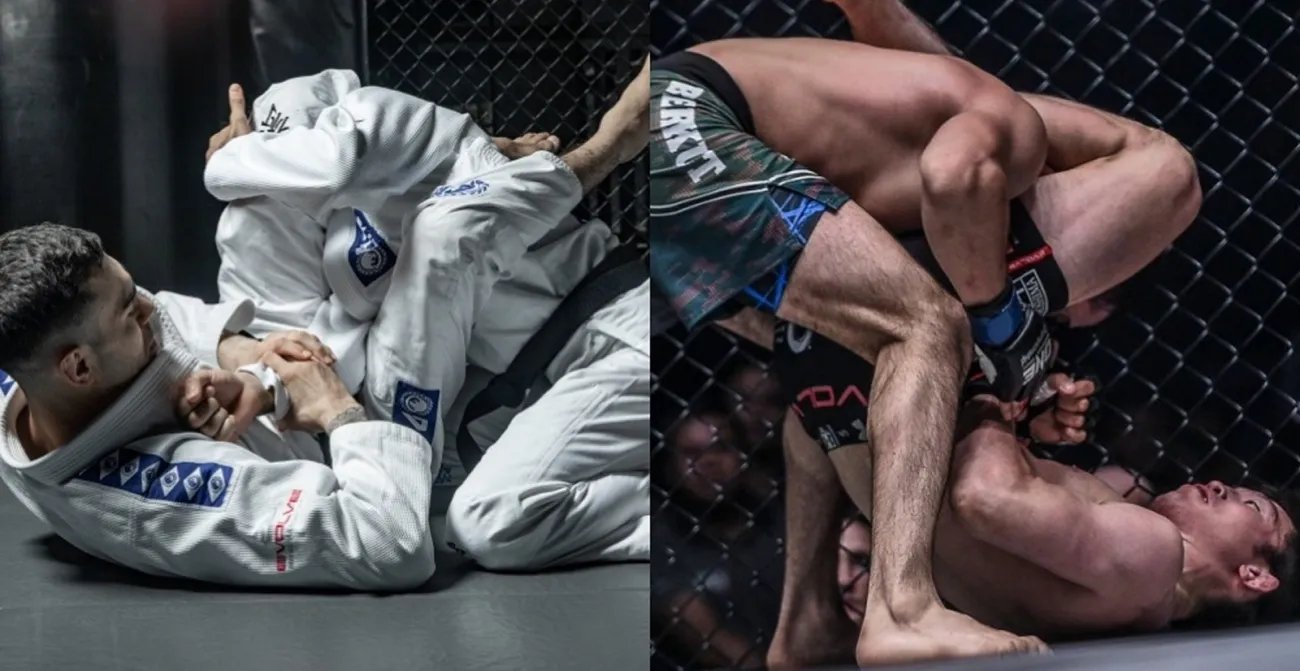
No, Brazilian Jiu-Jitsu and MMA are not the same thing, though the confusion is understandable — BJJ played a huge role in shaping how modern MMA is fought.
What Each One Actually Is
BJJ is a single grappling art focused on ground control, submissions, and leverage-based technique against a resisting opponent. It has its own rule set, belt system, and competition format (gi and no-gi), entirely separate from striking.
MMA is a full combat sport that combines techniques from multiple disciplines — striking arts like boxing and Muay Thai, along with grappling arts like BJJ, wrestling, and judo — inside one unified rule set that allows both striking and grappling.
BJJ is one of several arts that feed into MMA. It is not MMA itself, the same way boxing is not MMA even though punches are legal in both.
Why the Confusion Exists
BJJ's reputation is closely tied to MMA's early history. Royce Gracie's dominant performances in the early UFC tournaments of the 1990s, using almost pure BJJ against much larger opponents trained in other styles, proved ground grappling's real effectiveness and helped legitimize both BJJ and the sport of MMA at the same time. That shared origin story is a big part of why the two get conflated in casual conversation.
Does Training BJJ Prepare You for MMA?
Partially. BJJ gives you a strong ground game — control, submissions, and escapes — which is genuinely valuable in MMA. But MMA also demands striking skill, takedown defense against wrestlers, and the ability to blend disciplines while getting hit, none of which pure BJJ training covers on its own. Most professional MMA fighters cross-train BJJ alongside striking arts and wrestling rather than relying on any single discipline.
Frequently Asked Questions
Can you compete in MMA with only BJJ training? It's possible at lower levels, but competitive MMA fighters need striking defense and takedown skills that pure BJJ training doesn't cover, so cross-training in other disciplines is standard at any serious level.
Is BJJ or MMA better for self-defense? They serve different scenarios — BJJ excels once a fight goes to the ground or a clinch, while MMA training covers a broader range of striking and grappling situations, at the cost of the specialized depth BJJ has in ground control specifically.
Did BJJ help create MMA as a sport? Yes, significantly — Royce Gracie's BJJ-based performances in the early UFC in the 1990s proved ground grappling's effectiveness and were a major factor in establishing MMA as a legitimate sport.
Is it necessary to train BJJ to be good at MMA? Not strictly necessary, but the overwhelming majority of successful MMA fighters have real grappling training, whether BJJ, wrestling, or judo, since fights frequently end up on the ground or in a clinch.
The Bottom Line
BJJ is a specific grappling art; MMA is a broader combat sport that draws on BJJ along with striking and other grappling disciplines. The two are closely related historically, but training one is not the same as training the other.
Tagged with:#MMA#comparison#bjj vs other arts
Frequently Asked Questions
Can you compete in MMA with only BJJ training?
It's possible at lower levels, but competitive MMA fighters need striking defense and takedown skills that pure BJJ training doesn't cover, so cross-training in other disciplines is standard at any serious level.
Is BJJ or MMA better for self-defense?
They serve different scenarios — BJJ excels once a fight goes to the ground or a clinch, while MMA training covers a broader range of striking and grappling situations, at the cost of the specialized depth BJJ has in ground control specifically.
Did BJJ help create MMA as a sport?
Yes, significantly — Royce Gracie's BJJ-based performances in the early UFC in the 1990s proved ground grappling's effectiveness and were a major factor in establishing MMA as a legitimate sport.
Is it necessary to train BJJ to be good at MMA?
Not strictly necessary, but the overwhelming majority of successful MMA fighters have real grappling training, whether BJJ, wrestling, or judo, since fights frequently end up on the ground or in a clinch.
About the Author
Mohsin AyubBJJ practitioner, 6 years — Gracie Barra
Founder & Editor, BJJ Sportswear
Mohsin has trained Brazilian Jiu-Jitsu for six years at Gracie Barra and has competed at IBJJF-affiliated tournaments. He writes about competition, gear, and athlete careers, and founded BJJ Sportswear to help grapplers find equipment and information they can trust.
- Six years training Brazilian Jiu-Jitsu at Gracie Barra
- Competed at IBJJF-affiliated tournaments
- Writes on BJJ competition, gear testing, and athlete careers
This article was last reviewed and updated on 2026-08-18.