

BJJ Black Belt: What It Means to Reach Expert Level
By BJJ Sportswear Editorial Team
Reviewed by competitive black belts | Last Updated: February 2, 2026
The BJJ black belt is widely considered the “gold standard” of martial arts mastery.
Unlike other disciplines where a black belt can be earned in 2–3 years, achieving this rank in Brazilian Jiu-Jitsu typically requires a decade of sweat, injuries, and mat time. It is estimated that less than 1% of white belts ever reach the rank of BJJ black belt. However, contrary to popular belief, receiving this belt is not the end of the journey—it is merely the beginning of your advanced study.
In this guide, we break down the IBJJF requirements, the meaning of the red bar versus the white bar, and the timeline for degrees and titles.
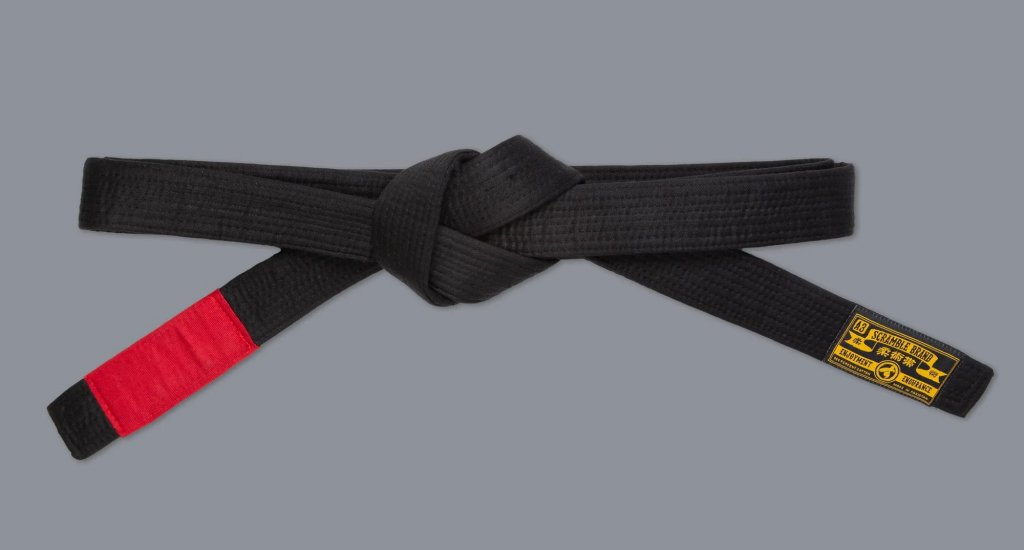
Table of Contents
Requirements to Earn a BJJ Black Belt
There is no formal “test” for a BJJ black belt in most academies. It is awarded subjectively by a qualified instructor (usually a 2nd-degree black belt or higher). However, the International Brazilian Jiu-Jitsu Federation (IBJJF) has strict minimums for official recognition.
- Minimum Age: You must be at least 19 years old (by the calendar year).
- Time in Grade: You must spend a minimum of 1 year as an active Brown Belt.
- First Aid: The IBJJF requires a CPR/First Aid certificate for black belt certification.
- Referee Course: You must have completed an IBJJF referee course within the last 12 months.
How Long Does It Take?
While the theoretical minimum is about 5.5 years (if you spend the exact minimum time at every belt), this almost never happens.
- The Average: 10 to 12 years of consistent training.
- The “Fast” Track: 6 to 8 years (usually world-class competitors training 2x a day).
- The Hobbyist: 13+ years. A recent survey suggests the average is actually closer to 13.3 years for non-professionals.
For a full breakdown of the timeline, read our guide on How Long to Get a Black Belt in BJJ.
The Red Bar vs. White Bar
Not all BJJ black belts look the same. The colored bar (ponteira) on the end of the belt signifies the wearer’s role.
- Red Bar: The standard for most black belts. It traditionally signifies that you are an instructor or a student under a Gracie lineage instructor.
- White Bar: This signifies a “competitor” or “fighter” BJJ black belt. It is worn by practitioners who are not teaching classes.
- Red Bar with White Borders: This is reserved for the Head Instructor or “Professor.” It often requires being a black belt for at least one year or completing a specific certification.
Degrees and Titles: The Timeline After Black
Once you earn your BJJ black belt, you stop changing belt colors and start earning stripes (degrees).
- 1st to 3rd Degree: Requires 3 years of active training/teaching for each degree.
- 4th to 6th Degree: Requires 5 years for each degree.
- The “Professor” Title: While many instructors use “Professor” immediately, traditionally, this title is reserved for a 2nd or 3rd degree black belt.
- Coral Belt (7th Degree): After 31 years as a black belt (7 years as a 6th degree), you are awarded the Red and Black Coral Belt.
Famous Black Belts to Study
To understand the depth of this rank, study the games of legends who redefined the art:
- Marcelo Garcia: Known for his high-percentage butterfly guard and guillotine game.
- Roger Gracie: The master of basics who proved that fundamental Jiu-Jitsu works at the highest level.
Conclusion
Earning a BJJ black belt is a life-changing achievement, but it brings heavy responsibility.
You are now a representative of the art. Whether you wear the red bar of an instructor or the white bar of a competitor, the goal remains the same: to refine your technique, mentor the next generation, and respect the BJJ Belt System.