
On This Page
Editorial Standards
Reviewed by the BJJ Sportswear Editorial Team for technical accuracy and kept current.
Kids BJJ Belt System Explained
Kids follow a completely different belt track than adults in BJJ. Here is the full youth belt order and how it leads into adult ranks.
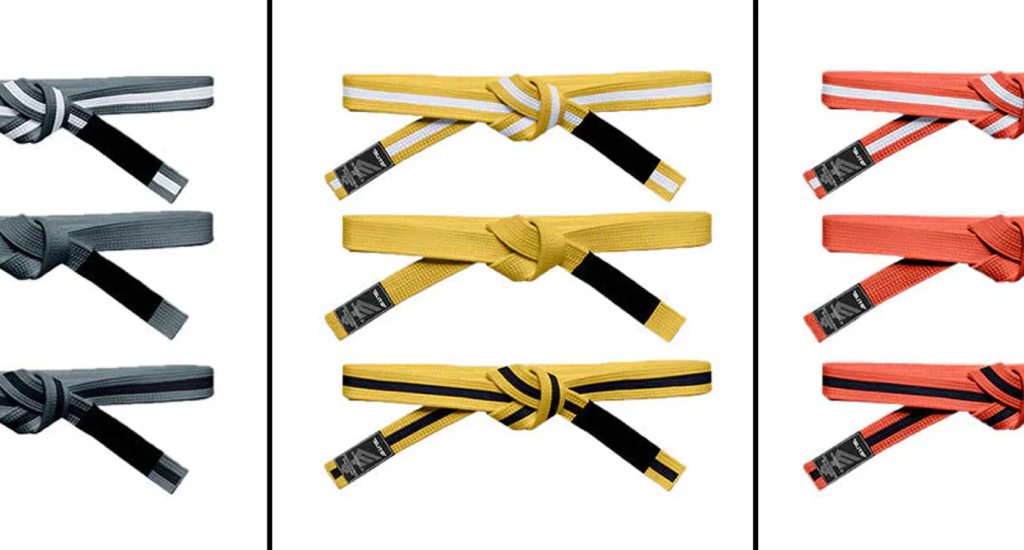
Kids under 16 do not follow the same white-to-black progression adults do. Instead, the IBJJF and most academies use a dedicated youth belt system, designed to give younger students more frequent, age-appropriate milestones.
The Youth Belt Order
Depending on age bracket, kids typically progress through:
- Grey belt (with grey/white and grey/black variations for younger age groups)
- Yellow belt (with yellow/white and yellow/black variations)
- Orange belt (with orange/white and orange/black variations)
- Green belt (with green/white and green/black variations)
Each belt also uses a stripe system, similar to the adult ranks, to mark progress within the belt itself.
Transitioning to Adult Belts
Once a student turns 16, they typically enter the adult belt system at white belt, though older or highly skilled teenagers (16-17) may sometimes be promoted directly to blue belt at an instructor's discretion, based on IBJJF age and rank eligibility rules.
Why Kids Use a Different System
Youth belts are designed around shorter attention spans, safety-first training (no submissions like heel hooks, and often limited leg locks generally), and more frequent positive reinforcement to keep kids motivated. It is a completely appropriate and separate track, not a "watered down" version of the adult belts.
Tagged with:#kids bjj#belt system
Frequently Asked Questions
What is the order of kids BJJ belts?
Kids progress through grey, yellow, orange, and green belts (each with white and black variations for younger age groups), before entering the adult white belt system at age 16.
How many youth BJJ belts are there before white belt?
Four main youth belt colors — grey, yellow, orange, and green — each with sub-variations for narrower age brackets, plus a stripe system within each belt to mark progress.
Can a kid skip straight to blue belt in BJJ?
It is uncommon, but older or highly skilled teenagers (16-17) may sometimes be promoted directly to blue belt at an instructor's discretion, within IBJJF age and rank eligibility rules.
Are kids BJJ belts easier to earn than adult belts?
They are not "easier," just designed differently — youth belts prioritize safety (no heel hooks, limited leg locks) and more frequent positive reinforcement to match shorter attention spans, not a watered-down version of adult standards.
Sources & Further Reading
About the Author
Mohsin AyubBJJ practitioner, 6 years — Gracie Barra
Founder & Editor, BJJ Sportswear
Mohsin has trained Brazilian Jiu-Jitsu for six years at Gracie Barra and has competed at IBJJF-affiliated tournaments. He writes about competition, gear, and athlete careers, and founded BJJ Sportswear to help grapplers find equipment and information they can trust.
- Six years training Brazilian Jiu-Jitsu at Gracie Barra
- Competed at IBJJF-affiliated tournaments
- Writes on BJJ competition, gear testing, and athlete careers
This article was last reviewed and updated on 2026-08-01.