
On This Page
Editorial Standards
Reviewed by the BJJ Sportswear Editorial Team for technical accuracy and kept current.
BJJ Purple Belt Guide: The Coaching Belt
Purple belt marks a real shift in BJJ — from collecting techniques to understanding the system behind them. Here is what the rank involves.
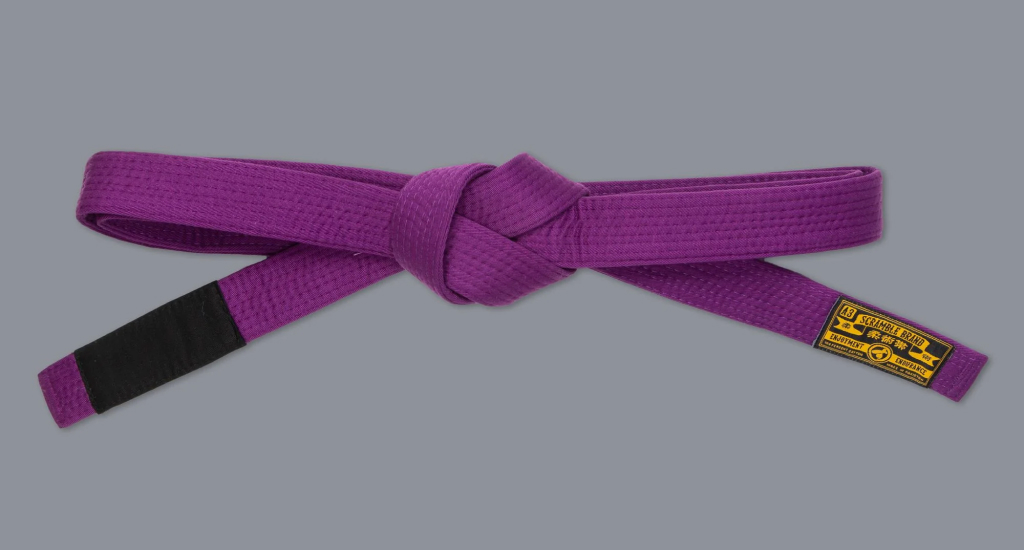
Purple Belt Curriculum2 - 4 Years (600 - 1000 Mat Hours)
"Identity & Flow. The purple belt is known as the "creative belt". You transition from memorizing individual moves to playing seamless, fluid Jiu-Jitsu."
Primary Tactical Focus
Anticipation, speed of transition, chaining offensive moves, developing a specialized dangerous A-game, and beginning to teach and mentor.
Required Milestones
Check what you've masteredDefine your signature A-Game (e.g. Berimbolo specialist, Pressure Passer, Leg Locker)
Anticipate opponent counters 2-3 moves in advance and set traps
Control the pace of sparring rounds against equal and lower ranks effortlessly
Possess a dangerous submission threat from virtually any top or bottom position
Common Pitfalls at This Rank
⚠Only playing your favorite comfortable positions and neglecting defensive weaknesses
⚠Ignoring wrestling takedowns and standup clinch mechanics
⚠Training recklessly through recurring joint pains without proper rehab
Stripe Simulator & Time Calculator
Estimate your stripe status based on cumulative mat hours
Your Mat Hours:
Stripe #1680 hrs
Seamless chaining of 3-move submission traps
Stripe #2780 hrs
Advanced guard passing (Leg Weave, Long Step, Headquarters)
Stripe #3890 hrs
Inverted guard, modern leg entanglements (Straight Ankle/Kneebar)
Stripe #41000 hrs
Coaching fluency, round management, and competition readiness
Purple belt is often called the "coaching belt," and that nickname captures what changes here better than any technical checklist. By purple, you are expected to understand BJJ as a connected system, not a collection of separate moves.
What Sets Purple Belt Apart
Where blue belt is about building a reliable game, purple belt is about understanding why that game works, and being able to adapt it when it does not. Purple belts are commonly trusted to help teach fundamentals classes, and many academies formally lean on them to assist newer students.
Typical Purple Belt Focus Areas
- Developing counters to your own go-to techniques, so opponents cannot simply avoid your game
- Studying the "why" behind positions deeply enough to teach them clearly to others
- Refining timing and efficiency — using less strength for the same or better results
- Building a broader technical vocabulary across multiple positions, not just your favorites
Time at Purple Belt
Purple typically takes 1.5-2 years before a brown belt promotion, making it usually shorter than blue belt but still demanding. Many competitive purple belts also begin testing themselves against tougher competition brackets during this stretch.
Moving Toward Brown Belt
Brown belt promotion from purple generally comes down to consistency, refinement of your existing game rather than constant new material, and your instructor's confidence that you are close to functioning at a black-belt level of understanding, even if your execution is still sharpening. The IBJJF sets a minimum of 18 months at purple belt before brown belt eligibility for registered competitors.
Tagged with:#purple belt#belt system
Frequently Asked Questions
Why is purple belt called the "coaching belt" in BJJ?
Because purple belts are commonly trusted to help teach fundamentals classes and assist newer students. It marks the point where you understand BJJ as a connected system well enough to explain it, not just perform it.
How long does purple belt take in BJJ?
Purple belt typically lasts 1.5-2 years before a brown belt promotion, making it usually shorter than blue belt but still demanding — the focus shifts from building a game to refining and understanding it deeply.
What is the difference between purple and blue belt in BJJ?
Blue belt is about building a reliable set of positions; purple belt is about understanding why that game works and adapting it when it does not. Purple belts are also expected to have a broader technical vocabulary and start teaching others.
Can a purple belt teach BJJ classes?
Many academies do lean on purple belts to help lead fundamentals classes or assist newer students, though this varies by gym and is at the head instructor's discretion. It is common enough that purple is often nicknamed the "coaching belt."
Sources & Further Reading
About the Author
Mohsin AyubBJJ practitioner, 6 years — Gracie Barra
Founder & Editor, BJJ Sportswear
Mohsin has trained Brazilian Jiu-Jitsu for six years at Gracie Barra and has competed at IBJJF-affiliated tournaments. He writes about competition, gear, and athlete careers, and founded BJJ Sportswear to help grapplers find equipment and information they can trust.
- Six years training Brazilian Jiu-Jitsu at Gracie Barra
- Competed at IBJJF-affiliated tournaments
- Writes on BJJ competition, gear testing, and athlete careers
This article was last reviewed and updated on 2026-08-01.