
On This Page
Editorial Standards
Reviewed by the BJJ Sportswear Editorial Team for technical accuracy and kept current.
BJJ Blue Belt Guide: What Changes After White Belt
Blue belt is where BJJ starts to feel less like survival and more like a real game. Here is what changes, and where most blue belts get stuck.
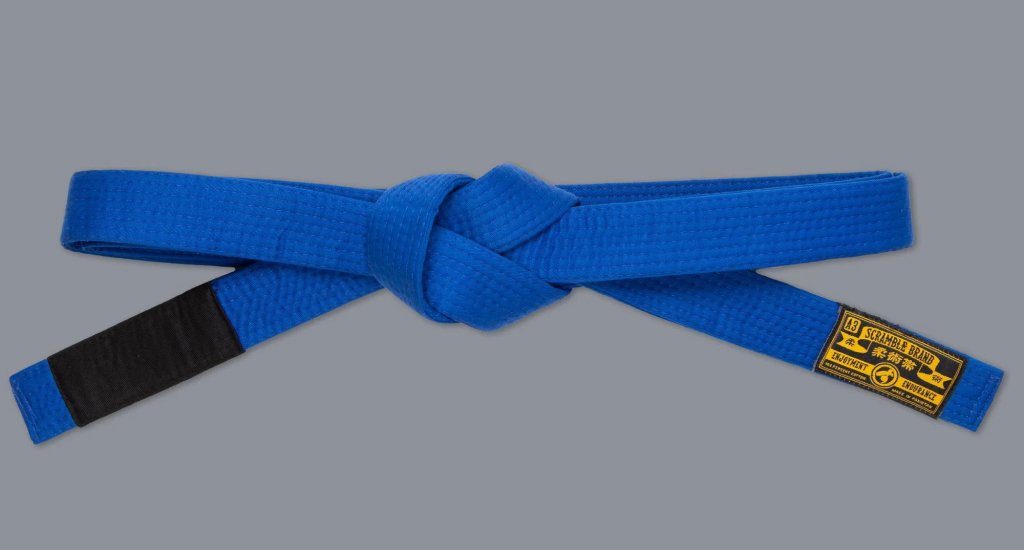
Blue Belt Curriculum2 - 3.5 Years (350 - 600 Mat Hours)
"Technical Breadth & Surviving the "Blue Belt Blues". You now know enough moves to attack, but you must learn to connect techniques into combinations."
Primary Tactical Focus
Developing an open guard system (De La Riva, Half Guard, Butterfly), reliable guard passing, and learning to escape bad positions with minimal muscle.
Required Milestones
Check what you've masteredHave at least 2 reliable guards you can play comfortably under pressure
Execute dynamic guard passes (Knee slice, Toreando, Over-Under pass)
Consistently submit white belts with control, precision, and zero injury risk
Survive rounds against upper belts without immediately conceding mount
Common Pitfalls at This Rank
⚠Disappearing from training ("Blue Belt Blues") due to feeling plateaued
⚠Collecting hundreds of flashy Instagram moves instead of mastering high-percentage basics
⚠Forcing submissions with explosive strength instead of using levers and angles
Stripe Simulator & Time Calculator
Estimate your stripe status based on cumulative mat hours
Your Mat Hours:
Stripe #1275 hrs
Solid Half-Guard recovery, Underhook sweeps, and Knee Cut pass
Stripe #2360 hrs
Open Guard connections (De La Riva, Butterfly) & Triangle combinations
Stripe #3460 hrs
Back take sequences from turtle & Rear Naked Choke finishing mechanics
Stripe #4560 hrs
Multi-step passing chains, submission chains, and competition sparring
Blue belt is the first belt most practitioners actually feel proud of, and for good reason — reaching it usually means a year or more of consistent training and enough live sparring to develop real instincts.
What Changes at Blue Belt
Where white belt is about survival, blue belt is about starting to impose your own game. You are expected to know a working set of positions and transitions, not just isolated techniques, and to start understanding why techniques work rather than just how to perform them.
The "Blue Belt Blues"
Blue belt has a well-known reputation as the rank where people quit — see our breakdown of why so many blue belts walk away for the full picture. It is the longest belt for most practitioners (often 2-3 years), and the initial excitement of white belt has worn off while black belt still feels impossibly far away. Plateaus are common and normal here — the fix is almost always the same: keep showing up, and lean into competition or a specific game (like a strong guard or a reliable pass) rather than trying to be equally good at everything at once.
What Blue Belts Should Focus On
- Building a real "A-game" — two or three positions you can rely on under pressure
- Rounding out weaknesses, especially defense against submissions you have not seen much
- Starting to understand chains — sweep into pass into submission, not isolated moves
- Competing at least once, if your goals allow it — nothing accelerates learning faster
Getting to Purple Belt
Purple belt typically requires 2-3 years at blue, consistent training, and a demonstrated ability to control rolls against other blue belts rather than just survive them. There is no shortcut here — mat time and live sparring are what actually build the instincts your instructor is evaluating, and the IBJJF itself requires a minimum of two years at blue belt before purple belt eligibility for registered competitors.
Tagged with:#blue belt#belt system
Frequently Asked Questions
Why do so many people quit BJJ at blue belt?
Blue belt is often the longest rank (2-3 years), and the initial excitement of starting has worn off. It is a common plateau, not a sign that BJJ is not for you.
What rank is a BJJ blue belt equivalent to?
There is no exact equivalent in other martial arts, but a BJJ blue belt roughly represents a solid intermediate practitioner — someone who has moved past pure survival and can impose a working game, similar to how a colored belt (not black) reads in striking arts.
How long does it take to get a blue belt in BJJ?
Most practitioners reach blue belt after 1-2 years of consistent training. The exact timeline depends heavily on training frequency, prior grappling experience, and how much live sparring you get in each week.
Is blue belt considered a beginner or intermediate rank?
Blue belt sits at the intermediate stage. White belt is the true beginner rank; by blue belt, you are expected to have a working set of positions and enough experience to hold your own against other blue belts, even if you are still developing.
Sources & Further Reading
About the Author
Mohsin AyubBJJ practitioner, 6 years — Gracie Barra
Founder & Editor, BJJ Sportswear
Mohsin has trained Brazilian Jiu-Jitsu for six years at Gracie Barra and has competed at IBJJF-affiliated tournaments. He writes about competition, gear, and athlete careers, and founded BJJ Sportswear to help grapplers find equipment and information they can trust.
- Six years training Brazilian Jiu-Jitsu at Gracie Barra
- Competed at IBJJF-affiliated tournaments
- Writes on BJJ competition, gear testing, and athlete careers
This article was last reviewed and updated on 2026-08-01.