
On This Page
Editorial Standards
Reviewed by the BJJ Sportswear Editorial Team for technical accuracy and kept current.
BJJ White Belt Guide: What to Expect in Your First Year
White belt is where every BJJ practitioner starts. Here is what the rank actually covers, what trips people up, and what your instructor is looking for.
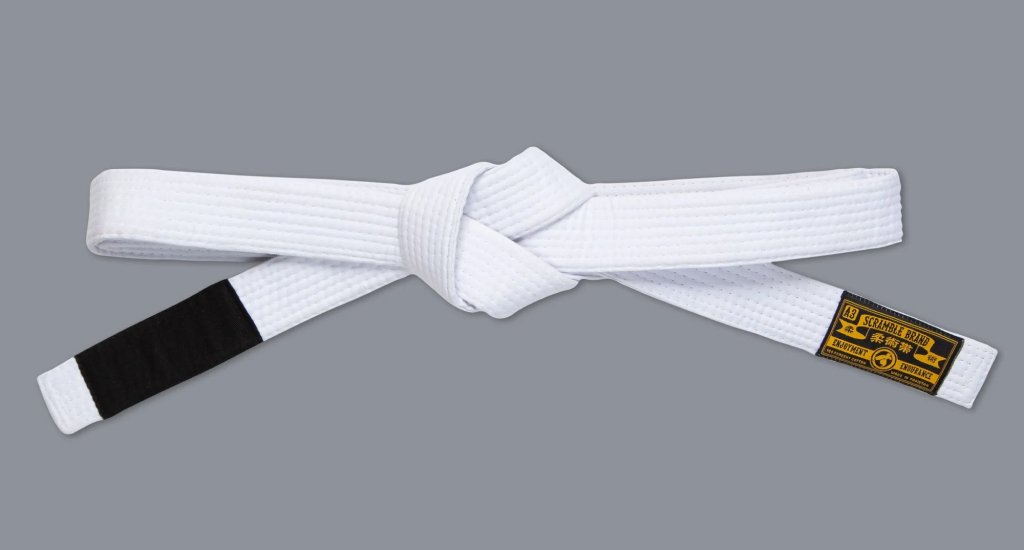
White Belt Curriculum1 - 2.5 Years (150 - 300 Mat Hours)
"Survival, Breathing, and Overcoming Panic. The white belt journey is about learning to feel comfortable being uncomfortable and keeping your ego off the tatami."
Primary Tactical Focus
Posture, basic framing, fundamental escapes (elbow-escape from mount, shrimping from side control), breaking closed guard, and tapping early.
Required Milestones
Check what you've masteredLearn how to break falls safely without slapping elbows or whipping neck
Master the basic bridge and shrimp (hip escape) with body mechanics
Understand closed guard posture: straight spine, elbows tight, hands on hips
Successfully execute the 3 core basic submissions: Cross Collar Choke, Armbar, Triangle
Common Pitfalls at This Rank
⚠Holding breath and exhausting stamina in the first 90 seconds of a round
⚠Spidermanning on top without establishing heavy base or underhooks
⚠Reaching both arms extended inside an opponent’s guard (getting armbarred/triangled)
⚠Refusing to tap to shoulder locks (Americana/Kimura) out of stubbornness
Stripe Simulator & Time Calculator
Estimate your stripe status based on cumulative mat hours
Your Mat Hours:
Stripe #135 hrs
Basic movement, warmups, safe falling, and tapping etiquette
Stripe UnlockedStripe #275 hrs
Mount and side control survival frames & basic hip escape
Stripe UnlockedStripe #3130 hrs
Closed guard retention, scissor sweep, and cross-collar choke
Stripe #4200 hrs
Guard breaking, passing to side control, and controlled sparring
Every black belt was once a white belt who got tapped out by everyone in the room, including the smaller, newer students. That is not a discouraging fact — it is the most reassuring one in the sport. White belt exists to get you comfortable being uncomfortable.
What White Belt Actually Covers
At white belt, your instructor is not expecting technical mastery. They are looking for a few specific things:
- Basic safety: how to fall, how to tap, how to warm up without hurting yourself
- Fundamental positions: mount, side control, closed guard, back control
- A small toolbox of escapes, especially from mount and side control
- Enough submission awareness to defend the basics (armbar, choke, kimura)
- Consistency — simply showing up regularly matters more than any single skill
How Long White Belt Lasts
Most academies keep students at white belt for 1-2 years. That sounds long for a "beginner" rank, but there is a lot packed into it: your body is learning entirely new movement patterns, and your instructor wants to see you handle live sparring without panicking before handing you a blue belt.
The Most Common White Belt Mistakes
- Trying to out-muscle every roll instead of learning technique — this works short-term and stalls your progress long-term
- Holding your breath during scrambles, which burns your gas tank in under a minute
- Skipping the "boring" fundamentals (posture, framing, hip escapes) to chase submissions
- Refusing to tap early, which leads to injuries that keep you off the mats
What Gets You to Blue Belt
There is no universal checklist — every instructor grades differently — but broadly, you are ready for blue belt when you can survive rolls against other white belts without being dominated, defend the basic submissions instinctively, and show a working understanding of at least two or three positions well enough to hold your own. Consistent mat time (2-3 times a week, sustained over a year or more) is the single biggest factor.
If you are just getting started, our guide on choosing a gi and our guide to what BJJ classes are actually like are worth reading before your first week is out. Rank and promotion standards ultimately trace back to the IBJJF, even at academies that aren't formally affiliated.
Tagged with:#white belt#beginners#belt system
Frequently Asked Questions
How long does white belt last in BJJ?
Typically 1-2 years of consistent training, though this varies significantly by academy and training frequency.
Is it normal to lose every roll at white belt?
Yes. Losing to higher belts, and even to other white belts with more experience, is completely normal and expected. It is how you learn what does not work.
How many stripes does a BJJ white belt have?
Most academies use a four-stripe system on the white belt before promoting to blue. Stripes are awarded by your instructor based on their own assessment of your progress — there is no universal rulebook for exactly when each one is earned.
What should a white belt focus on learning first?
Survival and escapes — getting out of mount, side control, and back control safely — before worrying about submissions or an offensive game. A white belt who can stay calm and escape bad positions is already ahead of most beginners.
Sources & Further Reading
About the Author
Mohsin AyubBJJ practitioner, 6 years — Gracie Barra
Founder & Editor, BJJ Sportswear
Mohsin has trained Brazilian Jiu-Jitsu for six years at Gracie Barra and has competed at IBJJF-affiliated tournaments. He writes about competition, gear, and athlete careers, and founded BJJ Sportswear to help grapplers find equipment and information they can trust.
- Six years training Brazilian Jiu-Jitsu at Gracie Barra
- Competed at IBJJF-affiliated tournaments
- Writes on BJJ competition, gear testing, and athlete careers
This article was last reviewed and updated on 2026-08-01.