
On This Page
Editorial Standards
Reviewed by the BJJ Sportswear Editorial Team for technical accuracy and kept current.
MMA Training Center vs. Regular Gym: Which Is Better?
An MMA gym and a regular gym build fitness in very different ways. Here is an honest, category-by-category comparison to help you pick the one that actually fits your goals.
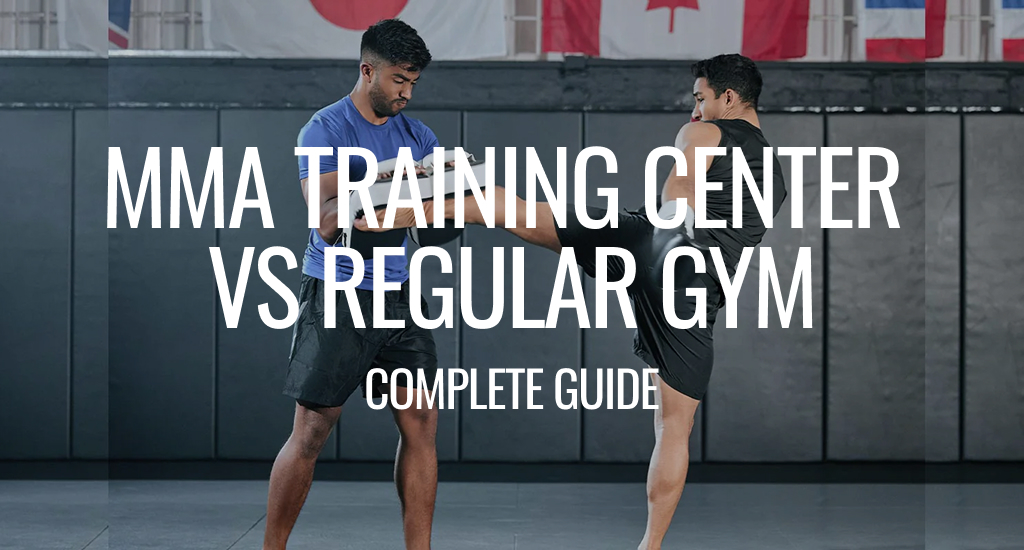
MMA training centers and regular gyms build fitness in genuinely different ways. Neither one wins across the board. The right pick depends on your actual goals, not just which one sounds more intense. Here's an honest comparison across the factors that matter most.
Quick Comparison
| Factor | MMA Training Center | Regular Gym |
|---|---|---|
| Calorie burn | Higher, full-body | Lower, activity-dependent |
| Skill learning | Self-defense, fighting | Minimal |
| Community | Built-in team environment | Mostly solo |
| Coaching | Included in class price | Extra cost for a trainer |
| Monthly cost | Higher | Lower |
| Schedule | Fixed class times | 24/7 access |
| Muscle building | Functional strength | Better for pure hypertrophy |
| Beginner comfort | Can feel intimidating at first | Lower pressure |
1. Workout Intensity and Calorie Burn
MMA classes burn more calories per hour than most standard gym workouts. The reason is simple: your whole body works at once. Striking, clinching, and grappling all engage large muscle groups together, not one at a time. Rounds run in short, hard bursts with brief rests — a natural interval structure that pushes both your aerobic and anaerobic systems. A regular gym session can absolutely match that intensity too, but it depends heavily on what you're doing. A slow lifting session burns far less. A hard cardio session on a bike or stair climber can get closer to MMA's numbers.
2. Functional Strength vs. Isolated Muscle Growth
MMA training builds what's called functional strength — strength that shows up in real movement, not just on a lifting chart. You push through strikes and frames. You pull through clinches and grip fights. You stabilize your base under pressure while someone tries to take you down. All of that trains coordination and full-body power together.
A regular gym is the better tool for pure muscle size and one-rep max strength. Progressive overload on a barbell, targeting one muscle group at a time, is simply more effective for hypertrophy than combat training will ever be. If your main goal is bigger arms or a heavier squat, the gym wins that specific contest. If your goal is strength you can actually use, MMA has the edge.
3. Mental Toughness and Discipline
Getting hit, submitted, or dominated by a training partner teaches ego management fast — there's no faking your way past live resistance. That kind of controlled stress tends to build real composure under pressure, the sort that shows up outside the gym too. A regular gym builds discipline in a different way: showing up consistently with no one checking on you, and no partner expecting you at 6pm. Both build mental strength. They just build it through different mechanisms — external pressure in one case, internal consistency in the other.
4. Community and Accountability
MMA and BJJ gyms come with a built-in team. Drilling requires a partner, so isolation is hard to default into. Coaches actively correct you throughout class, and that instruction is already included in the price — no separate personal trainer fee. Teammates notice when you're missing, which becomes its own quiet accountability system.
Regular gyms trade that structure for flexibility. You can train alone, whenever you want, with no schedule to work around. Some people genuinely prefer that privacy. Others need the social pull of a team to actually show up consistently — and for that group, an MMA gym's built-in community is a real retention advantage.
5. Skill Acquisition and Self-Defense
This is where MMA has no real competitor. A regular gym makes you fitter, but it doesn't teach you what to do in an actual physical confrontation. MMA training — especially the grappling side through BJJ — builds positional awareness, escapes, and control under real resistance. That's a skill set a treadmill simply can't replicate, regardless of how fit it makes you.
6. Cost
Regular gyms are almost always cheaper per month than MMA training centers. You're paying for equipment access, not coaching or a curriculum. MMA gyms charge more because the price includes live instruction, structured class programming, and often access to multiple disciplines under one membership. Whether that's worth the premium depends on whether you'd otherwise be paying for a personal trainer anyway — in which case the gap narrows quickly.
7. Time Efficiency
A well-run MMA class packs warm-up, technique, live drilling, and conditioning into one session, so you leave having trained strength, cardio, and skill all at once. Replicating that at a regular gym usually takes longer, since you're typically doing cardio and strength work as separate blocks rather than one integrated session.
8. Injury Risk
This one genuinely favors the regular gym. Lifting weights and using cardio machines carries a real but generally lower and more predictable injury risk than live grappling or striking, where you're training against a resisting opponent. MMA training isn't reckless when it's coached well — reputable gyms manage this risk through progressive contact and proper technique instruction — but the baseline risk is still higher than moving a barbell through a controlled range of motion.
9. Beginner-Friendliness
Walking into a regular gym for the first time is intimidating in its own way, but the bar to "doing it right" is lower — you can quietly figure out a machine without much scrutiny. Walking into an MMA gym means partnering with strangers on day one, which is a bigger ask for a lot of people. That said, gyms with genuine fundamentals programs are built specifically to make this transition smooth, and most experienced practitioners will tell you the awkward first weeks pass faster than you'd expect.
10. Long-Term Adherence
This is where MMA training tends to pull ahead. A large share of regular gym memberships go unused after the first few months, partly because solo training with no external structure is easy to quietly abandon. MMA and BJJ gyms tend to hold onto students longer, because the built-in community and steady skill progression — belts, stripes, visible improvement — give people a reason to keep showing up beyond just "I should exercise today."
Can You Do Both?
Plenty of serious grapplers do exactly this: MMA or BJJ training for skill, community, and functional conditioning, plus separate strength training at a regular gym to build a stronger base and prevent injury. If your budget and schedule allow it, this combination gets you most of the upside of both without giving up much of either.
Who Should Choose Which
Choose an MMA or BJJ gym if you want to learn real self-defense, thrive on structure and community, and stay motivated by visible skill progression rather than just numbers on a scale.
Choose a regular gym if your main goal is maximum muscle size or strength, you need fully flexible scheduling, or you'd rather train solo without the social pressure of a class.
The Bottom Line
Neither option is objectively better — they're built for different outcomes. MMA training centers win on functional fitness, self-defense skill, community, and long-term motivation. Regular gyms win on cost, flexibility, pure muscle building, and lower injury risk for beginners. The right choice comes down to what you actually want out of training, not which one sounds tougher.
Tagged with:#health#fitness#comparison
Frequently Asked Questions
Does MMA training burn more calories than a regular gym workout?
MMA classes typically burn more calories per hour than a moderate gym session, since they engage the whole body continuously through striking, grappling, and conditioning. A hard cardio session at a regular gym can come close, but overall MMA training tends to burn more due to its full-body, high-intensity structure.
Is an MMA gym or a regular gym better for beginners?
Regular gyms are generally less intimidating for complete beginners since you can train solo with less social pressure. MMA and BJJ gyms with a real fundamentals program are still very beginner-friendly and tend to build faster skill progress and stronger long-term motivation once the initial adjustment period passes.
Can I do both MMA training and a regular gym?
Yes, and many serious practitioners do exactly this — MMA or BJJ for skill, conditioning, and community, plus separate strength training at a regular gym to build a stronger physical base and reduce injury risk.
Is MMA training safe for beginners?
Yes, at a well-run gym with a real fundamentals program that introduces contact gradually. Injury risk is genuinely higher than at a regular gym since you train against a resisting partner, but reputable schools manage this through progressive contact, proper coaching, and teaching students to tap early.
Which is cheaper, an MMA gym or a regular gym?
Regular gyms are almost always cheaper per month, since you're paying for equipment access rather than live coaching and a structured curriculum. MMA gyms charge more because the price includes instruction that would otherwise cost extra as a personal trainer at a regular gym.
About the Author
Mohsin AyubBJJ practitioner, 6 years — Gracie Barra
Founder & Editor, BJJ Sportswear
Mohsin has trained Brazilian Jiu-Jitsu for six years at Gracie Barra and has competed at IBJJF-affiliated tournaments. He writes about competition, gear, and athlete careers, and founded BJJ Sportswear to help grapplers find equipment and information they can trust.
- Six years training Brazilian Jiu-Jitsu at Gracie Barra
- Competed at IBJJF-affiliated tournaments
- Writes on BJJ competition, gear testing, and athlete careers
This article was last reviewed and updated on 2026-08-18.