Reviewed by competitive black belts specializing in modern guard and leg lock systems | Last Updated: January 10, 2026
The Single Leg X Guard (SLX)—also known as ashi garami—stands as one of Brazilian Jiu-Jitsu’s most versatile and universally applicable positions. This guard variation provides sweeping power for IBJJF competitors, devastating leg lock entries for submission-only grapplers, and control mechanisms that work equally well in gi and no-gi contexts.
According to Evolve MMA’s X-guard analysis, Single Leg X focuses on isolating one opponent leg, making it highly effective for direct attacks on the trapped leg while allowing greater control and efficient balance disruption. BJJ Fanatics’ SLX breakdown emphasizes that this position transcends styles—working in gi, no-gi, points competition, and submission-only formats.
After coaching hundreds of students through SLX development and using it extensively across multiple competition formats, I’ve found it’s the most immediately useful guard for intermediate practitioners. Unlike complex inversion-based systems that require years of development, SLX provides practical sweeping and submission opportunities accessible to blue belts while remaining sophisticated enough for world-class black belt competition.
Whether you’re a blue belt building guard retention or a brown belt developing leg lock systems, understanding Single Leg X mechanics provides offensive pathways and defensive insurance that function against any opponent, in any grappling context.

Table of Contents
What Is Single Leg X Guard?
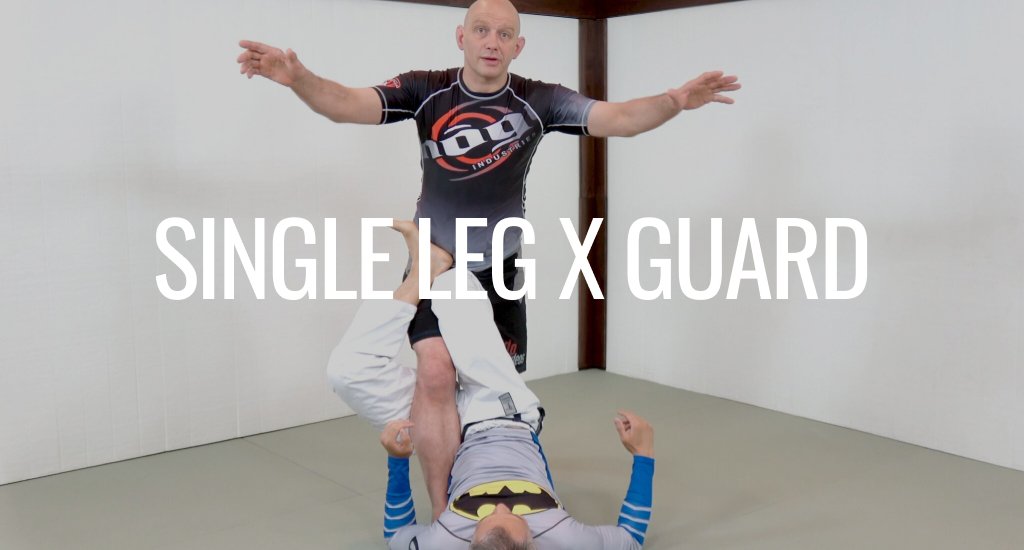
Single Leg X Guard occurs when the bottom player traps one opponent leg between both of their legs, creating control through a specific configuration where your inside leg hooks behind their knee while your outside leg connects across their hip or thigh.
Core SLX Elements:
- Both your legs control one opponent leg
- Inside leg hooks behind their knee
- Outside leg connects to their hip/thigh
- Creates “X” or crossing configuration on single leg
- Optional underhook on trapped leg for enhanced control
The position shares DNA with traditional X-guard but focuses entirely on controlling one leg rather than creating the full X configuration. This simplified focus makes SLX simultaneously easier to learn and more specialized for specific attacks.
Understanding what is guard in BJJ provides context for why SLX became fundamental—it bridges the gap between traditional open guards and modern leg entanglement systems.
The Evolution: From Marcelo Garcia to Modern Leg Locks
Marcelo Garcia: The SLX Pioneer
Marcelo Garcia—widely considered one of the greatest grapplers ever—popularized Single Leg X Guard in the mid-2000s through his dominance at ADCC and IBJJF World Championships.
Marcelo’s SLX System:
- Used extensively from butterfly guard positions
- Entered SLX when opponents posted leg to counter butterfly hooks
- Swept opponents consistently to achieve top position
- Controlled opponent’s neck-fighting hand and swept them over
- Simple, high-percentage execution under maximum pressure
According to BJJ Fanatics’ historical overview, Marcelo played butterfly guard which caused opponents to lift legs for defensive posting—exactly the situation that creates SLX entries. His approach prioritized sweeping to top position rather than leg locks, proving SLX’s effectiveness independent of submission attacks.
Marcelo’s influence cannot be overstated. When the greatest competitor of a generation builds major portions of his game around a position, everyone pays attention.
The Leg Lock Revolution
While Marcelo used SLX primarily for sweeps, modern grapplers recognized the position’s leg lock potential:
Why SLX Became Leg Lock Central:
- Position is identical to standing ashi garami (fundamental leg entanglement)
- Traps opponent’s leg in perfect configuration for straight ankle locks
- Provides control while attacking heel hooks (no-gi/submission-only)
- Allows toe holds, estima locks, and other leg attacks
- Creates “closed guard of leg locks”—central position from which everything else develops
BJJ Fanatics emphasizes that Single Leg X is the MOST important guard for leg locks, serving as the position that everything else develops from—just as closed guard serves that role for upper body attacks.

The Danaher Death Squad Influence
John Danaher’s leg lock system, implemented by athletes like:
- Garry Tonon
- Gordon Ryan
- Eddie Cummings
- Craig Jones
These grapplers demonstrated absolute mastery of SLX positioning, using it as the foundation for devastating leg attack systems that dominated submission-only competition throughout the 2010s and 2020s.
Their success forced the BJJ community to recognize SLX as essential—you either learned to attack from it or learned to defend it at elite levels.
Modern SLX Champions
Contemporary competitors who built games around SLX:
Elite SLX Practitioners:
- Lucas Lepri – Multiple-time world champion using SLX/spider hybrid (“one x-spider”)
- Leandro Lo – Legendary competitor with dynamic SLX sweeps
- Craig Jones – ADCC medalist with comprehensive SLX leg attack system
- Lachlan Giles – Analytical approach to SLX entries and finishes
- Felipe Pena – Heavyweight champion proving SLX works at all sizes
The position evolved from Marcelo’s sweeping platform to complete system encompassing sweeps, leg locks, back takes, and transitions that define modern competition.
Understanding how the crab ride and the truck connect to SLX transitions shows back attack evolution.
Why Single Leg X Works: Mechanical Advantages
Universal Applicability
SLX works across every grappling context:
Gi Competition:
- Grips enhance control and sweeping leverage
- Chains seamlessly with spider guard (one x-spider)
- Legal at all belt levels in IBJJF
- Provides sweeps (2 points) and positional advances
No-Gi and Submission-Only:
- Ankle control and underhooks replace gi grips
- Direct entry to heel hooks and ankle locks
- Works perfectly in ADCC and EBI formats
- No rule restrictions on position itself
MMA Application:
- Creates distance from strikes
- Sweeps lead to top position
- Allows standing up under control
- Better striking defense than inverted positions
This versatility explains SLX’s ubiquity—it’s “the best of both worlds,” working in IBJJF competition while setting up techniques banned in those same rules.
Structural Control
SLX creates mechanical problems for standing opponents:
Control Mechanisms:
- Both legs focus power on single opponent leg (2-vs-1 advantage)
- Inside hook prevents them stepping forward or backward
- Outside leg controls hip preventing lateral movement
- Underhook (when established) prevents posture recovery
- Creates unstable base impossible to maintain long-term
Evolve MMA’s mechanical analysis notes that SLX allows greater control of one leg with efficient balance disruption—you’re not trying to control their whole body, just the single leg that determines their stability.
Gateway Position
SLX functions as transitional hub:
Primary SLX Pathways:
- Sweeps to top position (Marcelo Garcia style)
- Leg locks straight ankle, heel hook, toe hold (submission-only)
- Back takes when opponent turns away
- X-guard when they post second leg
- De La Riva variations for different angles
I tell students: SLX is like a highway interchange. You don’t live there—you pass through on the way to somewhere better. Master the transitions and the position becomes infinitely more powerful.

Core SLX Mechanics and Setup
Establishing Single Leg X
The foundation is the leg configuration:
Proper SLX Structure
- Inside leg (closest to their trapped leg) hooks behind their knee
- Outside leg crosses over, connecting to their hip or outer thigh
- Both legs create tension—inside pulls toward you, outside pushes away
- Hips elevated off mat (critical for control)
- Optional underhook on trapped leg enhances control
Critical Detail: Your hips must be off the ground. Flat hips kill SLX effectiveness. Elevate your hips toward their trapped leg to create the structural tension that makes the position work.
Standard SLX Configuration
Classic positioning:
Essential Elements
- SLX leg configuration on their lead leg
- Same-side hand controls their ankle (prevents distance creation)
- Opposite hand posts on mat, controls their knee, or establishes underhook
- Shoulders off mat maintaining active posture
- Constant hip elevation and adjustment
Posture Requirement: Keep your shoulders off the mat. Getting flattened kills your offensive options and opens you to passing.
Entry Methods
Multiple pathways to SLX:
From Butterfly Guard (Marcelo Garcia Method)
- Playing butterfly with hooks in
- Opponent posts leg to counter your butterfly hooks
- Immediately shoot legs to SLX on posted leg
- Establish ankle control and complete position
From Seated Guard
- Seated with shin-to-shin connection
- Opponent attempts to pass or create pressure
- Scoot underneath, shooting legs to SLX
- Elevate hips and secure position
From De La Riva Guard
- DLR hook established
- Opponent defends or backstepping
- Free leg switches to inside hook
- Convert DLR configuration to SLX
From Reverse De La Riva
- RDLR inside hook active
- Free leg threads through creating SLX
- Seamless transition between positions
- Maintain ankle control throughout
Understanding how closed guard differs from open guards like SLX helps beginners appreciate guard variety.
Grip Strategy
Grips determine SLX effectiveness:
Gi Grip Priorities
1. Ankle/pant grip (same side as trapped leg): Essential for preventing distance
2. Knee grip or underhook: Controls their posture and base
3. Belt or pants grip: Alternative upper body control
4. Collar grip: For certain sweep variations
No-Gi Adaptations
- Ankle control (absolutely critical—two hands if necessary)
- Underhook on trapped leg (provides maximum control)
- Wrist control on their posting hand
- Alternative: overhook their trapped leg
In my experience, blue belts establish the legs correctly but neglect ankle control. Without ankle grip, they create distance and your SLX collapses.

Essential SLX Techniques
1. Standing Sweep (Marcelo Garcia Classic)
The fundamental SLX sweep:
Step-by-Step Execution
- Establish SLX with ankle control
- Control their neck-fighting hand (pull it aside)
- Elevate hips forcefully upward
- Extend both legs while maintaining hip elevation
- Sweep opponent backward over their compromised base
- Land in top position or ashi garami for leg attacks
Why It Works: You’re attacking their only supporting leg from underneath with maximum leverage. They have nowhere to post and nothing to base on.
Competition Application: This sweep works on anyone, any size, any skill level when executed with proper timing and hip elevation.
2. Technical Standup
Converting SLX to standing position:
Execution Sequence
- SLX established with strong ankle control
- Post outside hand on mat
- Drive hips up while extending trapped leg
- Come to standing while maintaining leg control
- Finish single leg takedown or return to standing guard
Tactical Use: When opponent refuses to engage or you need to disengage safely, technical standup provides exit while maintaining offensive control.
I’ve used this extensively in no-gi when opponents stall—forces them to engage or concede position.
3. Straight Ankle Lock
Primary submission from SLX:
Mechanics
- SLX position established
- Sweep motion begins (or fake the sweep)
- As they react, trap their ankle
- Fall back securing ankle lock grip
- Apply pressure to Achilles tendon
- Finish submission
Strategic Value: The sweep and ankle lock work together—they defend one, you attack the other. This creates constant offensive pressure.
4. Heel Hook (No-Gi/Submission-Only)
Modern SLX primary submission:
Setup and Finish
- SLX configuration identical to standing ashi garami
- Control their knee line (prevent rotation)
- Secure heel grip (outside heel hook preferred)
- Break posture down to mat
- Apply rotational pressure for finish
SAFETY WARNING: Heel hooks are extremely dangerous. Only practice under qualified black belt supervision in appropriate training environments. Never legal in IBJJF gi competition.
Understanding rear naked choke mechanics helps with back takes when opponent escapes SLX.
5. X-Guard Transition
Converting SLX to full X-guard:
Transition Mechanics
- SLX established on one leg
- Opponent posts second leg for base
- Switch outside leg to hook posted leg
- Create full X configuration
- Execute X-guard sweeps or back takes
Why This Matters: SLX and X-guard function as system. Chain them together for complete guard game that adapts to opponent’s reactions.
6. Tripod Sweep Variation
When opponent creates distance:
Execution
- SLX starting to fail as they create space
- Plant outside leg on their far hip (creates tripod)
- Pull ankle while pushing hip
- Sweep them backward
- Follow to top position
This technique bridges SLX and traditional open guard sweeps, providing backup when primary attacks fail.
SLX Variations and Advanced Systems
One X-Spider (Lucas Lepri System)
Combining SLX with spider guard:
Configuration:
- SLX on one leg
- Spider hook on opposite arm/sleeve
- Creates upper and lower body control simultaneously
- Off-balances opponent in multiple directions
- Extremely effective in gi competition
Lucas Lepri used this hybrid to win multiple world championships, proving SLX effectiveness at absolute elite levels.
SLX with Overhook
Enhanced control variation:
Mechanics:
- Standard SLX leg configuration
- Overhook opponent’s trapped leg with your arm
- Locks their leg in place preventing escape
- Provides superior control for sweeps
- Creates tighter ankle lock entries
This variation appears frequently in modern no-gi competition.
50/50 Guard Transition
From SLX to 50/50:
Transition Pathway:
- SLX established
- Opponent counters by sitting and entering your legs
- Both legs now entangled (50/50 configuration)
- Execute 50/50 attacks or transitions
- Or return to SLX if they disengage
Understanding this transition prevents being surprised when opponent counters with leg entanglement.
Back Take From SLX
When opponent turns away:
Setup:
- SLX threatening sweep or leg lock
- Opponent turns away to defend/escape
- Immediately release SLX and take their back
- Establish hooks and seatbelt grip
- Attack rear naked choke
Elite competitors use this constantly—the threat of SLX attacks creates back exposure.
SLX Defense and Passing
Passing SLX: Top Player Perspective
Understanding SLX passing improves your guard:
Backstep Pass
- Control their hooking leg at knee
- Create strong posture preventing them elevating hips
- Backstep with trapped leg while maintaining balance
- Circle away from their body
- Complete pass to side control
Counter for Guard Player: Follow their movement, extend trapped leg maximally, transition to different guard variation.
Smash Pass
- Establish heavy top pressure
- Flatten their hips to mat (kills their leverage)
- Drive shoulder into their non-trapped leg
- Maintain pressure while clearing legs
- Secure side control
Counter for Guard Player: Don’t let them flatten you. Constant hip elevation prevents smash passing.
Ankle Lock Counter
- They threaten ankle lock from SLX
- Pull your foot back (preventing full extension)
- Maintain strong posture
- Create distance and disengage
- Or counter with your own leg attack
Defending SLX Attacks
When someone plays SLX against you:
Preventative Measures
- Don’t let them control your ankle
- Maintain strong base (wide stance)
- Keep posture upright
- Prevent them elevating hips
- Break their grips immediately
Counter-Attacking
- Pressure passes when they’re flat
- Backsteps when they elevate
- Leg locks when entangled (submission-only)
- Never allow underhook on trapped leg
I teach students: SLX defense is 80% prevention. Once it’s locked in with ankle control and elevated hips, escaping becomes exponentially harder.

Training SLX by Skill Level
For Blue Belts: Building Foundations
Blue belts should establish SLX basics:
Beginner Priorities
- Master standing sweep (highest percentage)
- Develop entries from butterfly and seated guard
- Practice ankle control obsession
- Study when SLX works vs. other guards
- Drill SLX → X-guard → SLX transitions
Resources about first BJJ class expectations help beginners understand guard progression.
Training Tip: Focus on hip elevation. Record yourself drilling—if your hips touch the mat, you’re doing it wrong.
For Purple Belts: System Development
Purple belts develop complete SLX systems:
Intermediate Development
- Master all major sweeps (standing, tripod, technical standup)
- Study straight ankle locks safely
- Learn to chain SLX with DLR and RDLR
- Develop one x-spider variation (gi)
- Practice SLX passing to understand vulnerabilities
Exploring blue belt development goals helps structure SLX integration.
For Brown/Black Belts: Specialization
Advanced practitioners refine details:
Advanced Refinements
- Develop personalized SLX based on body type
- Study elite practitioners (Marcelo Garcia, Craig Jones, Lucas Lepri)
- Master heel hooks and advanced leg attacks (qualified instruction only)
- Create counter-strategies for all passing systems
- Perfect seamless transitions between all guard variations
- Understand when NOT to enter SLX
At this level, some competitors become SLX specialists while others become SLX killers. Both paths work.
Competition Strategy and Applications
IBJJF Gi Competition
SLX thrives in points-based gi:
Strategic Advantages
- Sweeps score 2 points
- Legal at all belt levels
- Works across all weight divisions
- Chains with legal guards (spider, DLR, X-guard)
- Prevents opponent’s passing points
Competition Reality: SLX provides reliable sweeping system for competitors who struggle with complex guard sequences.
ADCC and No-Gi
SLX dominates submission-only formats:
No-Gi Applications
- Direct entry to heel hooks
- Faster transitions than gi
- Works without grip dependencies
- Leg lock specialists rely heavily on SLX
- Legal in virtually all no-gi competitions
Craig Jones used SLX extensively at ADCC, demonstrating world-class effectiveness.
MMA and Self-Defense
SLX has real but limited MMA application:
MMA Considerations
- Creates distance from ground-and-pound
- Allows technical standup
- Sweeps lead to top position
- Better than inverted guards for striking defense
- Must modify for punch threats
Self-Defense: Use SLX to create space and stand up. Don’t hunt submissions from bottom in self-defense scenarios.
Common SLX Mistakes
Flat Hips
The #1 beginner error:
The Problem
- Hips on mat kill leverage
- Can’t sweep effectively
- Opens you to smash passes
- Removes offensive threat
The Solution
- Elevate hips constantly
- Think “climb their leg with your hips”
- Drive hips toward trapped leg
- Never let them flatten you
No Ankle Control
Allowing opponent free leg movement:
Result
- They create distance
- SLX collapses
- Can’t attack or sweep
Fix
- Grip ankle BEFORE completing SLX
- Never release ankle control
- Use two hands if necessary
- If grip breaks, transition immediately
This mistake kills more SLX attempts than any other technical error.
Wrong Leg Hook Position
Hooking too low or too high:
Issue
- Hook at ankle: no control, easy escape
- Hook at hip: no leverage, ineffective sweeps
- Correct position: behind the knee
Correction
- Inside leg hooks directly behind their knee
- Creates maximum control and sweeping leverage
- Allows proper hip elevation
Fighting Lost Positions
Holding SLX when it’s clearly being passed:
Problem
- Wastes energy
- Gets passed anyway
- Misses transition opportunities
Better Approach
- Recognize when SLX fails (2-3 seconds max)
- Transition to butterfly, DLR, or standing guard
- Chain positions fluidly
- Accept that no single guard solves every problem
Elite competitors flow between positions. SLX is one tool in complete arsenal.
The SLX Legacy: Bridge Between Old and New School
From Marcelo Garcia’s sweeping dominance in the mid-2000s to the Danaher Death Squad’s leg lock revolution in the 2010s to modern competitors using SLX across all formats, Single Leg X Guard represents BJJ’s ability to evolve while maintaining foundational principles.
What began as entry from butterfly guard became complete positional system that works in gi and no-gi, points and submission-only, IBJJF and ADCC, lightweight and heavyweight divisions. SLX’s universality stems from fundamental mechanical advantages—two legs controlling one leg creates leverage problems opponents can’t solve through strength or athleticism.
The position demonstrates how BJJ innovation doesn’t always mean complex new techniques. Sometimes the most effective evolution involves refining and systematizing positions that already existed, revealing depths previous generations didn’t fully explore.
Whether you’re a blue belt learning first sweeps or a black belt perfecting leg lock entries, understanding Single Leg X mechanics provides offensive tools and defensive knowledge that function against any opponent in any grappling context.
Mastering SLX fundamentals creates foundation for exploring complete modern guard systems—from De La Riva guard to berimbolo inversions to Reverse De La Riva variations that define contemporary competition.
How We Reviewed This Article
Editorial Standards: Technical information verified through Marcelo Garcia instructional content, John Danaher leg lock system materials, and contemporary SLX specialists. Mechanical analysis reviewed by competitive black belts using SLX in tournament settings. Strategic applications based on IBJJF, ADCC, and submission-only competition footage (2005-2025).
Sources Referenced:
- Marcelo Garcia SLX sweeping systems and competition footage
- John Danaher leg lock instructional materials
- Craig Jones, Lachlan Giles, and modern SLX practitioners
- Evolve MMA technical X-guard analysis
- BJJ Fanatics SLX breakdown and applications
- IBJJF and ADCC competition analysis
Last Updated: January 10, 2026