
On This Page
Editorial Standards
Reviewed by the BJJ Sportswear Editorial Team for technical accuracy and kept current.
Knee Slice Pass: The #1 Guard Pass in Brazilian Jiu-Jitsu
If you could only learn one guard pass for the rest of your life, it should be the knee slice. Here is the mechanics, the step-by-step, and the fixes for where it stalls.
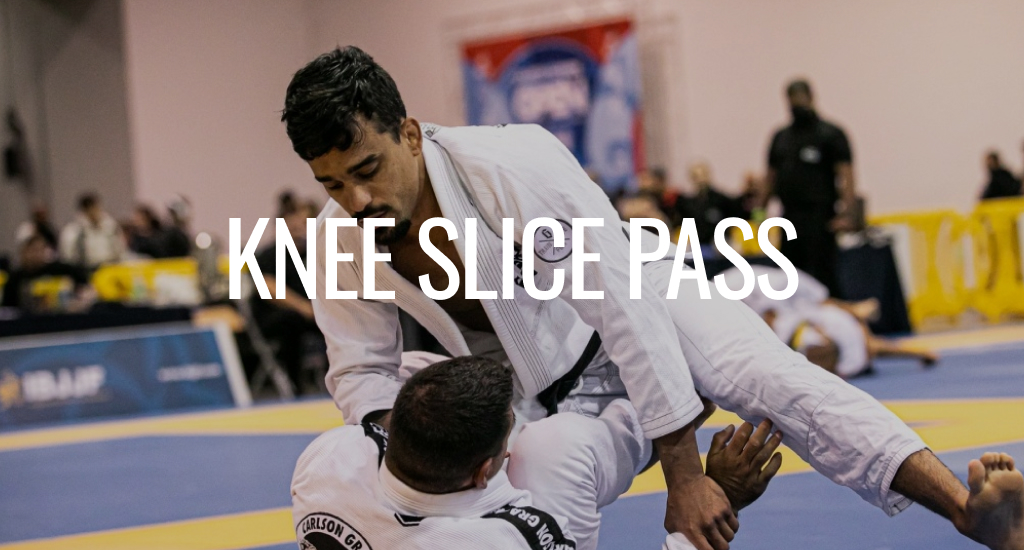
If you could only keep one guard pass for the rest of your BJJ career, the knee slice pass is the one worth keeping, because it blends speed, pressure, and structural stability into a single continuous motion that holds up in the gi, in no-gi, and in MMA. World champions like Lucas Lepri and Romulo Barral have built entire competition careers around this one move, refining it until it became close to unstoppable at the highest levels of the sport.
This guide breaks down the underlying mechanics behind the knee slice, walks through the pass step by step from half guard, and covers the fixes for the specific spots where most students get stuck along the way.
What Is the Knee Slice Pass?
The knee slice pass, also called the knee cut, works by driving your knee diagonally across your opponent's thigh to pin their leg flat to the mat. Three things happen at once.
- The wedge. Your shin acts as a wedge that splits your opponent's legs apart.
- The pin. Driving your knee down to the mat pins their bottom leg in place, so it cannot follow your hips around.
- The slide. Once that leg is pinned, you slide your own hips through the gap to land in side control.
The key detail people miss is that you do not fall over your opponent's leg. You drive through it with intent, cutting across their guard the way a knife cuts, not the way a tree falls.
The 3 Essential Mechanics
Three details separate a knee slice that stalls out from one that lands clean every time.
1. The Underhook
Get an underhook on the far side before you commit to the cut. Skip it, and your opponent has a clean lane to take your back the moment your knee lands. Grapplers summarize this with a simple rule: win the underhook, win the pass. If the underhook is not available, a collar grip or a wrist pin on the mat is the fallback that keeps you safe while you work for it.
2. Head Position
Your head steers your body, so where it goes, your hips follow. Looking down at your opponent's legs gives them a straight line to frame against your head and shove you off. Instead, drive your head into their far shoulder or the mat beside their head. That flattens their spine and kills any bridge they try to build.
3. The Angle
Never pass straight forward. Cut at roughly 45 degrees. That angle lines your spine up for maximum driving power and makes it much harder for your opponent to build a frame that stops you.
Step-by-Step: Passing the Half Guard
The knee slice shows up most often from top half guard, once you already have some control over your opponent's hips.
- Free the trapped knee. If your knee is stuck between their legs, use your free foot to press their leg down and pop the trapped knee loose.
- Make the cut. Drive your knee across their thigh, aiming for the mat right next to their hip.
- Lock in your grips. Dig for the underhook the instant your knee lands, then pull up on their far elbow to flatten them to the mat.
- Slide the foot free. Do not just lift your trailing foot — slide it out along the mat, the way you would scrape gum off a shoe. Lifting it straight up is what lets opponents recapture you in quarter guard.
Troubleshooting: Why You Get Stuck
Problem: They catch my foot in quarter guard. This is the most common snag, and it is not a disaster. Drive your knee down to the mat, backstep with your free leg to hook their ankle, and kick your trapped foot loose.
Problem: They are framing on my neck and I can't get close. Switch to the long step pass instead. If they are pushing you away, use that same pushing energy to explode around to the other side rather than fighting straight into it.
Problem: They have a knee shield and I can't start the cut. Weave your arm inside to smash their knees together, or use a C-grip on their pants to punch the shielding knee down before you attempt the cut. If the shield keeps resetting no matter what you try, switching to a stack pass or an over-under pass removes the leg mobility problem entirely instead of fighting through it.
Conclusion
The knee slice pass is the bread and butter of guard passing because it runs on leverage, not weight. Get the underhook, control the head, cut at the right angle, and the pass takes care of itself. Focus on the underhook above everything else — win that grip, and you are already ninety percent of the way through the guard. Once passing feels automatic from half guard, drilling it against a tighter closed guard is the next step toward making it live against any opponent.
Tagged with:#knee slice pass#knee cut#guard passing#half guard#gi#no-gi
Frequently Asked Questions
Does the knee slice pass hurt the opponent?
It can feel uncomfortable because of the pressure, but it is a safe, legal technique at every belt level. It only becomes dangerous if you intentionally drop your knee onto the groin, which is not part of the technique.
Can I use the knee slice pass against reverse De La Riva guard?
Yes, but it is harder, since reverse De La Riva is built specifically to stop the knee slice. You usually need to clear the hook first before you can start the cut.
What is the difference between the knee slice and the knee cut?
Nothing — they are the same pass. Knee cut is simply the more common name in no-gi and MMA gyms, while knee slice is used more often in gi-focused academies.
Why do I keep getting stuck in quarter guard after the knee slice?
You are lifting your trailing foot straight up instead of sliding it out along the mat. Slide the foot free like scraping gum off a shoe, and backstep with your free leg if they still catch the ankle.
What grip matters most for the knee slice pass?
The far-side underhook. It stops your opponent from taking your back the moment your knee lands, and without it you are exposed even if the cut itself lands cleanly.
Sources & Further Reading
About the Author
Mohsin AyubBJJ practitioner, 6 years — Gracie Barra
Founder & Editor, BJJ Sportswear
Mohsin has trained Brazilian Jiu-Jitsu for six years at Gracie Barra and has competed at IBJJF-affiliated tournaments. He writes about competition, gear, and athlete careers, and founded BJJ Sportswear to help grapplers find equipment and information they can trust.
- Six years training Brazilian Jiu-Jitsu at Gracie Barra
- Competed at IBJJF-affiliated tournaments
- Writes on BJJ competition, gear testing, and athlete careers
This article was last reviewed and updated on 2026-08-17.