
On This Page
Editorial Standards
Reviewed by the BJJ Sportswear Editorial Team for technical accuracy and kept current.
The BJJ Stripe System, Explained
Stripes appear on every belt in BJJ, not just white. Here is how the system works overall, and why it looks different from gym to gym.
Stripes show up on every belt color in BJJ, not just white — you will see striped blue, purple, brown, and even black belts. Understanding what they mean at each level clears up a lot of confusion for newer students.
The Basic Structure
Below black belt, most belts can carry up to four stripes before the next promotion. Once you reach black belt, stripes (often called "degrees") mark years of continued practice and contribution to the art rather than new technical material — the first black belt degree typically comes about three years after your promotion, with further degrees spaced out even further.
Why Stripe Standards Vary So Much
Unlike the belt colors themselves, which the IBJJF and most federations define loosely by broad skill expectations, stripes are entirely at each instructor's discretion. A competition-heavy academy might tie stripes closely to tournament results and hard technical benchmarks. A hobbyist-friendly gym might weigh consistency and attitude more heavily. Neither approach is wrong — they are just optimizing for different things.
Reading Someone's Stripes Correctly
Because of this variation, do not assume a 3-stripe purple belt from one gym is automatically better (or worse) than a fresh purple belt from another. Stripes are a useful internal yardstick for you and your instructor, but they are not a standardized, cross-gym measurement the way belt colors roughly are.
Kids Belts Use a Modified System
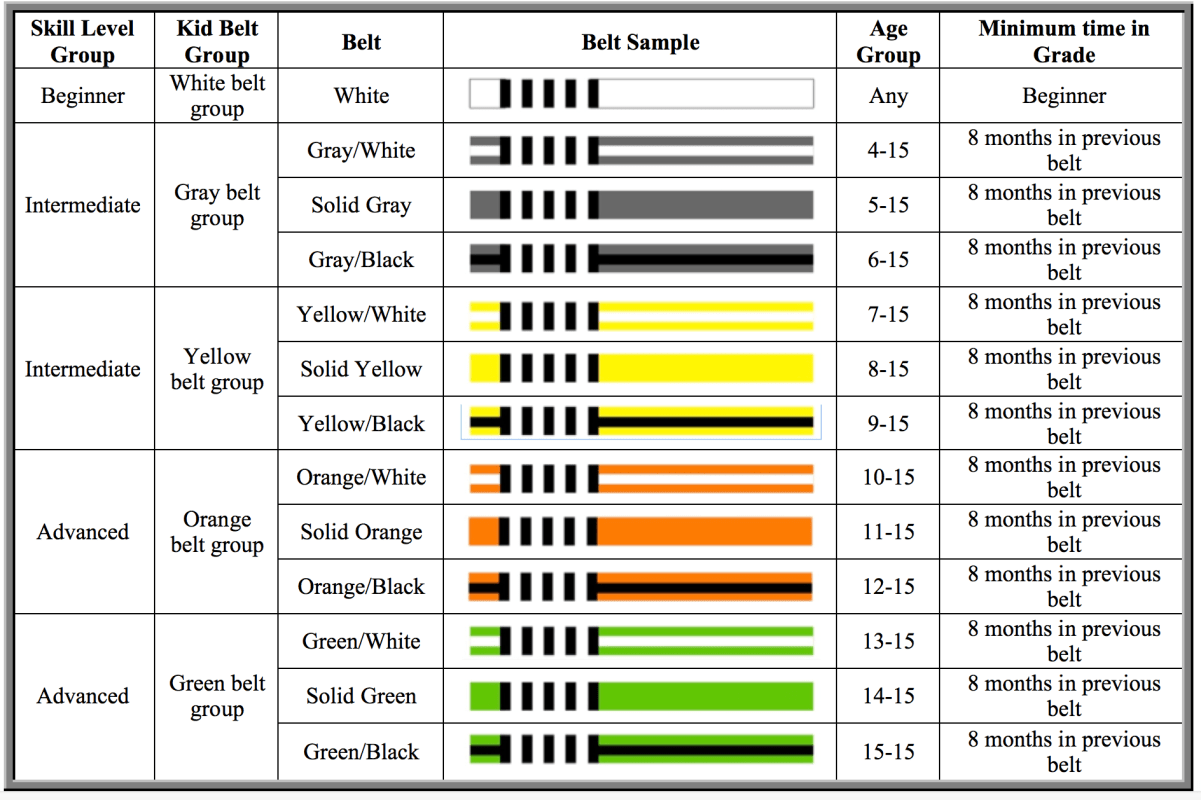
Youth belts (grey through green, for practitioners under 16) also use stripes, but the requirements and pacing are adjusted for younger students. See our full kids BJJ belt system guide for details.
Tagged with:#stripes#belt system
Frequently Asked Questions
Do black belts get stripes too?
Yes, but they are usually called "degrees" instead of stripes. Black belt degrees mark roughly 3-5 years of continued practice and contribution rather than new technique, unlike stripes on the colored belts below black.
Why do stripe rules differ so much between gyms?
Because stripes are entirely at each instructor's discretion — no federation standardizes them the way belt colors are loosely defined. A competition-focused gym may tie stripes to tournament results, while a hobbyist gym may weigh consistency and attitude instead.
Do kids belts use stripes the same way as adult belts?
Kids belts (grey through green) use a similar stripe system, but the pacing and requirements are adjusted for younger students. See our [kids BJJ belt system guide](/belt-system/kids-bjj-belt-system/) for the full breakdown.
Sources & Further Reading
About the Author
Mohsin AyubBJJ practitioner, 6 years — Gracie Barra
Founder & Editor, BJJ Sportswear
Mohsin has trained Brazilian Jiu-Jitsu for six years at Gracie Barra and has competed at IBJJF-affiliated tournaments. He writes about competition, gear, and athlete careers, and founded BJJ Sportswear to help grapplers find equipment and information they can trust.
- Six years training Brazilian Jiu-Jitsu at Gracie Barra
- Competed at IBJJF-affiliated tournaments
- Writes on BJJ competition, gear testing, and athlete careers
This article was last reviewed and updated on 2026-08-01.