
On This Page
Editorial Standards
Reviewed by the BJJ Sportswear Editorial Team for technical accuracy and kept current.
Are Expensive BJJ Rash Guards Worth It?
A $60 rash guard and a $20 one both cover your torso. Whether the price gap is worth it comes down to fabric, stitching, and how often you actually train.
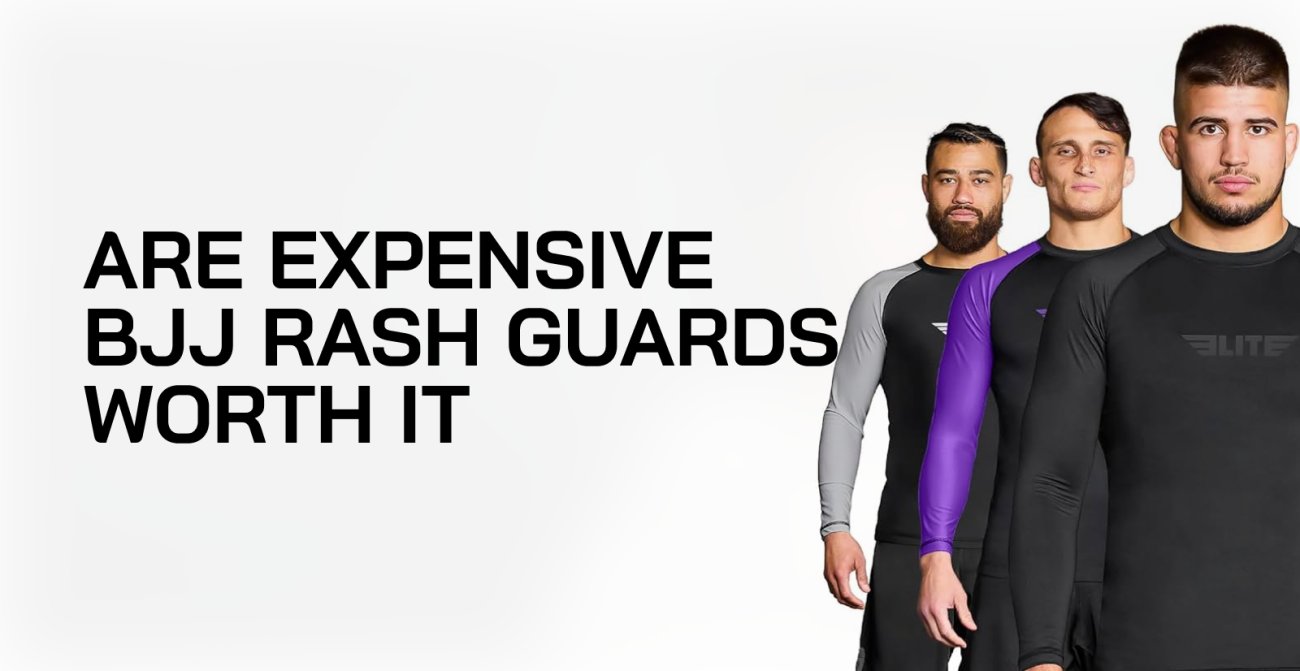
A rash guard is one of the few pieces of BJJ gear you're in direct, sweaty contact with for every single round, so the quality gap between a budget option and a premium one shows up fast — usually within the first few months of regular training.
What Actually Changes With Price
Fabric weight and blend. Higher-quality rash guards use a heavier-grade polyester-spandex blend that holds its compression fit through repeated washing and stretching. Cheaper blends thin out and lose their grip on your torso within a few months of regular use, which matters in BJJ specifically since a loose rash guard is easier for an opponent to grab and control.
Stitching. Premium rash guards use flatlock stitching with reinforced seams at the shoulders and underarms — the areas that take the most stress from gripping, framing, and being pulled on. Budget rash guards often use simpler overlock stitching that's more prone to seam separation under that same repeated stress.
Printing method. Higher-end rash guards use sublimation printing, where the design is dyed directly into the fabric fibers rather than printed on top. Sublimated graphics won't crack, peel, or fade with washing, while surface-printed designs on cheaper rash guards commonly start cracking within a season of regular training and washing.
Odor resistance. Some premium fabrics include an antimicrobial treatment that genuinely cuts down on the bacteria buildup that causes persistent odor — a real practical difference if you're training multiple times a week and re-wearing gear between washes.
When the Extra Cost Is Worth It
If you train 3 or more times a week, the durability difference compounds fast — a budget rash guard that needs replacing every 3-4 months can cost more over a year than one premium rash guard that lasts through a full season of hard training. Frequent training is exactly where the compression-fit and seam-durability gap matters most, since it's under constant grip pressure and repeated washing.
When a Budget Option Makes More Sense
If you're training once or twice a week, still deciding whether BJJ is for you, or need a rash guard for a single kids' class, a budget option is a genuinely reasonable choice — you're putting far less wear on the garment, and there's no reason to pay a premium for durability you won't stress-test.
What to Check Before Buying, Regardless of Price
- Fit — it should be genuinely compression-tight, not loose like a regular athletic shirt; a loose rash guard is easier for a training partner to grab
- Sleeve length — long sleeve protects more skin from mat burn and cuts; short sleeve is cooler and preferred by some no-gi competitors
- Competition legality — if you plan to compete, confirm your rash guard meets your federation's color and coverage rules before buying (see our BJJ gi size chart for gi sizing questions, or check current IBJJF uniform rules directly for no-gi rash guard requirements)
Frequently Asked Questions
Do expensive rash guards actually last longer than cheap ones? Generally yes — heavier fabric blends and reinforced stitching at high-stress seams hold up noticeably longer under the repeated grabbing, stretching, and washing that regular BJJ training puts a rash guard through.
Is sublimation printing actually better than regular printing on a rash guard? Yes, meaningfully — sublimated graphics are dyed into the fabric itself and won't crack or peel, while surface-printed designs on cheaper rash guards commonly start degrading within a season of regular washing.
How often should you replace a BJJ rash guard? It depends heavily on training frequency and rash guard quality — a budget rash guard trained in 3+ times a week may need replacing every few months, while a well-made premium one can hold its compression and print quality for a full season or longer.
Do rash guards need to be a specific color for competition? Under IBJJF no-gi rules, yes — approved colors are black, white, black-and-white, or a design incorporating your belt rank color, with specific coverage requirements. Always check your specific federation's current rulebook before a competition.
The Bottom Line
For anyone training multiple times a week, a higher-quality rash guard genuinely pays for itself in durability and fit retention. For occasional or trial training, a budget option is a perfectly reasonable place to start — you can always upgrade once you know you're sticking with the sport.
Tagged with:#rash guards#gear buying guide#bjj guides
Frequently Asked Questions
Do expensive rash guards actually last longer than cheap ones?
Generally yes — heavier fabric blends and reinforced stitching at high-stress seams hold up noticeably longer under the repeated grabbing, stretching, and washing that regular BJJ training puts a rash guard through.
Is sublimation printing actually better than regular printing on a rash guard?
Yes, meaningfully — sublimated graphics are dyed into the fabric itself and won't crack or peel, while surface-printed designs on cheaper rash guards commonly start degrading within a season of regular washing.
How often should you replace a BJJ rash guard?
It depends heavily on training frequency and rash guard quality — a budget rash guard trained in 3+ times a week may need replacing every few months, while a well-made premium one can hold its compression and print quality for a full season or longer.
Do rash guards need to be a specific color for competition?
Under IBJJF no-gi rules, yes — approved colors are black, white, black-and-white, or a design incorporating your belt rank color, with specific coverage requirements. Always check your specific federation's current rulebook before a competition.
Sources & Further Reading
About the Author
Mohsin AyubBJJ practitioner, 6 years — Gracie Barra
Founder & Editor, BJJ Sportswear
Mohsin has trained Brazilian Jiu-Jitsu for six years at Gracie Barra and has competed at IBJJF-affiliated tournaments. He writes about competition, gear, and athlete careers, and founded BJJ Sportswear to help grapplers find equipment and information they can trust.
- Six years training Brazilian Jiu-Jitsu at Gracie Barra
- Competed at IBJJF-affiliated tournaments
- Writes on BJJ competition, gear testing, and athlete careers
This article was last reviewed and updated on 2026-08-18.