
On This Page
Editorial Standards
Reviewed by the BJJ Sportswear Editorial Team for technical accuracy and kept current.
Who Invented BJJ? The Real History, Explained
BJJ was not invented by one genius in a single moment. It was built by a traveling Japanese judoka, a family who systematized his teachings, and a smaller brother who adapted them for people without size or strength. Here is the real story.
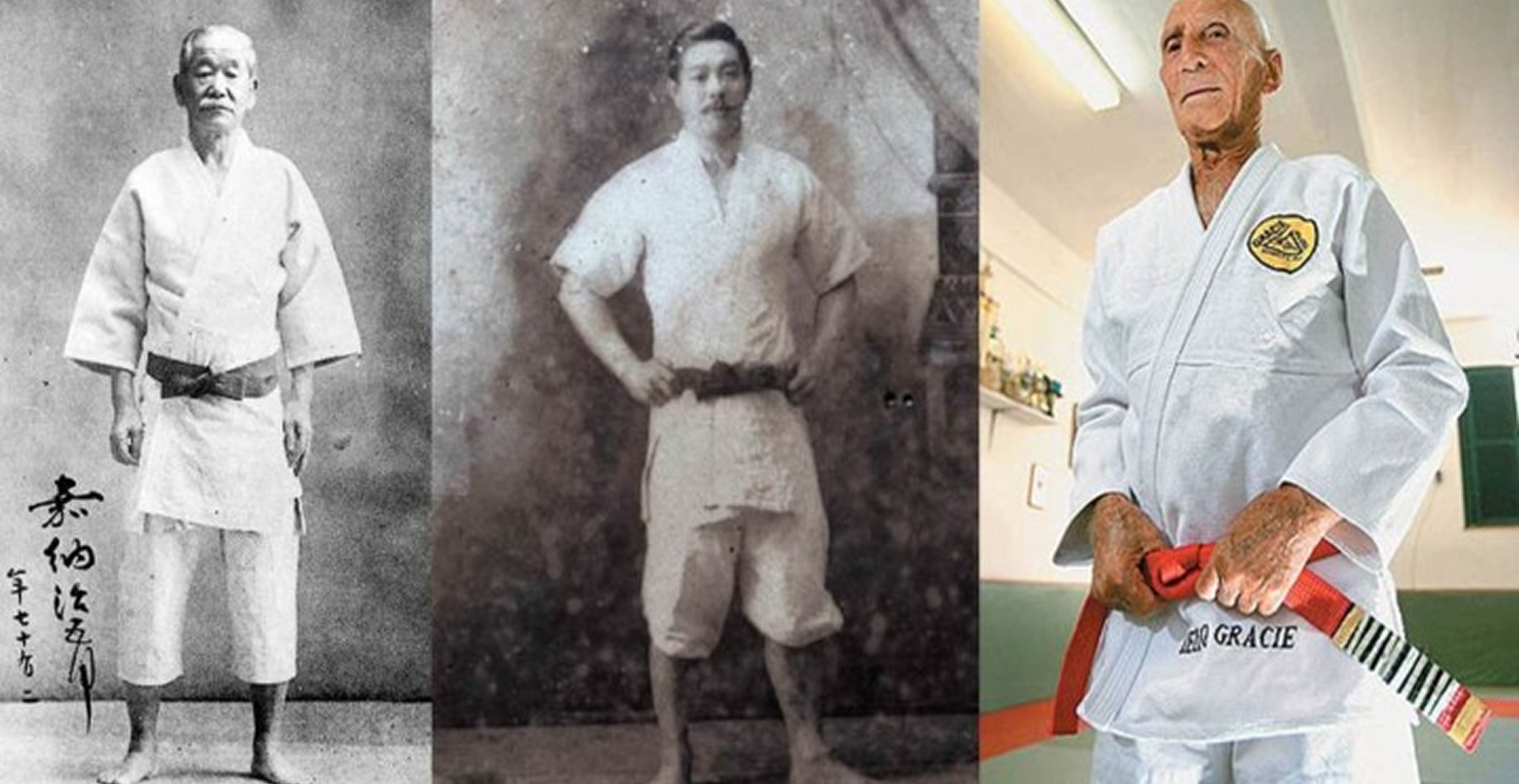
Ask who invented BJJ, and you'll get different answers depending on who you ask. That's because BJJ wasn't invented by one person. It came together through a Japanese judo master who brought his art to Brazil, a family that turned his teachings into a system, and a smaller, weaker student who reshaped it around leverage instead of strength. Here's the real history, contested parts included.
Mitsuyo Maeda: The Man Who Brought Judo to Brazil
Everything starts with Mitsuyo Maeda. Born in Japan in 1878, Maeda trained at the Kodokan under Tomita Tsunejiro, one of Jigoro Kano's first students. Kano founded judo itself. In its early years, judo still looked a lot like a branch of jujutsu — ground fighting mattered just as much as throws. That's the version of the art Maeda learned and carried with him.
In 1904, Maeda left Japan on a mission to spread judo around the world. He fought professional challenge matches in the United States. He got expelled from the Kodokan for taking money to fight. He kept going through Europe, then Central and South America, taking on wrestlers, boxers, and fighters of every style along the way. By the time he settled in Belem, Brazil, in November 1914, he'd reportedly fought over 2,000 matches. Locals called him "Conde Koma" — Count Koma.
Maeda taught judo and jujutsu, not "Brazilian Jiu-Jitsu." That name came later — see our Jujutsu vs. BJJ comparison for how different the two arts actually are today. He also taught more than one student in Brazil, not just the Gracie family — a detail the popular version of this story often leaves out.
Carlos Gracie: The Systematizer
Carlos Gracie studied under Maeda as a teenager, roughly from age 14 to 19. In 1925, at 23, he opened the first Gracie academy in Rio de Janeiro's Botafogo district. He didn't just replicate what Maeda taught. He organized it into a real curriculum. He built a structured belt progression. He started testing the art in Brazil's no-rules vale tudo competitions and street challenges.
Carlos also built the business side of what became BJJ. The "Gracie Challenge" — an open invitation for anyone to fight a Gracie — became a marketing strategy as much as a proving ground. It built the family's reputation across Brazil. He taught his brothers Oswaldo, Gastao, Jorge, and Helio, laying the groundwork for the family network that eventually spread the art worldwide.
Helio Gracie: The Innovator
This is where the real technical transformation happened. Helio Gracie was notably smaller and physically weaker than his brothers and most training partners. He found that a lot of what Carlos taught him didn't actually work for his body. So he adapted it. He stripped out techniques that depended on strength or explosive athleticism. He rebuilt the art around leverage, timing, and position instead.
Helio is widely credited with developing the modern guard position: using the legs to control a larger opponent from the bottom. That's a genuinely novel idea. It didn't exist in the same form in judo or traditional jujutsu. This single contribution is arguably the most important technical shift separating BJJ from its Japanese roots.
Luiz Franca: The Forgotten Pioneer
Maeda didn't just teach the Gracies. Luiz Franca, another of his students, developed his own parallel lineage in Brazil. That lineage produced real champions, including the well-known Oswaldo Fadda. Franca's branch gets far less attention than the Gracie story. But it's a real part of BJJ's early history — proof that the art's development in Brazil was broader than one family's narrative.
What Actually Changed From Judo to BJJ
A few specific shifts define the move from Maeda's judo into what we now call BJJ. A much heavier emphasis on ground fighting over throws. Leverage prioritized over athleticism, so smaller practitioners could compete with larger ones. Submissions as the primary finishing method. Real-world testing through vale tudo and street challenges that pressure-tested techniques constantly. And eventually, a structured belt and competition system that didn't fully exist yet in Japan.
So Who Really Invented BJJ?
The honest answer: nobody, alone. Maeda provided the technical foundation and proved its effectiveness through real fighting. Carlos systematized it into a teachable curriculum and built the business and reputation around it. Helio adapted the technical core around leverage instead of strength — arguably the single biggest innovation that makes BJJ recognizably different from judo. And Luiz Franca kept a parallel lineage alive, showing the art's development wasn't limited to one family.
The Carlos-versus-Helio question specifically remains genuinely debated inside the BJJ community — Carlos's descendants tend to credit him as the true founder, while Helio's lineage credits him as the technical genius who actually made the art what it is. Both sides have a real case, and the honest answer is that the truth sits somewhere between them, not cleanly on either side.
Why This Debate Still Matters
Understanding this history isn't just trivia. It explains a lot about how BJJ actually works today — why leverage and technique are treated as more important than raw strength, why ground fighting is so central compared to judo's throw-heavy roots, and why the art still carries a family-lineage structure (who taught who, which academy you trace back to) that shapes a lot of BJJ culture even now.
Frequently Asked Questions
Did Carlos or Helio Gracie invent BJJ? Neither alone, and it's genuinely disputed. Carlos systematized Maeda's teachings into the first academy and curriculum. Helio adapted the technical core around leverage rather than strength, a shift many consider the defining innovation of BJJ specifically. Most serious historians credit both, alongside Maeda and Luiz Franca.
Was BJJ invented in Japan or Brazil? Its technical roots are Japanese, through Mitsuyo Maeda's judo and jujutsu training at the Kodokan. Its transformation into BJJ specifically — the leverage-first, ground-fighting-heavy art we know today — happened in Brazil, mainly through Carlos and Helio Gracie's adaptations.
Who is Luiz Franca and why does he matter? Franca was another student of Mitsuyo Maeda who built his own BJJ lineage outside the Gracie family, producing real champions like Oswaldo Fadda. His story is a reminder that BJJ's early development in Brazil wasn't limited to one family, even though the Gracie name dominates the popular history.
The Bottom Line
BJJ doesn't have one inventor, and that's actually the more interesting story. It's the product of a traveling Japanese fighter proving his art across the world, a family that turned it into an institution, and one physically overmatched student who rebuilt the technical core around leverage instead of strength — plus at least one parallel lineage the popular story tends to leave out.
Tagged with:#history#Gracie family#origins
Frequently Asked Questions
Who invented BJJ?
No single person invented BJJ. Mitsuyo Maeda brought judo and jujutsu to Brazil and provided the technical foundation. Carlos Gracie systematized it into the first academy and curriculum. Helio Gracie adapted the core techniques around leverage instead of strength. Luiz Franca built a parallel lineage outside the Gracie family.
Did the Gracie family invent Brazilian Jiu-Jitsu?
The Gracie family played a central role, especially Carlos (systematizing the art) and Helio (adapting it around leverage), but they built on Mitsuyo Maeda's judo and jujutsu teachings, and other students like Luiz Franca developed parallel lineages at the same time.
When was BJJ invented?
There's no single invention date. Mitsuyo Maeda arrived in Brazil in 1914. Carlos Gracie opened the first academy in 1925. The technical shifts that define modern BJJ — leverage over strength, heavy ground-fighting focus — developed gradually through the 1920s-1950s, mainly under Helio Gracie.
Who invented jiu jitsu, not just Brazilian Jiu-Jitsu?
Traditional Japanese jiu-jitsu (jujutsu) predates BJJ by centuries, developing as a battlefield combat system for samurai. Its documented roots trace back to at least the 1500s, well before Mitsuyo Maeda brought a judo/jujutsu hybrid to Brazil in 1914 that eventually became BJJ.
Was Carlos or Helio Gracie the true inventor of BJJ?
It's genuinely disputed within the BJJ community. Carlos's descendants credit him as the founder for systematizing Maeda's teachings into the first academy. Helio's lineage credits him as the technical innovator who adapted the art around leverage instead of strength — the shift many consider BJJ's defining feature. Most serious historians credit both.
About the Author
Mohsin AyubBJJ practitioner, 6 years — Gracie Barra
Founder & Editor, BJJ Sportswear
Mohsin has trained Brazilian Jiu-Jitsu for six years at Gracie Barra and has competed at IBJJF-affiliated tournaments. He writes about competition, gear, and athlete careers, and founded BJJ Sportswear to help grapplers find equipment and information they can trust.
- Six years training Brazilian Jiu-Jitsu at Gracie Barra
- Competed at IBJJF-affiliated tournaments
- Writes on BJJ competition, gear testing, and athlete careers
This article was last reviewed and updated on 2026-08-18.