

Will BJJ Help With Wrestling? Complete Crossover Analysis (2026)
By BJJ Sportswear Editorial Team
Reviewed by wrestlers, BJJ practitioners, and crossover athletes | Last Updated: January 15, 2026
BJJ will significantly improve your wrestling through enhanced scrambling ability (spending time inverted and in chaotic positions develops instinctual reactions that translate to superior escape wrestling and get-out-from-bottom situations), improved body awareness and hip mobility (BJJ’s emphasis on hip movement and unconventional positions strengthens anterior chain and flexibility that wrestling alone doesn’t develop), superior submission defense understanding (recognizing choke and joint lock setups prevents dangerous positions in wrestling matches), and extended conditioning capacity (BJJ rolling rounds lasting 6-10 minutes build endurance beyond wrestling’s 6-minute match format), though BJJ won’t directly improve your takedown entries or top pressure since these are wrestling-specific skills requiring dedicated wrestling practice.
Fanatic Wrestling on crossover benefits: “If you are a wrestler reading this before you begin jiu jitsu, I promise you: after a good bit of time in bjj, your scrambling in wrestling will improve EXPONENTIALLY—your far ankle defense isn’t gonna skyrocket, but any crackdown position, sit out, get out from bottom, front headlocks, they’ll all improve, and one thing that helps is you spend more time UPSIDE DOWN”. Elite Sports on wrestling-BJJ synergy: “Brazilian Jiu-Jitsu improves your wrestling game as most BJJ techniques can easily be applied in Wrestling—BJJ potentially helps in honing the grappling game in Wrestling since both grappling arts enhance the awareness of your own body and teach how to remain calm in a stressful situation”.
The reverse relationship is equally valuable as wrestling dramatically improves BJJ performance through superior takedown proficiency eliminating the common BJJ weakness of pulling guard from lack of standup confidence, dominant top pressure and control that makes holding mount position and side control significantly more effective, explosive scrambling during transitions preventing opponents from establishing advantageous positions, and mental toughness developed through wrestling’s intensity that carries over to competitive BJJ rolling and tournaments.
Understanding the BJJ vs Wrestling fundamental differences while recognizing crossover benefits allows wrestlers to enhance their mat game during off-season training and BJJ practitioners to shore up standup weaknesses, creating well-rounded grapplers who dominate both in wrestling rooms and BJJ classes from white belt through competitive levels.
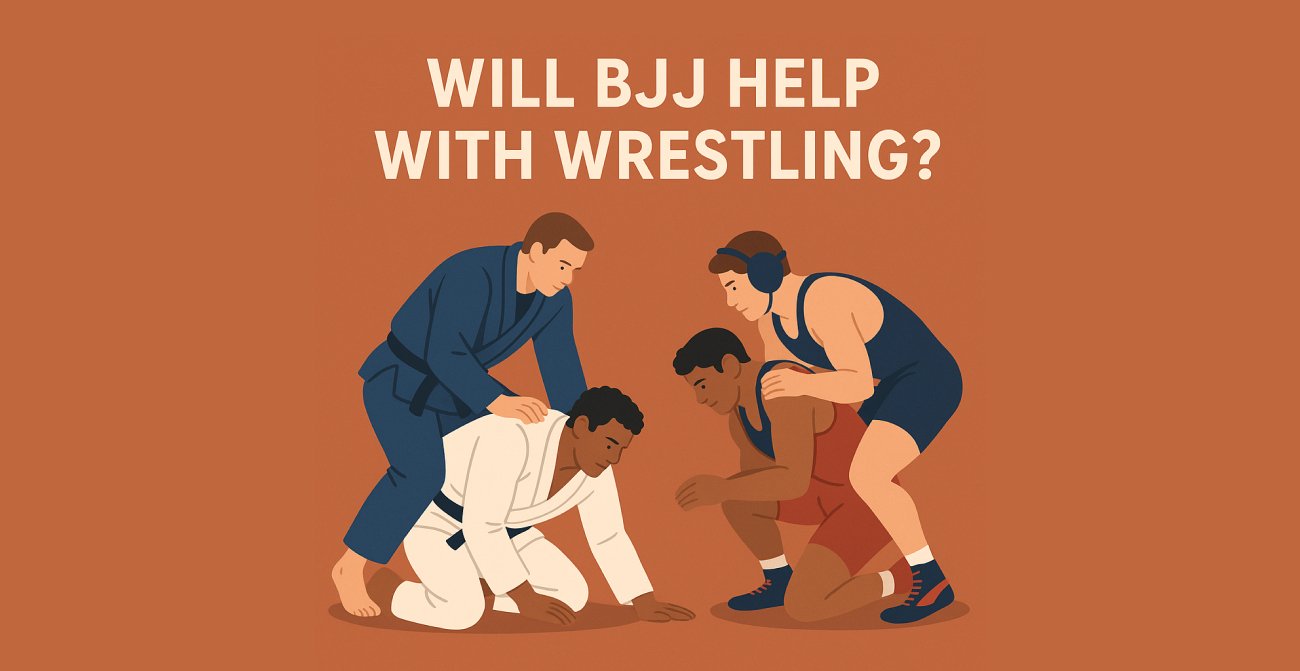
Table of Contents
How BJJ Improves Your Wrestling
1. Exponentially Better Scrambling
Fanatic Wrestling on scrambling improvement: “After a good bit of time in bjj, your scrambling in wrestling will improve EXPONENTIALLY—any crackdown position, sit out, get out from bottom, front headlocks, they’ll all improve, and one thing that helps is you spend more time UPSIDE DOWN”.
Why BJJ improves scrambling:
- Inverted positions common (triangles, turtle attacks, berimbolo)
- Comfort being upside down (no panic when flipped)
- Chaotic transitions normalized (BJJ rolling = constant scrambles)
- Instinctual reactions develop (muscle memory in chaos)
Wrestling applications:
- Crackdown escapes: BJJ shrimping translates directly
- Sit-out defense: Hip awareness from guard work
- Front headlock counters: Submission defense knowledge
- Ankle defense: Understanding leg entanglement escapes
- Bottom wrestling: Comfort in bad positions = better escapes
Real-world example:
- Wrestler trains BJJ 6 months (off-season)
- Returns to wrestling season
- Teammates notice: “You’re impossible to pin now”
- Escape rate dramatically improved
Reference: Understanding shrimp escape technique fundamentals
2. Enhanced Hip Mobility and Flexibility
Fanatic Wrestling on physical benefits: “BJJ has an even greater emphasis on the hips than wrestling, your anterior chain will become immensely stronger as you train”.
BJJ’s hip emphasis:
- Hip escapes (shrimping) = primary movement
- Closed guard requires hip flexibility
- Inversions and rolls develop unconventional mobility
- Anterior chain strength (hip flexors, abs, obliques)
Wrestling benefits:
- Smoother level changes (shooting takedowns)
- Better hip switches (reversals)
- Improved sprawl flexibility
- Enhanced mat returns (bringing opponent down)
- More dynamic movement overall
Physical development comparison:
| Attribute | Wrestling Alone | Wrestling + BJJ |
|---|---|---|
| Hip mobility | Good (functional) | Excellent (dynamic) |
| Flexibility | Moderate | Superior |
| Core strength | Strong (isometric) | Very strong (dynamic) |
| Body awareness | High | Exceptional |
3. Superior Conditioning and Endurance
Fanatic Wrestling on conditioning: “BJJ often involves much longer rounds of sparring—it isn’t uncommon for rolls to be six to ten minutes long”.
BJJ conditioning advantages:
- Longer rolling rounds: 6-10 minutes typical (vs 6-minute wrestling matches)
- Constant engagement (no whistles/stops)
- Multiple rounds back-to-back (5-7 rounds common)
- Builds superior gas tank
Wrestling match application:
- 6-minute match feels shorter (trained for 10)
- Third period dominance (opponents exhausted, you’re not)
- Overtime advantage (conditioned for extended effort)
- Outlast opponents
Mental endurance:
- BJJ teaches staying calm when tired
- Wrestling panic under fatigue = mistakes
- Composure in exhaustion = tactical advantage
Reference: Understanding will BJJ build muscle and conditioning
4. Improved Defense From Bottom
Lake Effect BJJ on defensive improvements: “A teammate of mine has been training bjj like a maniac in his off seasons—while his takedowns haven’t been anything to write home about, he is probably the best escape artist on our team, he’s more dangerous on bottom than any other wrestler I’ve seen, all thanks to bjj”.
BJJ bottom game skills:
- Guard positions (closed, open, half)
- Hip escapes and frames (preventing pins)
- Submission threats from bottom (offense as defense)
- Comfort on back (no panic)
Wrestling translation:
- Preventing pins (frames and hip movement)
- Escaping breakdowns (technical standup from BJJ)
- Counter-wrestling from bottom (reversals)
- Most dangerous wrestler on bottom
Mindset shift:
- Wrestling teaches: Bottom = bad, escape immediately
- BJJ teaches: Bottom can be offensive position
- Combined: Calm escapes + offensive threats
5. Better Grip Fighting and Hand Control
Fanatic Wrestling on grip strength: “The grip strength required to effectively use the gi has left my hands and forearms aching for days when I was starting”.
BJJ gi training benefits:
- Crushing grip strength (holding gi fabric)
- Forearm endurance (sustained gripping)
- Breaking grips (understanding leverage)
- Hand fighting sophistication
Wrestling applications:
- Superior collar ties (stronger hands)
- Breaking opponent grips (technical understanding)
- Sustained grip endurance (late match)
- Control in hand fighting exchanges
No-gi BJJ benefits:
- Wrist control techniques
- Underhook battles (similar to wrestling)
- Body lock defenses
- Direct wrestling crossover
What BJJ WON’T Improve in Wrestling
Takedown Entries and Setups
High Altitude MMA reality check: “BJJ won’t directly teach you wrestling takedowns—you need wrestling practice for single legs, double legs, and level changes”.
What BJJ lacks:
- Penetration steps (shooting technique)
- Level change explosiveness (wrestling-specific)
- Setup sequences (snap-downs, head taps)
- Wrestling room needed for these
Why BJJ doesn’t develop this:
- Most BJJ starts from knees or guard pull
- Standing emphasis minimal (2-3 minutes max)
- Takedowns not primary focus
- Different sport priorities
Solution for wrestlers:
- Use BJJ for ground game improvement
- Maintain wrestling practice for takedowns
- Cross-train both, don’t replace
Top Pressure and Control
Wrestling pressure superiority:
- Wrestling teaches relentless forward pressure
- Pin-focused mentality (crushing weight)
- Ride time accumulation (sustained top control)
- BJJ doesn’t emphasize same pressure
BJJ top game differences:
- Position maintenance (control without excessive pressure)
- Submission setup (technical over forceful)
- Space creation for attacks (not always smothering)
- Different objectives
Result:
- BJJ improves ground transitions
- Wrestling maintains pressure dominance
- Complementary, not overlapping
How Wrestling Improves Your BJJ
1. Dominant Takedown Game
RollBliss on BJJ standup weakness: “One of the biggest advantages of wrestling is takedown proficiency—many BJJ practitioners feel uncomfortable standing, especially against aggressive opponents, and wrestling training changes that quickly”.
Common BJJ problem:
- Guard pulling culture (avoiding standup)
- Weak takedown entries (no wrestling background)
- Defensive standup only (don’t initiate)
- Losing 2 points immediately (opponent scores takedown)
Wrestling solution:
- Single leg, double leg mastery
- Blast double explosiveness
- Body lock throws
- Dictate where fight happens (your terms)
Competition advantage:
- Score takedown (2 points immediately)
- Choose top position (avoid guard passing struggle)
- Psychological edge (opponent knows you’ll engage standing)
- Reference: Competition preparation via IBJJF guide
2. Superior Top Control and Pressure
RollBliss on pressure benefits: “Wrestling teaches how to stay heavy, balanced, and in control—cross-training wrestling improves your ability to apply pressure without overcommitting, making it harder for opponents to escape or recover guard”.
Wrestling pressure skills:
- Heavy hips (weight distribution)
- Shoulder pressure (pinning)
- Crossface control (head isolation)
- Making escapes exhausting
BJJ applications:
- Side control maintenance (wrestling pressure)
- Mount dominance (heavy hips)
- Back control (ride time translation)
- Positional dominance scoring
Competition impact:
- Opponents can’t escape positions (accumulate points)
- Submission setups easier (opponent exhausted)
- Win via control (IBJJF points system rewards)
Reference: Understanding weight classes and weight advantages
3. Explosive Scrambling and Transitions
RollBliss on scrambling: “Scrambles are moments where matches are often decided—wrestling thrives in these chaotic transitions, and cross-training sharpens your ability to move quickly, maintain balance, and recover position when things break down”.
Wrestling scramble training:
- Fast exchanges normalized
- Balance under chaos
- Explosive position recovery
- Instinct over thinking
BJJ applications:
- Sweep defense (scramble to recover)
- Guard retention under pressure
- Transitional attacks (capitalize on chaos)
- Win scrambles = win matches
Examples:
- Opponent attempts sweep → Wrestle back to top
- Lose position briefly → Explosive recovery
- Never fully out of position
4. Mental Toughness and Pace
RollBliss on mental benefits: “Wrestling is demanding—it pushes your conditioning, explosiveness, and mental endurance, and mental toughness is another benefit as wrestling training challenges comfort zones and reinforces discipline”.
Wrestling intensity:
- High-pace drilling (cardio demand)
- Live wrestling rounds (no mercy)
- Competitive culture (pushing limits)
- Forges mental resilience
BJJ translation:
- Tournament nerves reduced (experienced intensity)
- Pace control (dictate match speed)
- Relentless pressure (opponent breaks first)
- Outlast mentally and physically
Reference: Understanding staying consistent through challenges
5. Base and Balance Development
Lake Effect BJJ on base improvement: “Wrestling will help you improve your base—if you just train one 5 minute round of just takedowns every time that you train bjj, your base will get so much better, and wrestling will help you identify the inches necessary to have a good strong base”.
Wrestling base fundamentals:
- Low center of gravity (harder to sweep)
- Wide base (stable platform)
- Posture awareness (head up, back straight)
- Subtle positioning matters
BJJ applications:
- Sweep defense (impossible to off-balance)
- Guard passing stability
- Positional transitions (smooth, balanced)
- Defensive foundation
Optimal Cross-Training Strategies
For Wrestlers Adding BJJ
Off-season focus (summer):
- Train BJJ 3-4x weekly (build ground game)
- Focus on submissions and guard work
- Learn escapes and defensive positions
- Develop weakness areas
In-season maintenance:
- BJJ 1-2x weekly (maintain skills)
- Wrestling practice priority (season focus)
- Open mat sessions (flexible scheduling)
- Don’t overtrain
Recommended progression:
- Start with fundamentals class
- Learn basic positions first
- Progress to competition class after 3-6 months
- Reference: First BJJ class preparation
For BJJ Practitioners Adding Wrestling
Wrestling integration:
- Join wrestling class 1-2x weekly
- Focus on takedowns and top pressure
- Drilling emphasis (learn technique)
- Complement BJJ, don’t replace
Focus areas:
- Single leg and double leg entries
- Sprawl defense
- Top pressure from turtle/referee position
- Standup confidence building
Competition preparation:
- Wrestling for takedowns (opening of match)
- BJJ for ground game (finish from top)
- Complete grappling skillset
Reference: Understanding BJJ vs Wrestling differences
Common Crossover Challenges
Rule Set Confusion
Wrestling rules:
- Back exposure = near fall points (avoid at all costs)
- Locking hands illegal (specific situations)
- Out of bounds stops action
- 6-minute match time limit
BJJ rules:
- Back control = advantageous position (seek it)
- Locking hands encouraged (submissions)
- Out of bounds = fight continues
- Longer match times (5-10 minutes)
Mental switching:
- Know which ruleset applies
- Don’t give back in wrestling (catastrophic)
- Actively seek back in BJJ (4 points + submissions)
- Practice rule-specific responses
Training Intensity Differences
Wrestling culture:
- 100% intensity always (competitive)
- Hard sparring every session
- “No days off” mentality
- Burnout risk if not managed
BJJ culture:
- Varied intensity (flow rolling vs hard rolling)
- Technical focus over pure competition
- Sustainable long-term training
- Reference: Staying consistent strategies
Balance approach:
- Hard days in wrestling (maintain intensity)
- Technical days in BJJ (learn, don’t compete)
- Avoid overtraining (cross-training adds volume)
The Bottom Line: BJJ and Wrestling Synergy
How BJJ helps wrestling:
- ✅ Scrambling: Exponentially better (inverted comfort)
- ✅ Hip mobility: Superior flexibility and strength
- ✅ Conditioning: Extended endurance capacity
- ✅ Bottom defense: Escape artist development
- ✅ Grip strength: Crushing hand/forearm power
- ❌ Takedowns: Won’t replace wrestling practice
- ❌ Top pressure: Different emphasis
How wrestling helps BJJ:
- ✅ Takedowns: Eliminate standup weakness
- ✅ Top pressure: Dominant control positions
- ✅ Scrambling: Explosive transitions
- ✅ Mental toughness: Competition resilience
- ✅ Base: Impossible to sweep/off-balance
Cross-training recommendations:
Wrestlers (off-season):
- Train BJJ 3-4x weekly
- Focus: Guard, submissions, escapes
- Return to wrestling with superior ground game
- Become complete grappler
BJJ practitioners:
- Add wrestling 1-2x weekly
- Focus: Takedowns, top pressure, base
- Eliminate standup weakness
- Dominate from standing to submission
The best grapplers train both:
- Wrestling for standup and pressure
- BJJ for submissions and ground transitions
- Complementary skills = complete fighter
Whether you’re a wrestler exploring BJJ during off-season or a BJJ practitioner shoring up takedowns, cross-training creates well-rounded athletes who dominate in both sports and excel in MMA applications.
Train both. Become complete. Dominate. 💪
Related resources:
- BJJ vs Wrestling – Detailed comparison
- First BJJ Class – Starting BJJ as wrestler
- How to Pass Guard – Wrestling pressure application
- BJJ Classes – Class structure
- Fundamental Positions – Ground game basics
- IBJJF Guide – BJJ competition rules
Cross-train smart. Dominate both. OSS! 🥋🤼
How We Reviewed This Article
Editorial Standards: Crossover athlete interviews, wrestling coach consultations, BJJ instructor perspectives, competition analysis, and sports science research on grappling transfer.
Sources Referenced:
- Fanatic Wrestling (comprehensive crossover benefits analysis)
- Elite Sports (wrestling-BJJ synergy breakdown)
- BJJ Fanatics (wrestler BJJ integration guide)
- RollBliss (wrestling for BJJ success detailed guide)
- Lake Effect BJJ (wrestling importance in BJJ)
- High Altitude MMA (realistic crossover expectations)
- Reddit r/bjj and r/MMA (community experiences)
Last Updated: January 15, 2026