Half Guard BJJ: Sweeps, Variations & Passing Guide
The half guard is the great equalizer in BJJ.
For the first four decades of the sport, nobody wanted to be there. If your closed guard got broken and your opponent got half way through, you were losing. You were halfway to side control. You had one option: try to get back to full guard before they flattened you. Then Roberto “Gordo” Correa got a knee injury and changed everything.
Today, Bernardo Faria has won five world championships from it. Lucas Leite has built an entire competitive career around it. Tom DeBlass has not had his guard passed in over a decade using it. John Danaher calls it “the older you get, the more you need it” — because it works without speed or explosiveness.
This guide covers the complete half guard system — from the basics Gordo discovered to the modern variations, the dogfight position, passing concepts, and how to build it at every belt level.
Position fact: The half guard is one of the most versatile positions in BJJ — it can be entered from closed guard, open guard, after failed passes, from scrambles, and even from standing. It appears in virtually every BJJ match at every belt level.

Table of Contents
What is the half guard?
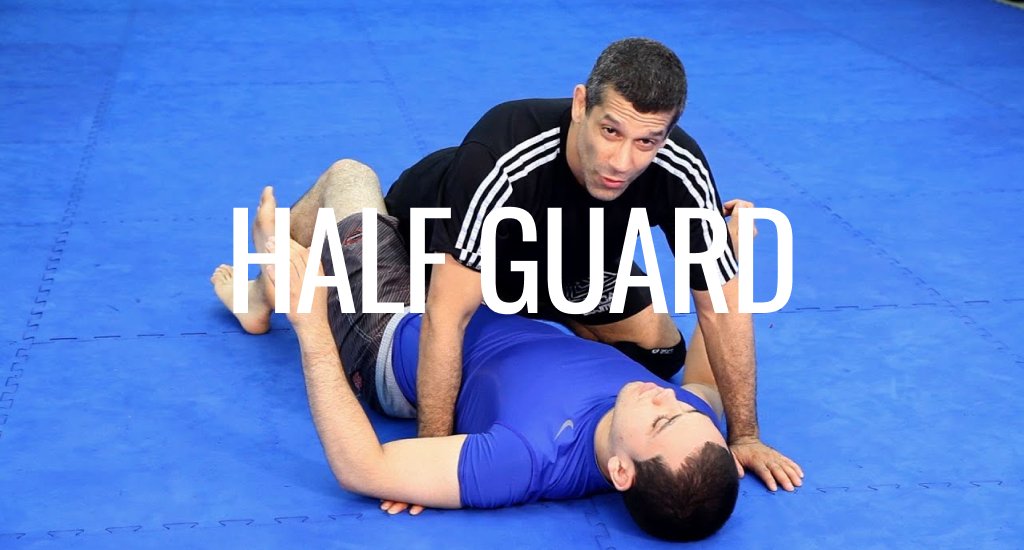
The half guard is a position where the bottom player traps one of the top player’s legs between their own two legs. Unlike the closed guard — which controls both of the opponent’s hips — the half guard controls a single leg.
This creates an asymmetric position. One leg is trapped and controlled. The other leg is free. The top player has partial mobility — they can move one leg and one hip freely, but the trapped leg anchors them in place.
For the bottom player, this asymmetry is an opportunity. The trapped leg is a lever. Control it, angle your body correctly, and you can sweep, take the back, or submit — all without the full hip control that closed guard provides.
The half guard is unique because it serves as both a guard and a passing position at the same time. The bottom player is trying to sweep or take the back. The top player is trying to extract their leg and pass. Neither player is in a fully dominant position — which is exactly why the position is so rich with attacking opportunities for both sides.

How Gordo changed everything
According to BJJ Heroes, Roberto “Gordo” Correa suffered a serious knee injury in the early 1990s that prevented him from playing his normal closed guard game. Rather than stop training, he began exploring what he could do from the half guard position — something most practitioners at the time treated as a last resort to be escaped as quickly as possible.
What Gordo discovered changed the sport. By staying on his side, winning the underhook on the inside, and using his legs to control the trapped leg while reaching for the far knee, he could sweep opponents of any size. He went on to win multiple world championships using this system — and in doing so, proved to the entire BJJ world that the half guard was not a defensive emergency. It was an offensive system.
Gordo’s innovation triggered a generation of half guard specialists. Each one refined and expanded the system:
- Eddie Bravo developed the Lockdown and the 10th Planet no-gi half guard system
- Jeff Glover popularised the deep half guard
- Bernardo Faria built a complete competition game around the over-under pass counter from half guard
- Lucas Leite developed the coyote half guard for gi competition
- Tom DeBlass refined the butterfly half guard system

The underhook battle — the most important concept
Before you learn a single sweep or variation, understand this: everything in half guard starts and ends with the underhook battle.
The underhook is when your arm goes under your opponent’s arm and into their armpit. In the half guard, the underhook belongs to whoever’s arm is inside — closest to the opponent’s body.
If the bottom player has the underhook: They can get to their side, create angles, attack sweeps, take the back, and control the position. The underhook prevents the crossface — the top player cannot flatten them out. Every offensive opportunity from the bottom requires the underhook first.
If the top player has the underhook and the crossface: They can flatten the bottom player, pin their shoulder to the mat, eliminate the frame, and pass. The bottom player’s attacks become very limited.
This is why every half guard drill starts the same way: get to your side and fight for the underhook. Before the sweep. Before the back take. Before any submission. Win the underhook.
Core principle: Half guard is an underhook battle with a trapped leg. Win the underhook and you control the position. Lose it and you get flattened. Everything else flows from this.
The first rule: stay on your side
The second most important concept after the underhook is body position. You must stay on your side.
When a top player gets someone in half guard, their first goal is to flatten them — to push their shoulder to the mat and pin them on their back. A flat bottom player has almost no offensive options. Their frames are destroyed, their leverage disappears, and passing becomes straightforward.
Staying on your side creates four essential advantages:
- Your elbow can post on the mat — creating a frame against their cross-face attempt
- Your shoulder angle makes it very difficult for them to apply effective pressure
- Your hips are mobile — you can create angles, shrimp, and change directions
- Your underhook arm has the physical space to thread into their armpit
The moment you get flattened, reset your focus to one thing: get back to your side. Shrimp, bridge, frame — whatever it takes. Everything else comes after you are back on your side.
Old School sweep — step by step
The Old School sweep — Gordo’s original invention — is the foundation of the entire half guard system. Learn this before any other variation.
- Get to your side. The moment you are in half guard, roll onto your side. Post your elbow on the mat. Face your opponent. Never stay flat.
- Win the underhook. Drive your top arm under their armpit and grab their back, their belt (in gi), or their shoulder (in no-gi). This is your primary control grip.
- Control their far leg. With your bottom arm, reach through the gap between your bodies and grab the back of their far knee or ankle. This stops them from stepping over your body — which would end the sweep attempt immediately.
- Block their trapped leg. Your legs hold their leg in place. Do not let them pull it free during the sweep. Your leg grip is what keeps the lever in place.
- Bridge and drive. Drive your shoulder into their chest. Bridge your hips upward and toward them. The combination of the underhook lifting their weight and the far leg control preventing a base creates the off-balance. They tip over you and you end up on top — typically in side control or mount.
Old School sweep key detail: The far leg grab is what most beginners forget. Without it, your opponent simply steps over your body and the sweep fails completely. Reach through and find that far knee before you attempt the bridge.
Z-guard (knee shield half guard)
The Z-guard is a half guard variation where you place your top knee between your body and your opponent — creating a frame that prevents them from flattening you and getting the crossface.
The knee can frame into three different positions:
- Into the chest: Maximum distance creation. Good for re-establishing grips.
- Into the shoulder: Stops the crossface directly. Most common in competition.
- Into the bicep: Controls their arm and creates the entry for triangles, armbars, and kimuras.
The Z-guard is considered one of the safest half guard positions for beginners because the knee frame makes it very hard for the top player to flatten you. As long as the frame is in place, you have time to re-establish grips, create angles, and attack.
From the Z-guard, the primary attacks are:
- Transitions to the underhook position — when they try to pass the frame
- Triangle choke — when their arm is inside the knee frame targeting the bicep position
- Armbar — from the same bicep frame entry
- Omoplata — when their near arm extends across the body
Deep half guard
The deep half guard is an advanced variation where the bottom player goes under the opponent’s hips entirely — placing their head between the opponent’s thighs and looking up at their back.
Jeff Glover popularised this system. Bernardo Faria later built one of the most successful competition systems around it, using the deep half as his primary entry for the over-under pass counter that won him five world championships.
Entering deep half guard
- From standard half guard, lower your level and drive under your opponent’s trapped leg
- Slide your head under their hips — your head ends up between their thighs
- Control their far leg with your near arm, wrapping around the outside of their thigh
- Use your other arm to control their near leg from the inside
The waiter sweep from deep half
The primary sweep from deep half is the waiter sweep. Control their far leg with your arm like a waiter carrying a tray — your arm under their leg, lifting it. As you lift the far leg, bridge your hips and drive. Their base collapses to the swept side and you come on top.
Why deep half guard works
The deep half guard is extremely hard to pass because your body position is under your opponent’s center of gravity. They cannot easily get around you when you are beneath them. For shorter or more flexible practitioners, this becomes one of the most reliable guard positions available.
The lockdown (Eddie Bravo’s 10th Planet system)
The lockdown is Eddie Bravo’s foundational half guard control position. Instead of a standard leg trap, you weave your bottom leg behind your opponent’s trapped leg and lace your top foot in front of their ankle — creating a figure-four leg lock position that immobilises their entire lower body.
The lockdown is designed for no-gi specifically — the leg control it provides compensates for the lack of gi grips. From the lockdown, Bravo’s 10th Planet system opens attacks to:
- The electric chair — a leg lock-style stretch using the lockdown
- The dog fight — transitioning to the dogfight position
- Old school sweep variations — using the locked ankle as an additional lever
The lockdown has been controversial in traditional BJJ academies — some coaches see it as a stalling tactic. In no-gi grappling however, the control it provides makes it a legitimate and effective system when trained systematically.
Half butterfly guard
The half butterfly guard combines standard half guard with a butterfly guard hook. In the standard half guard, both legs wrap around one of the opponent’s legs. In the half butterfly, one leg wraps around their leg as normal, while the other hooks inside their thigh with a butterfly hook.
This creates an additional sweeping tool. The butterfly hook can lift the opponent’s free leg off the mat, removing their base in a completely different direction from the Old School sweep. Tom DeBlass built one of the most effective half guard systems around this variation, generating sweeps in both directions and back takes from the same position.
The half butterfly is particularly effective against opponents who have strong base and resist the Old School sweep. Adding the butterfly hook gives you a second lever — they cannot base out against both directions simultaneously.
The dogfight position
The dogfight is the transitional position that connects half guard to the back take — and it is one of the most important positions in the entire half guard system.
You reach the dogfight when you have the underhook from half guard and you sit up to your near knee — creating a position where both players are up on their knees, facing the same direction, with one player having the underhook on the other.
From the dogfight, three main options exist:
- Back take: Drive behind your opponent using the underhook as a lever. This is the primary goal — getting to back control and attacking the rear naked choke.
- Cement mixer (John Cena roll): Roll forward under your opponent, converting the underhook into a top position — you end up in side control or mount.
- Sweep to top position: Use the underhook leverage to tip your opponent forward and take the top position.
The dogfight is the moment when half guard becomes back-attack guard. Most elite half guard players view every sweep attempt as a route to the dogfight — and the dogfight as the primary route to the back.
Back take from half guard
The back take from half guard is one of the highest-percentage back takes in all of BJJ. The route is: half guard → underhook → dogfight → back control → rear naked choke.
- Establish the underhook from half guard
- Come up to your near knee — creating the dogfight
- Use the underhook to drive behind your opponent — your chest goes to their back
- Insert your first hook as you arrive behind them
- Bring your second hook in and establish the seatbelt grip
- Attack the rear naked choke
The beauty of this route is that it flows naturally from sweep defense. When your opponent defends the Old School sweep by posting their arm or driving forward, that defensive movement creates the dogfight entry. Sweep threat creates back take opportunity — just as in the closed guard game.
Submissions from half guard
The half guard is primarily a sweeping and back-taking position — but it also offers direct submission opportunities.
Kimura from half guard
When the top player reaches for the crossface or posts their arm, the near arm is available for a kimura. Lock the figure-four grip and use the half guard position itself as leverage — you can finish the kimura from your back, sweep to top position using it, or follow the escape to take the back.
Guillotine from half guard
When the top player drives forward with their head low to apply crossface pressure, their neck comes forward. Attack the guillotine choke immediately. Fall back to full guard or closed guard to finish. The guillotine from half guard works especially well against wrestlers who shoot their head into you.
Triangle choke from Z-guard
When the top player’s arm enters the Z-guard knee frame, the triangle choke becomes available. Thread your leg over their shoulder and lock the triangle as their arm gets trapped inside the frame.
Straight ankle lock from deep half
From the deep half guard position, their far leg is controlled and exposed. When they try to extract it, catch the straight ankle lock on the near ankle as they shift their weight. The ankle lock and the deep half sweep share the same defensive reaction from the top player — they cannot stop both simultaneously.
Passing the half guard — top player concepts
If you are on top in half guard, the goal is clear: extract your leg and pass to side control. The path requires two things before anything else — win the underhook and establish the crossface.
Knee slice pass
The most common half guard pass in modern BJJ. After establishing the underhook and crossface, slide your free knee across the opponent’s top thigh — slicing toward the mat. Once the knee touches the mat on the other side of their leg, pull your trapped foot free and stabilise in side control. See our knee slice pass guide for full details.
Smash pass (pressure pass)
Drop your chest weight onto the opponent’s upper body. Walk your hips to the side while maintaining chest pressure — flattening their frames and eliminating their mobility. Once they are flat, extract the trapped leg by stepping over it and complete the pass to side control.
Torreando counter
When the bottom player creates distance and sits up, grab both of their knees with your hands and push them to one side while you move in the opposite direction — the same torreando pass mechanics from open guard apply here.
What to avoid on top
- Do not let the bottom player get to their side — flatten them first
- Do not let them win the underhook — fight for it immediately
- Do not stand up with your trapped leg still trapped — this creates the back take entry
- Do not rush the extraction without the crossface — they will create the dogfight
Gi vs no-gi differences
In the gi: Collar and lapel grips dramatically change the half guard game. The bottom player can use collar grips to break posture and set up submissions. Lapel grips can be used to control the opponent’s movement or create novel sweeping mechanics. The gi slows transitions — giving more time to establish underhooks and control positions.
In no-gi: Everything depends on body mechanics and underhook position. Wrist control and overhooks replace collar grips. The lockdown and deep half guard are even more valuable in no-gi because leg control compensates for the absence of fabric grips. Transitions are faster — the dogfight and back take opportunities appear and disappear more quickly.
Key no-gi adjustment: Without gi grips, the underhook must be secured even faster. In the gi, a collar grip can buy time while you fight for the underhook. In no-gi, the underhook is your only reliable control — establish it immediately or you will be flattened.
Combo chains
The half guard is most effective as a connected system — where each attack creates the next one.
- Old School sweep → top position: If they defend by posting → dogfight → back take
- Underhook → dogfight → back take → rear naked choke
- Kimura threat → sweep: When they grab the mat to defend the kimura, sweep to top position using the grip as a lever
- Guillotine → closed guard finish: Lock the guillotine and fall back to close your guard for the finish
- Z-guard triangle → armbar: They defend the triangle by posturing → switch to armbar on the trapped arm
- Deep half sweep → waiter sweep → top position → kimura from top
Common mistakes
- Getting flattened without fighting back. The moment your shoulder goes to the mat, you are losing. Bridge, shrimp, and frame to get back to your side immediately.
- Trying to sweep before winning the underhook. Without the underhook, there is no leverage for the sweep. Fight for the underhook first — every time.
- Letting go of their far knee during the Old School sweep. Release the far leg and they simply step over you. The far leg grab must stay throughout the entire sweep.
- Ignoring the dogfight. Most practitioners drill sweeps but not the dogfight. The dogfight is where the back take lives — and the back take is often the highest-percentage finish from the half guard system.
- Playing half guard flat with no frame. A flat half guard with no underhook and no frame is just a delayed guard pass. You need at minimum the Z-guard frame or the underhook to have any offensive options.
- Not training from top half guard. The half guard is bidirectional. If you only train the bottom, you will not understand the passing game — and you will not recognise when your opponent is creating the dogfight against you.
Belt-level training guide
The BJJ belt system gives you clear milestones for where your half guard should be at each stage.
White belt — Old School sweep and staying on your side
Learn one thing first: stay on your side. Then learn the Old School sweep. Nothing else yet. Drill the underhook grip and the far leg grab until they feel automatic. Check the white belt guide for the foundational habits that make every guard position — including half guard — more effective from day one.
Blue and purple belt — variations and the dogfight
Add the Z-guard as a secondary position. Learn the dogfight and the back take route through it. Add the kimura from half guard. Practice the half guard to back take chain until it flows automatically. At this stage, half guard should be creating scoring opportunities in live rolling regularly.
Brown and black belt — complete system
Add deep half guard and the waiter sweep. Develop personal preferences between variations — which half guard game suits your body type and style. Build complete chains. At this level, for advanced study, John Danaher’s Half Guard: Go Further Faster is the most comprehensive systematic framework available.
Champions built on half guard
Several of BJJ’s most accomplished competitors have built their entire game around the half guard:
- Roberto “Gordo” Correa: Multiple world champion. The inventor of the modern half guard system. Proved it was offensive, not defensive.
- Bernardo Faria: 5x IBJJF World Champion. Built his entire game around the over-under pass counter from half guard and deep half. One of the most decorated half guard players in history.
- Lucas Leite: Multiple IBJJF World Champion. Developed the coyote half guard system specifically for gi competition.
- Tom DeBlass: Has not had his guard passed in over a decade using the butterfly half guard system. One of the most effective defensive and offensive half guard games in modern BJJ.
- Eddie Bravo: Developed the Lockdown and the entire 10th Planet half guard system for no-gi grappling. Proved the position could work in MMA.
Frequently asked questions
What is the half guard in BJJ?
The half guard is a BJJ position where the bottom player traps one of the top player’s legs between their own two legs. It was historically considered defensive but has evolved into one of BJJ’s most offensive guard positions, generating sweeps, back takes, and submission attacks.
Who invented the half guard in BJJ?
Roberto “Gordo” Correa is credited with revolutionising the half guard in the early 1990s. A knee injury prevented him from playing closed guard, so he developed the half guard as an offensive system — winning multiple world championships and proving it was far more than a last resort.
What is the most important concept in half guard?
The underhook battle is the most important concept. Whoever wins the underhook controls the position. The bottom player with the underhook can sweep, take the back, and attack. The top player with the underhook and crossface can flatten the bottom player and pass. Everything else follows from the underhook battle.
What are the main half guard variations?
The main variations are: standard half guard, Z-guard (knee shield), deep half guard, lockdown, half butterfly guard, and the dogfight position. Each has distinct mechanical advantages and preferred attacks. Most practitioners develop expertise in two or three variations that suit their body type and game.
What is the Z-guard in BJJ?
The Z-guard places the bottom player’s top knee between themselves and the opponent as a frame — into the chest, shoulder, or bicep. This prevents the crossface and creates space for attacks including the triangle choke, armbar, and transitions to the underhook game.
What is the deep half guard?
The deep half guard has the bottom player slide under the opponent’s hips entirely, with their head between the opponent’s thighs. From here, the waiter sweep — controlling the far leg and lifting it — is the primary attack. Popularised by Jeff Glover and used extensively by Bernardo Faria at world championship level.
How do I pass the half guard?
The two most reliable passes are the knee slice pass and the smash pass. Both require winning the underhook and establishing the crossface first. The knee slice slides the free knee across their thigh. The smash pass uses chest pressure and hip walking to flatten before extracting the leg.
Quick reference
| Element | What to do |
|---|---|
| First priority | Get to your side — never stay flat |
| Second priority | Win the underhook — before any sweep attempt |
| Primary sweep | Old School — underhook + far knee grab + bridge |
| Key detail | Far leg grab must stay throughout the entire sweep |
| Z-guard purpose | Frame to prevent crossface + triangle and armbar entries |
| Deep half purpose | Waiter sweep + ankle lock counter to their leg extraction |
| Dogfight | Both players up on knees — primary route to back take |
| Back take chain | Underhook → dogfight → chest to back → hooks → RNC |
| Top priority | Win underhook + crossface → flatten → knee slice pass |
| Primary chain | Sweep → dogfight → back take → RNC |
The half guard rewards patience more than almost any other guard in BJJ. You do not need to be explosive. You do not need to be fast. You need to stay on your side, win the underhook, and read which opportunity your opponent gives you — the sweep, the back take, or the submission.
Start with the Old School sweep. Get the underhook habit automatic. Add the dogfight and the back take chain. Then build your preferred variation on top of that foundation. Over time, the half guard becomes one of the most reliable positions in your game — because it works across gi, no-gi, and MMA, and it keeps working as you get older and bigger.
For more on guard fundamentals, see our guides on the closed guard, butterfly guard, and back control.
Mohsin has trained Brazilian jiu-jitsu for 6 years at Gracie Bara.
He has competed at IBJJF-affiliated tournaments and writes about BJJ
competition, gear, and athlete careers. He founded BJJ Sportswear
to help grapplers find quality equipment and information.