
On This Page
Editorial Standards
Reviewed by the BJJ Sportswear Editorial Team for technical accuracy and kept current.
Will BJJ Help With Wrestling? What Actually Transfers
BJJ builds real ground skill that carries over to wrestling, but not every skill transfers evenly. Here is exactly what does and does not.
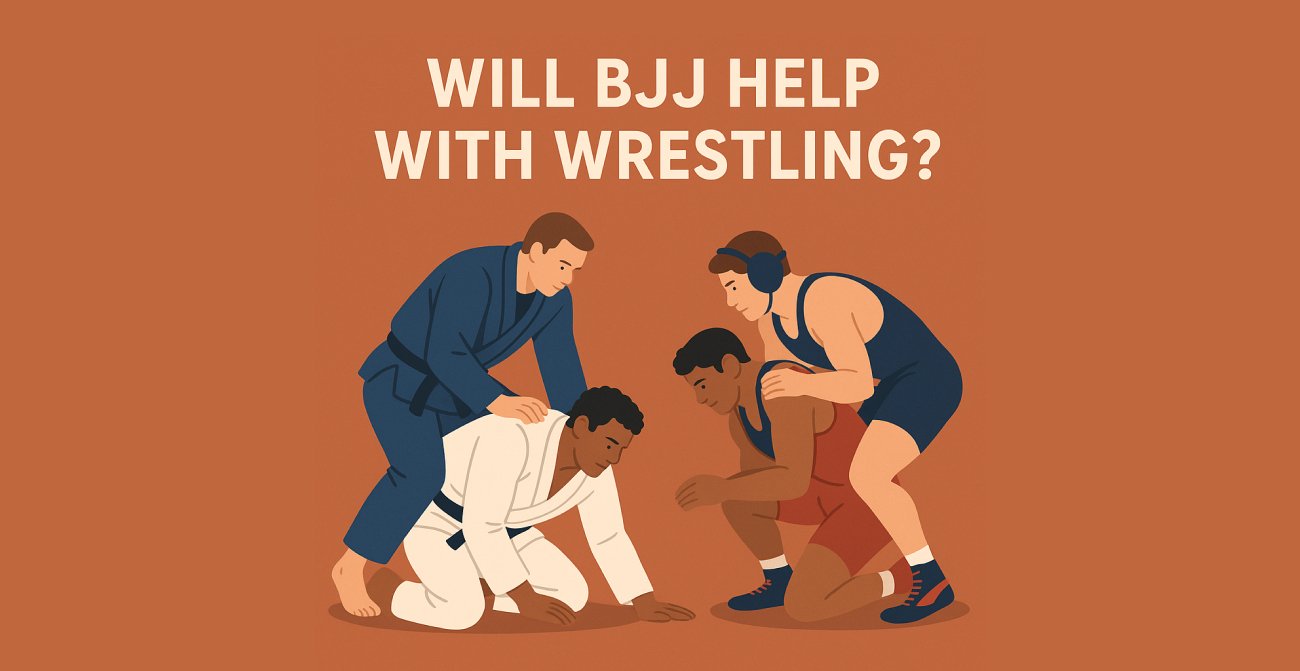
BJJ genuinely helps with wrestling, though the transfer isn't uniform — some skills carry over strongly, while others (especially takedowns) still need dedicated wrestling-specific training.
What Transfers Well From BJJ to Wrestling
Mat awareness and positional sense. BJJ builds a deep, repetition-based feel for body position, weight distribution, and control on the ground that translates directly to wrestling's top-and-bottom positional battles.
Hip movement and escapes. Shrimping, bridging, and hip-escape mechanics — foundational BJJ skills — are directly useful for wrestling scrambles and escaping bottom position, even though wrestling's specific escape rules differ from BJJ's.
Comfort under pressure. The live-sparring culture of BJJ builds real comfort being controlled, pinned, or in a bad position without panicking — a genuine advantage in wrestling's high-pressure scrambles.
Submission awareness, in situations (like folkstyle-adjacent submission wrestling or freestyle with some submission rules) where that applies — though most traditional wrestling rule sets don't include submissions at all.
What Doesn't Transfer as Directly
Takedowns. Standard BJJ training includes relatively little dedicated takedown work compared to wrestling's heavy focus on the standing phase. A BJJ practitioner without wrestling-specific training will typically have a real gap in shot timing, sprawling, and takedown defense.
Pinning strategy. Wrestling's scoring and win conditions revolve around pins and control in ways that differ meaningfully from BJJ's submission-focused objectives — the tactical priorities aren't identical even in similar top-control positions.
Explosive, whistle-to-whistle pace. Wrestling matches run at a different pace and intensity profile than most BJJ rounds, and that specific conditioning doesn't fully transfer without direct wrestling-style training.
Does It Work the Other Way Too?
Yes, and arguably more directly — wrestlers who cross into BJJ tend to have an easier transition than the reverse, since wrestling's takedown and top-control skills are immediately useful in BJJ, while BJJ's guard-heavy bottom game is a newer concept for most wrestlers. See our full BJJ vs. wrestling comparison for how the two arts compare more broadly.
Frequently Asked Questions
Does BJJ improve your wrestling takedowns? Not much on its own — most BJJ training includes relatively little dedicated takedown work, so a wrestling-specific program is still needed to build that skill.
Can a BJJ black belt beat a good wrestler in a wrestling match? Not necessarily — wrestling's specific rules, scoring, and takedown emphasis reward skills that pure BJJ training doesn't build as directly, regardless of BJJ rank.
Is cross-training BJJ and wrestling together a good idea? Yes, commonly recommended — the two arts cover different strengths (wrestling's takedowns and top control, BJJ's guard and submissions) that complement each other well.
Which transfers better: BJJ to wrestling, or wrestling to BJJ? Generally wrestling to BJJ transfers more directly, since wrestling's takedown and top-control base is immediately useful, while BJJ's guard-focused bottom game is a newer skill set for most wrestlers.
The Bottom Line
BJJ meaningfully helps with wrestling's ground phase — mat awareness, hip movement, composure under pressure — but doesn't replace dedicated takedown and pinning-strategy training. Cross-training both is the most complete path if wrestling specifically is the goal.
Tagged with:#wrestling#crossover training#bjj guides
Frequently Asked Questions
Does BJJ improve your wrestling takedowns?
Not much on its own — most BJJ training includes relatively little dedicated takedown work, so a wrestling-specific program is still needed to build that skill.
Can a BJJ black belt beat a good wrestler in a wrestling match?
Not necessarily — wrestling's specific rules, scoring, and takedown emphasis reward skills that pure BJJ training doesn't build as directly, regardless of BJJ rank.
Is cross-training BJJ and wrestling together a good idea?
Yes, commonly recommended — the two arts cover different strengths (wrestling's takedowns and top control, BJJ's guard and submissions) that complement each other well.
Which transfers better: BJJ to wrestling, or wrestling to BJJ?
Generally wrestling to BJJ transfers more directly, since wrestling's takedown and top-control base is immediately useful, while BJJ's guard-focused bottom game is a newer skill set for most wrestlers.
About the Author
Mohsin AyubBJJ practitioner, 6 years — Gracie Barra
Founder & Editor, BJJ Sportswear
Mohsin has trained Brazilian Jiu-Jitsu for six years at Gracie Barra and has competed at IBJJF-affiliated tournaments. He writes about competition, gear, and athlete careers, and founded BJJ Sportswear to help grapplers find equipment and information they can trust.
- Six years training Brazilian Jiu-Jitsu at Gracie Barra
- Competed at IBJJF-affiliated tournaments
- Writes on BJJ competition, gear testing, and athlete careers
This article was last reviewed and updated on 2026-08-18.