
On This Page
Editorial Standards
Reviewed by the BJJ Sportswear Editorial Team for technical accuracy and kept current.
Gracie Jiu-Jitsu Tattoo Ideas: Designs Worth Considering
BJJ tattoos have grown from simple team logos into real personal statements about a practitioner's journey. Here are the design categories worth knowing before you book an appointment.
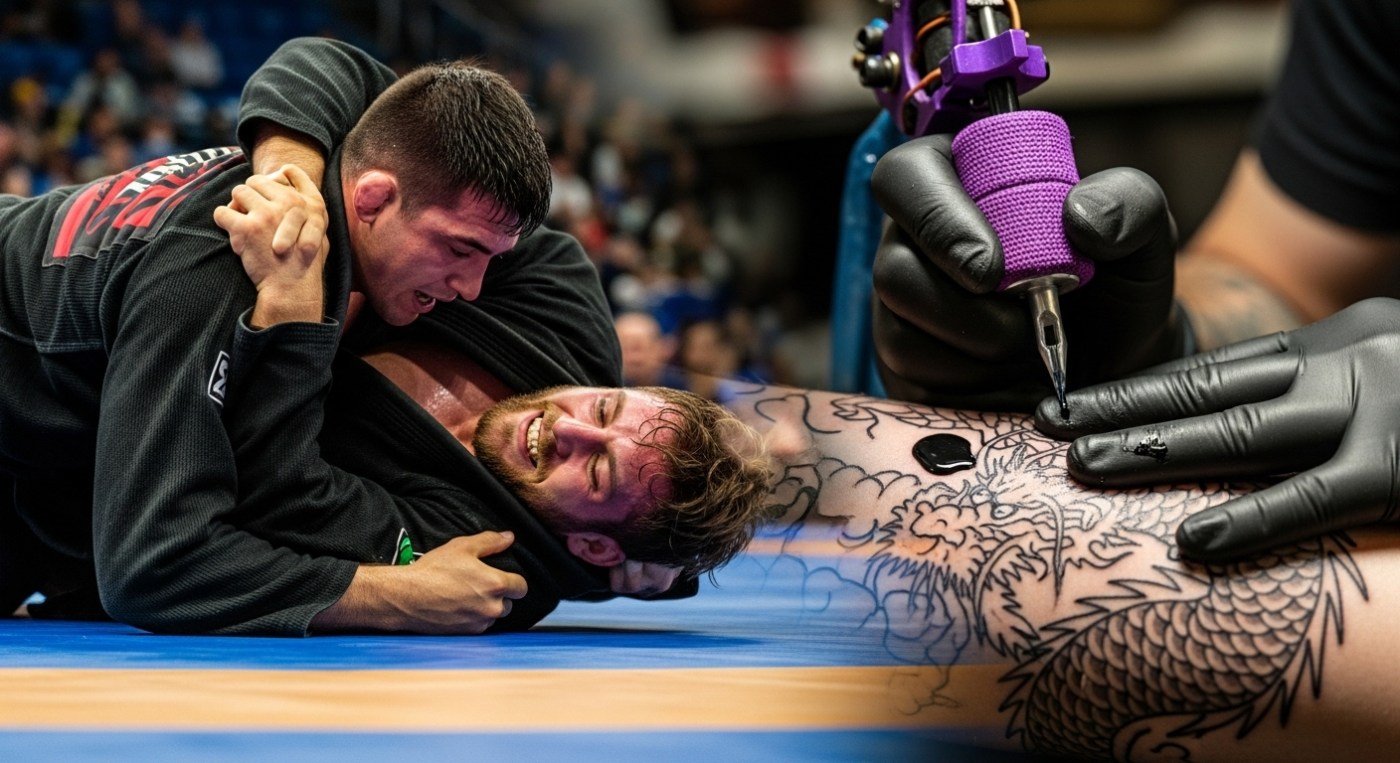
BJJ tattoos have grown well past simple team logos into genuine personal statements — a way to mark a promotion, honor a training lineage, or capture what the sport means to someone beyond the mats. Here are the main design categories practitioners actually choose, and what each one tends to represent.
Belt Rank Tattoos
Belt-rank tattoos, often wrapped around the forearm or bicep, mark a specific promotion or the full progression from white to black. Some practitioners get a single stripe or band added at each new rank, turning the tattoo into a running record of their journey through the belt system rather than a one-time piece.
Technique-Based Designs
Signature submissions make for some of the most personal BJJ tattoo ideas — an armbar, a triangle choke, or a rear naked choke rendered as line art captures a specific movement rather than a generic symbol. These tend to mean the most to practitioners who have a genuine go-to technique that defines their game.
Academy and Lineage Tattoos
Academy logos are some of the most common BJJ tattoos, and for good reason — training lineage is a real part of BJJ identity. A patch from your academy, worn permanently, signals which team and coaching tree you come from, similar to how a competition patch signals it on a gi.
Animal Motifs and Symbolism
Certain animals show up again and again in BJJ tattoo culture because they map onto real qualities in the sport. An octopus often represents flexibility and multiple simultaneous attack angles. A lion suggests courage and dominant top position. A snake is associated with patience and timing — qualities that matter as much in BJJ as raw aggression.
Japanese Cultural Elements
Because BJJ traces its roots to Japanese judo and jujutsu (see who actually invented BJJ for the full lineage), some practitioners choose designs that honor that heritage directly — a samurai figure representing the Bushido concept of discipline, or the kanji characters for jiu-jitsu itself.
Quote and Text Tattoos
Text-based tattoos pull from the sport's philosophy rather than its imagery — phrases about resilience, patience, or "the gentle art" concept that BJJ is often described by, referencing how the art emphasizes technique and leverage over brute force.
Choosing a Design That Will Still Mean Something in 10 Years
The BJJ tattoos that tend to age best are ones tied to something specific and personal — an actual technique you rely on, your real academy, or a rank you genuinely earned — rather than a generic design chosen mainly because it looked good in a search result. A tattoo tied to a real milestone in your own training tends to hold its meaning long after the design trends around it change.
Frequently Asked Questions
What is the most popular type of BJJ tattoo? Academy or team logo tattoos are among the most common, since training lineage is such a core part of BJJ identity — similar to how gis are patched with academy branding.
Do belt rank tattoos need to match your current belt? No fixed rule requires it, but many practitioners choose to update or add to a belt-rank tattoo as they're promoted, turning it into an ongoing record rather than a single fixed design.
What does an octopus tattoo mean in BJJ? It's commonly associated with flexibility and the ability to attack from multiple angles simultaneously — qualities tied to a versatile guard game.
The Bottom Line
BJJ tattoo ideas span belt-rank markers, signature techniques, academy lineage, symbolic animals, and cultural references back to the sport's Japanese roots. The designs that hold up best over time are the ones genuinely tied to your own training story, not just a design that looked good in a gallery.
Tagged with:#culture#tattoos#lifestyle
Frequently Asked Questions
What is the most popular type of BJJ tattoo?
Academy or team logo tattoos are among the most common, since training lineage is such a core part of BJJ identity — similar to how gis are patched with academy branding.
Do belt rank tattoos need to match your current belt?
No fixed rule requires it, but many practitioners choose to update or add to a belt-rank tattoo as they're promoted, turning it into an ongoing record rather than a single fixed design.
What does an octopus tattoo mean in BJJ?
It's commonly associated with flexibility and the ability to attack from multiple angles simultaneously — qualities tied to a versatile guard game.
About the Author
Mohsin AyubBJJ practitioner, 6 years — Gracie Barra
Founder & Editor, BJJ Sportswear
Mohsin has trained Brazilian Jiu-Jitsu for six years at Gracie Barra and has competed at IBJJF-affiliated tournaments. He writes about competition, gear, and athlete careers, and founded BJJ Sportswear to help grapplers find equipment and information they can trust.
- Six years training Brazilian Jiu-Jitsu at Gracie Barra
- Competed at IBJJF-affiliated tournaments
- Writes on BJJ competition, gear testing, and athlete careers
This article was last reviewed and updated on 2026-08-18.