
On This Page
Editorial Standards
Reviewed by the BJJ Sportswear Editorial Team for technical accuracy and kept current.
Ezekiel Choke: The Versatile BJJ & MMA Guide
Most chokes need your opponent's back. The Ezekiel lets you strangle someone while looking them in the eye, from mount or even from underneath in guard.
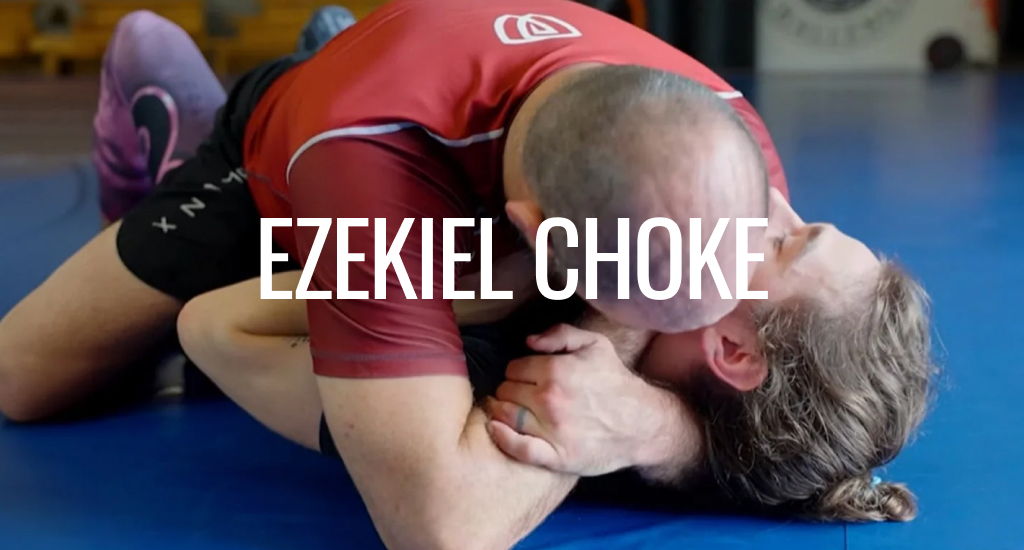
Most strangles in grappling need you behind your opponent. The Ezekiel choke breaks that rule entirely. You can finish it from mount, from side control, and — with the right timing — from flat on your back in closed guard, all while facing your opponent directly.
That face-to-face angle is what makes it so deceptive. An opponent tracking your hands for an arm triangle or a collar choke often never sees the sleeve grip coming, because by the time they feel pressure on the throat, your gi cuff is already doing the work.
This guide covers the classic gi setup from mount, the sneakier closed guard version, the no-gi "punch choke" adaptation, and the defensive habits that shut it down before it closes.
What the Ezekiel Choke Actually Does
The Ezekiel (known in judo as Sode Guruma Jime) is a sleeve-based strangle that works by scissoring pressure into the sides of the neck. One arm slides behind your opponent's head to anchor the position. The other arm — braced by your own sleeve — drives across the throat. Squeezed together, the two arms close off blood flow through the carotid arteries, not the windpipe.
It doesn't need your legs wrapped around the body. It doesn't need back control either. That means it can appear from almost any top position where the neck is open and the arms are tied up.
Setup #1: From Mount
Finishing from mount is the highest-percentage version of this choke. It punishes opponents who keep their elbows glued to their ribs to defend — exactly the habit that leaves their neck open.
- Anchor the arm. Slide one arm underneath your opponent's neck, as if you were about to hug them from on top. Get it in deep so your forearm sits behind, not beside, their head.
- Load the sleeve. Reach that same anchoring hand inside your own opposite sleeve, pushing your fingers all the way to the cuff — four fingers in, not just a fingertip grip.
- Bring the blade. Slide your free forearm across the front of their throat, resting the bone of your wrist against the neck rather than the soft underside of your arm.
- Finish. Straighten both elbows at once while driving your wrists inward, like a nutcracker closing. The scissor action, not brute pulling, is what closes the choke.
Setup #2: From Closed Guard
Finishing from the bottom is riskier — you're giving up top position to attempt it — but it works well against opponents who posture up carelessly after you've broken their base forward.
- Break their posture. Pull their head down onto your chest so their spine rounds forward and their base weakens.
- Wrap the anchor. While they're pulled in close, thread one arm around the back of their neck, the same anchoring position used from mount.
- Sneak the grip. As they try to straighten back up, feed your anchoring hand into your own sleeve before they clear the distance to defend it.
- Let their escape finish it. As they pull away to posture out, extend your arms rather than pulling harder. Their own backward momentum tightens the scissor for you.
No-Gi Variation: The Punch Choke
Without a sleeve to reinforce the choking arm, no-gi grapplers substitute their own body structure for the fabric.
- Replace the grip. Instead of grabbing a cuff, clasp your own opposite bicep (a figure-four grip) or simply close your hand into a fist.
- Drive the fist. Press your fist into the side of your opponent's neck at the same angle the sleeve would have sat.
- Squeeze. Bring your elbows together sharply. The motion looks like you're throwing a short punch into the neck — which is exactly where the nickname "punch choke" comes from.
It's a lower-percentage finish than the gi version, since there's no fabric locking the position in place. But it stays live in every no-gi and MMA context where a sleeve grip just isn't an option.
Defense and Escape
The Ezekiel closes quickly, so recognizing it in the first second or two matters more than out-muscling it once it's set.
- Bridge early. If you're mounted, explode your hips before the second hand crosses your throat. A hard bridge forces your opponent to post a hand for balance, which breaks the choke before it forms.
- Answer the phone. Bring your own hand up to your ear, palm facing your head, the moment you feel a grip settle behind your neck. This blocks the lane the choking arm needs to cross.
- Push the armpit. Drive your hand up into the armpit or tricep of the arm behind your head. Lifting that arm even slightly removes the leverage the whole choke depends on.
Tap early if the scissor closes fully — like most blood chokes, the warning window between "tight" and "unconscious" is short.
Why It Belongs in Your Game
The Ezekiel needs almost no strength and very little space. That's exactly why it catches experienced grapplers as often as beginners. Drill the sleeve-grip mechanics, and you carry a submission threat from mount, from guard, and — with the punch-choke adjustment — even when the gi comes off. For the top position most of these setups start from, see our mount position guide, and for the bottom-position version, our closed guard guide covers the posture breaks that set it up.
Tagged with:#ezekiel choke#submissions#gi#no-gi#mount
Frequently Asked Questions
What is the Ezekiel choke in BJJ?
A sleeve-reinforced strangle where one arm anchors behind the opponent's neck and the other, braced by your own gi sleeve, scissors across the throat to cut blood flow through the carotid arteries.
Can you do the Ezekiel choke without a gi?
Yes. The no-gi version, often called the punch choke, replaces the sleeve grip with a figure-four bicep grip or a closed fist, then closes the same scissoring motion into the side of the neck.
Why is the Ezekiel choke so hard to see coming?
It finishes from a face-to-face position rather than from the back, so opponents tracking a rear choke or an arm triangle often don't register the sleeve grip until the choke is already tight.
Is the Ezekiel choke legal at white belt?
Yes. It is legal at every belt level and age division under IBJJF rules, since it targets blood flow rather than the airway or a joint.
How do you defend an Ezekiel choke from mount?
Bridge explosively the instant you feel an arm slide behind your neck, before the second hand crosses your throat. The bridge forces your opponent to post a hand for balance, which breaks the choke before it locks.
About the Author
Mohsin AyubBJJ practitioner, 6 years — Gracie Barra
Founder & Editor, BJJ Sportswear
Mohsin has trained Brazilian Jiu-Jitsu for six years at Gracie Barra and has competed at IBJJF-affiliated tournaments. He writes about competition, gear, and athlete careers, and founded BJJ Sportswear to help grapplers find equipment and information they can trust.
- Six years training Brazilian Jiu-Jitsu at Gracie Barra
- Competed at IBJJF-affiliated tournaments
- Writes on BJJ competition, gear testing, and athlete careers
This article was last reviewed and updated on 2026-08-17.