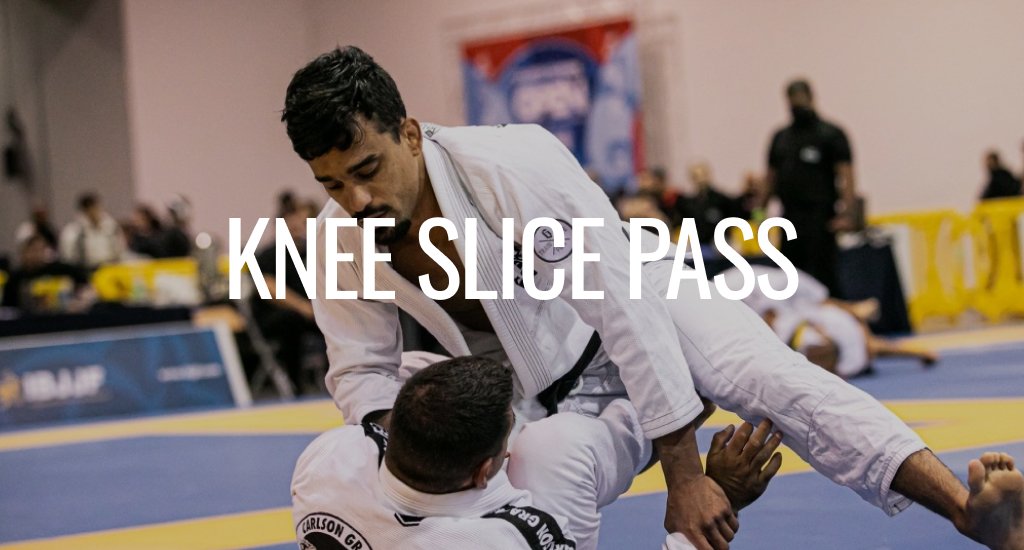
Knee Slice Pass: The Fundamental That Dominates Competition

By BJJ Sportswear Editorial Team
Reviewed by competitive black belts specializing in pressure passing systems | Last Updated: January 11, 2026

The Knee Slice Pass—also called the knee cut pass—stands as Brazilian Jiu-Jitsu’s most universally effective guard passing technique. From white belts learning their first pass to world champions executing it against elite guards, the knee slice combines simplicity, pressure, and mechanical advantage in ways no other pass can match.

According to Evolve MMA’s knee slice breakdown, this pressure pass is considered a fundamental technique that carries practitioners from beginner ranks to the highest levels of competition. BJJ legend Jean Jacques Machado emphasized that “the more you know in BJJ, the less you use”—and the knee slice exemplifies this principle perfectly.

Grapplearts’ analysis notes that the knee cut is one of the most powerful and commonly used guard passes in all grappling, appearing in gi, no-gi, and even MMA contexts. Its universal applicability stems from fundamental biomechanics that work regardless of opponent size, flexibility, or guard style.

After coaching hundreds of students through knee slice development and using it extensively across gi and no-gi competition, I’ve found it’s the most reliable pass under pressure. Unlike complex passing sequences requiring perfect timing or specific guard configurations, the knee slice creates forward progress through sustained pressure and angle management—skills that improve with every roll.

Whether you’re a white belt building your first passing game or a brown belt refining competition strategies, understanding knee slice mechanics provides the foundation for all pressure passing and creates offensive pathways that work against any guard system.

Knee Slice Pass bjj sports guide

Table of Contents

What Is the Knee Slice Pass?

The knee slice pass occurs when the top player uses their knee to pin and slice through the bottom player’s leg while maintaining forward pressure and control, ultimately achieving side control or other dominant positions.

Core Knee Slice Elements:

  • Knee drives across opponent’s thigh (creating “slice” or “cut”)
  • Near-side underhook controls their upper body
  • Far-side grip controls their far arm or wrist
  • Constant forward pressure toward their head
  • Back leg provides strong base for driving power
  • Finish in side control, kesa gatame, or mount

The technique earns its name from the cutting or slicing motion—your knee literally drives through their guard like a knife through butter when executed with proper pressure and angle.

Understanding what is guard in BJJ provides context for why passing matters—the guard player’s entire strategy revolves around preventing exactly what the knee slice accomplishes.

Knee Slice Pass
Knee Slice Pass

The Evolution: From Fundamental to Championship Weapon

Pressure Passing Foundations

The knee slice belongs to the pressure passing family—techniques that prioritize sustained forward pressure over speed or agility. This approach contrasts with “movement passes” (like toreando or leg drag) that emphasize quick direction changes.

Pressure Passing Principles:

  • Maintain constant chest-to-chest connection
  • Use weight and structure rather than speed
  • Eliminate space systematically
  • Force opponent into defensive positions
  • Control posture and limit mobility

The knee slice emerged naturally from these principles as grapplers discovered that driving the knee across the thigh created ideal angles for maintaining pressure while advancing position.

John Danaher’s Influence

John Danaher—arguably the most influential BJJ coach of the modern era—famously stated: “The easiest way to pass the guard is to force the opponent into half guard.”

Evolve MMA emphasizes this Danaher principle in their knee slice instruction: the technique works perfectly when opponents recover to half guard, which happens constantly in live rolling and competition.

This strategic insight transformed how competitors approach passing. Rather than trying to clear both legs immediately, modern passers intentionally force half guard situations where the knee slice becomes devastatingly effective.

Rafael Lovato Jr.: Championship Knee Slice

Rafael Lovato Jr.—IBJJF World Champion and former Bellator MMA Champion—built much of his passing game around simple, powerful knee slice variations.

Lovato’s Approach:

  • Emphasis on fundamental mechanics over complex sequences
  • Heavy emphasis on underhook control
  • Patient pressure rather than rushed execution
  • Chains knee slice with smash pass variations
  • Proves technique works from gi to MMA

Lovato’s success demonstrated that mastering fundamentals beats flashy technique—his straightforward knee slice dismantled world-class guards because the mechanics were perfect.

Modern Competition Applications

Contemporary champions who use knee slice extensively:

Elite Knee Slice Practitioners:

  • Bernardo Faria – Five-time world champion with pressure passing dominance
  • Lucas Lepri – Multiple-time world champion combining knee slice with movement
  • Marcus “Buchecha” Almeida – Legendary heavyweight proving size doesn’t limit technique
  • Gordon Ryan – No-gi GOAT using knee slice in submission-only formats
  • Gui Mendes – Technical precision with angle management

The position evolved from basic white belt technique to sophisticated passing system that world champions rely on when everything else fails.

Understanding how closed guard works helps appreciate why the knee slice effectively dismantles it.

Why the Knee Slice Works: Mechanical Advantages

Universal Applicability

The knee slice functions across every grappling context:

Gi Competition:

  • Underhook grips enhance control
  • Lapel and collar grips add pressure options
  • Works against all modern guard variations
  • Legal at all belt levels
  • Provides reliable path to 3-point pass

No-Gi and Submission-Only:

  • Underhook remains primary control
  • Wrist control replaces gi grips
  • Faster execution without friction
  • Works in ADCC, EBI, and all no-gi formats
  • Sets up leg locks when defended

MMA Application:

  • Maintains posture against strikes
  • Creates top position for ground-and-pound
  • Works in cage against fence
  • Superior to movement passes in MMA context
  • Allows strikes while passing

This versatility explains the knee slice’s ubiquity—it’s the fundamental that never stops working.

Biomechanical Efficiency

The knee slice creates structural problems for guard players:

Mechanical Advantages:

  • Weight distribution: Your entire body weight drives through single point (knee)
  • Leverage multiplication: Underhook controls their torso while knee pins their leg
  • Base creation: Back leg provides stable platform for pressure
  • Angle management: 45-degree approach makes defense nearly impossible
  • Progressive control: Each inch forward improves position

The technique doesn’t require strength or athleticism—it requires understanding how to use structure and weight effectively.

Countering Modern Guards

The knee slice specifically defeats positions covered in previous articles:

Against De La Riva Guard

  • Pressure forward preventing their hook effectiveness
  • Underhook neutralizes their grip fighting
  • Knee slice angle makes DLR inversion dangerous
  • Forces them to abandon DLR or get passed

Against Reverse De La Riva

  • Drive pressure into their inside hook
  • Knee slices through their defensive structure
  • Underhook prevents them elevating hips
  • Transitions smoothly when they convert to different guards

Against Single Leg X Guard

  • Pressure prevents their sweeping leverage
  • Knee drives through their leg control
  • Underhook stops technical standup attempts
  • Forces half guard where knee slice thrives

Understanding half guard helps because the knee slice frequently ends up there before completing the pass.

The Pressure Principle

Constant forward pressure is what separates effective knee slice from failed attempts:

Key Pressure Concepts:

  • Never move backward—only forward or lateral
  • Maintain chest-to-chest contact throughout
  • Drive toward their head/far shoulder (not perpendicular)
  • Small, controlled movements beat explosive attempts
  • Patience under pressure builds unstoppable momentum

I tell students: “The knee slice is like a glacier. Slow, inevitable, and impossible to stop once it’s moving.”

Core Knee Slice Mechanics and Setup

Establishing Position

The foundation starts from combat base or standing:

From Combat Base

  • Front knee between opponent’s legs (foot flat on mat)
  • Back knee on mat providing stability
  • Posture upright (don’t lean forward yet)
  • Hands controlling their hips, collar, or arms
  • Ready to initiate passing sequence

From Standing

  • Both feet planted, staggered stance
  • Hips back (don’t lean over them)
  • Hands controlling their ankles, knees, or collar
  • Prepare to drop to combat base
  • Balance and posture maintained

Critical Preparation: Before initiating knee slice, establish grip control. Without controlling their arms and posture, they’ll counter before you start.

Standard Knee Slice Configuration

Classic positioning from half guard:

Essential Elements

  • Right knee on top of their left thigh (assuming passing to their left)
  • Right foot NOT on mat yet (common mistake—avoid posting too early)
  • Left leg extended back providing strong base
  • Right arm underhook controlling their upper body
  • Left hand controlling their far wrist/elbow
  • Head driving toward their left shoulder/chin

Timing Detail: Don’t drop your knee to the mat until you’ve established the underhook. Knee down too early gives them single leg and back take opportunities.

The Underhook: Most Critical Element

Evolve MMA emphasizes that controlling the opponent’s head and arm with an underhook is the key ingredient for effective knee slice.

Proper Underhook Mechanics

  • Reach under their armpit deeply
  • Your shoulder should be in their chest/chin
  • Drive your weight through the underhook
  • Don’t just hold it—use it to control their torso
  • Prevents them turning into you or taking your back

Without the underhook, the knee slice fails. This is the single most important technical detail.

Grip Strategy

Grips determine knee slice success:

Gi Grip Priorities

1. Underhook (same side as slicing knee): Essential for control
2. Far wrist/elbow control (opposite hand): Prevents posting and frames
3. Optional: Collar grip instead of wrist for certain variations
4. Hip control: Alternative when arms aren’t available

No-Gi Adaptations

  • Underhook (absolutely essential)
  • Wrist control (tight grip around wrist bone)
  • Head control (cupping back of head)
  • Body lock when possible

In my experience, blue belts get the leg position right but neglect the underhook battle. You can have perfect knee placement, but without the underhook, you won’t pass.

Knee Slice Pass
Knee Slice Pass

Step-by-Step Knee Slice Execution

Phase 1: Opening the Guard

Starting from closed guard:

Guard Opening Process

  • Place hands on opponent’s biceps
  • Use your weight to pin their upper body
  • Carefully stand up maintaining balance
  • Place right knee between their glutes (forces guard open)
  • Sit back to combat base as guard opens
  • Immediately establish initial grips

Safety Note: Standing to open the guard requires balance. If you’re off-balance, they’ll sweep you. Practice this separately from the passing sequence.

Phase 2: Establishing Control

From combat base or after guard opens:

Control Setup

  • Right knee positioned on their left thigh (not on mat yet)
  • Left leg extended back for base
  • Right arm begins pummel for underhook
  • Left hand secures far wrist control
  • Posture stays low and forward

Common Mistake: Sitting too upright. Stay low with your weight forward—don’t give them space to recover guard.

Phase 3: The Slice

Driving the knee through:

Slicing Mechanics

  • Secure underhook deeply
  • Head drives toward their left shoulder/chin
  • Right knee begins cutting across their thigh
  • Left leg drives forward (provides power)
  • Maintain wrist control preventing their frames
  • Hip pressure forward (never backward)

Angle Critical Detail: Don’t slice parallel to their body. Cut at 45-degree angle toward their far shoulder. This maintains connection and pressure.

Phase 4: Clearing the Legs

Getting your bottom leg through:

Leg Clearing Sequence

  • Right knee continues slicing
  • Your right foot curls away from their legs
  • Left leg (back leg) steps through
  • Hip drives forward clearing their bottom leg
  • Maintain underhook and head pressure throughout
  • Never slide out sideways (common error)

Technical Detail: Touch your knee to the mat only after establishing the underhook and beginning the slice. Early knee placement gives them defensive options.

Phase 5: Securing the Pass

Finishing in dominant position:

Finish Options

Option 1: Kesa Gatame (Scarf Hold)

  • Pull their far arm up under your armpit
  • Slide your right leg through completely
  • Sit to the side with underhook maintained
  • Head controls their head
  • Heavy pressure on their chest

Option 2: Side Control

  • Clear both legs completely
  • Transition to crossface
  • Switch hips to standard side control
  • Establish control grips
  • Flatten them to mat

Option 3: Mount

  • If they turn away during pass
  • Drive over them as legs clear
  • Establish mount position
  • Secure grips and posture

Understanding rear naked choke helps when they turn away and expose their back during knee slice attempts.

Knee Slice Variations and Advanced Systems

From Half Guard

The highest-percentage knee slice application:

Setup:

  • Top half guard position established
  • Place right knee on their left thigh
  • Establish underhook (critical)
  • Control far wrist/elbow
  • Begin slicing sequence

Why This Works: According to John Danaher, half guard is the easiest position to pass from. The knee slice from half guard has the highest success rate.

I’ve passed countless guards from half guard using knee slice. It’s my go-to when everything else fails.

Knee Slice to Headquarters Pass

Combining passing systems:

Transition:

  • Initiate knee slice
  • Opponent defends by creating knee shield
  • Instead of fighting, transition to headquarters position
  • Switch passing directions
  • Return to knee slice when angle changes

Modern passers alternate between knee slice and headquarters constantly, never committing to losing battles.

Knee Slice with Collar Grip

Gi-specific variation:

Mechanics:

  • Same-side hand grips collar instead of underhook initially
  • Use collar to pull them toward you
  • Transition to underhook as you slice
  • Collar grip prevents them creating distance
  • Works when underhook initially unavailable

Knee Slice from Standing

Starting completely upright:

Entry:

  • Standing guard passing position
  • Drop to right knee on their thigh
  • Simultaneously establish underhook
  • Left leg extends back for base
  • Execute standard knee slice

This entry appears constantly when opponents pull guard in competition.

Chain Passing: Knee Slice to Backstep

When they defend:

Counter-Pass:

  • Attempt knee slice
  • Opponent creates strong knee shield defense
  • Instead of forcing, backstep around their legs
  • Circle to opposite side
  • Complete pass from new angle

Elite passers never fight losing positions—they flow to better opportunities.

Defending the Knee Slice

The Core Defensive Principle: Elbow-Knee Connection

Grapplearts emphasizes that maintaining elbow-knee connection is the most important concept in preventing the knee slice.

The Principle:

  • Passers try to invade space between your elbow and knee
  • Once they’re in that space, they control your torso
  • Keep knee and elbow connected to deny that space
  • Bring knee and shin ABOVE your biceps when defending
  • Creates four-layer sandwich (their knee, your shin, your arm, floor)

Without this connection, the knee slice succeeds almost automatically.

Defense 1: Leg Lasso

Creating external control:

Mechanics:

  • Secure their wrist
  • Loop your leg around OUTSIDE of their arm
  • Foot on their shoulder or through armpit
  • Create barrier preventing forward progress
  • Transition to offensive lasso guard if possible

Application: Works in gi and no-gi (limited) contexts.

Defense 2: Foot on Biceps

Internal frame creation:

Setup:

  • Can’t get leg lasso (blocked)
  • Bring foot up on INSIDE of their arm
  • Place foot directly on their biceps
  • Use leg as distance control
  • Prevents them closing distance
  • Works gi and no-gi equally

Defense 3: Knee Shield

Last-resort frame:

Position:

  • Top knee comes sideways across their hips
  • Shin creates frame preventing forward movement
  • Temporary block (won’t last forever)
  • Must transition quickly to recovery
  • Better than nothing when other defenses fail

I teach students: Knee shield is emergency brake, not parking space. Use it to buy time, then recover better position.

Defense 4: Underhook Counter

Fighting for the underhook:

Counter-Battle:

  • They want underhook on your left side
  • You fight for underhook on their right side
  • Winner of underhook battle controls the pass
  • Whizzer their arm if they get underhook
  • Take their back if you win underhook

Underhook battles determine knee slice success or failure more than leg positioning.

Training Knee Slice by Skill Level

For White Belts: Building Foundations

White belts should master basic knee slice before variations:

Beginner Priorities

  • Learn proper combat base posture
  • Practice underhook mechanics extensively
  • Study basic knee slice from half guard
  • Develop patience (don’t rush the pass)
  • Drill slow and controlled repetitions

Resources about first BJJ class expectations help beginners understand passing progression.

Training Tip: Drill the underhook battle separately from the leg movements. Master each component before combining.

For Blue Belts: System Development

Blue belts develop complete knee slice systems:

Intermediate Development

  • Master knee slice from multiple starting positions
  • Study all major defenses (lasso, biceps, knee shield)
  • Learn to chain knee slice with other passes
  • Develop pressure sensitivity (knowing when to push/when to flow)
  • Practice both gi and no-gi variations

Exploring blue belt development goals helps structure knee slice integration.

Knee Slice Pass
Knee Slice Pass

For Purple/Brown Belts: Refinement

Advanced practitioners perfect details:

Advanced Focus

  • Develop personalized knee slice based on body type
  • Study elite practitioners (Lovato, Faria, Lepri)
  • Create seamless transitions when knee slice fails
  • Perfect pressure application (minimal effort, maximum effect)
  • Master all finishing positions (kesa, side, mount)
  • Understand when NOT to knee slice

At this level, your knee slice should feel inevitable to opponents. They know it’s coming but can’t stop it.

For Black Belts: Teaching and Innovation

Black belts refine and teach:

Master Level

  • Develop signature variations
  • Teach mechanics to students effectively
  • Create counter-strategies for modern defenses
  • Perfect invisible pressure (feels effortless but unstoppable)
  • Adapt knee slice to opponent’s specific game

Competition Strategy and Applications

IBJJF Gi Competition

Knee slice thrives in points-based gi:

Strategic Advantages

  • Guard pass = 3 points (major score)
  • Works from standing, combat base, or half guard
  • Reliable under pressure
  • Chains with other pressure passes
  • Time-efficient (doesn’t require complex sequences)

Competition Reality: When you’re tired, losing, or under pressure, the knee slice remains reliable when complex passes fail.

ADCC and No-Gi

Knee slice dominates submission-only:

No-Gi Applications

  • Underhook control without gi dependency
  • Faster execution
  • Sets up leg locks when defended
  • Works perfectly in overtime situations
  • Gordon Ryan uses extensively in no-gi worlds

MMA

Knee slice appears constantly in MMA:

MMA Advantages

  • Maintains safe posture (striking defense)
  • Creates top position for ground-and-pound
  • Works in cage against fence
  • Pressure prevents bottom player creating space
  • Superior to flashy passes in fighting context

Self-Defense: The knee slice’s pressure and control make it ideal for real confrontations where maintaining top position is paramount.

Common Knee Slice Mistakes

Posting Knee Too Early

The #1 beginner error:

The Problem

  • Knee hits mat before underhook established
  • Opponent gets single leg opportunity
  • Can take your back or sweep
  • Kills your forward pressure

The Solution

  • Establish underhook FIRST
  • Begin slicing motion SECOND
  • Touch knee to mat LAST
  • Maintain proper sequencing always

Wrong Angle

Slicing perpendicular to opponent:

Issue

  • Slicing straight across (90 degrees) loses connection
  • Can’t maintain pressure
  • Opponent easily frames and recovers
  • Pass fails despite good technique otherwise

Correction

  • Slice at 45-degree angle toward their far shoulder
  • Think diagonal, not sideways
  • Maintain chest-to-chest pressure throughout
  • Head drives toward their opposite shoulder

No Hip Pressure

Upper body pressure without hip engagement:

Problem

  • All pressure in shoulders/arms
  • Hips stay back (disconnected)
  • Opponent easily shields and recovers
  • Wastes energy without progress

Fix

  • Drive hips forward constantly
  • Think “hip to hip” connection
  • Your hips should touch theirs
  • Pressure flows through entire body, not just upper
Knee Slice Pass
Knee Slice Pass

Fighting Lost Positions

Forcing knee slice when it’s clearly defended:

Issue

  • Opponent has perfect knee shield
  • You’re fighting uphill battle
  • Wastes time and energy
  • Better options available

Better Approach

  • Recognize when knee slice is blocked (within 3-5 seconds)
  • Transition to headquarters, backstep, or different pass
  • Chain passes fluidly
  • Never commit to losing battles

Elite passers flow between multiple passing systems. Knee slice is primary weapon, but not only weapon.

The Knee Slice Legacy: The Pass That Never Gets Old

From white belt fundamentals to world championship performances, the knee slice pass represents BJJ’s most enduring passing technique. What makes it special isn’t complexity or innovation—it’s the mechanical efficiency that makes it work for everyone, everywhere, always.

Rafael Lovato Jr. won world championships with it. Gordon Ryan submits world-class opponents after passing with it. White belts learn it in their first month. And forty years from now, grapplers will still be using it because the biomechanics are timeless.

The knee slice demonstrates a fundamental BJJ truth: mastering simple techniques executed perfectly beats knowing complex techniques executed poorly. The pressure, angle, and control principles that make knee slice effective haven’t changed in decades—and they won’t change in the future.

Whether you’re a white belt learning your first pass or a black belt competing at world championships, the knee slice provides reliable passing mechanics that work against any guard, in any context, under any rules. It’s the technique you learn first and use forever.

Mastering knee slice fundamentals creates the foundation for all pressure passing—from basic half guard passing to advanced systems that defeat De La Riva guardReverse De La Riva, and Single Leg X variations that define modern competition.


How We Reviewed This Article

Editorial Standards: Technical information verified through instructional content from Rafael Lovato Jr., Bernardo Faria, and contemporary pressure passing specialists. Mechanical analysis reviewed by competitive black belts using knee slice in tournament settings. Strategic applications based on IBJJF, ADCC, and MMA competition footage analysis (2000-2025).

Sources Referenced:

  • Rafael Lovato Jr. pressure passing systems
  • Bernardo Faria championship passing game
  • John Danaher passing principles
  • Evolve MMA knee slice technical breakdown
  • Grapplearts knee cut defense analysis
  • IBJJF and ADCC competition footage

Last Updated: January 11, 2026

Scroll to Top