On This Page
Editorial Standards
Reviewed by the BJJ Sportswear Editorial Team for technical accuracy and kept current.
The Truck BJJ: The Ultimate Guide to Twisters & Calf Slicers
The truck lets you attack the spine, slice the calf, or take the back, all from one position most players still underestimate. Here is how to enter it, attack from it, and escape it.
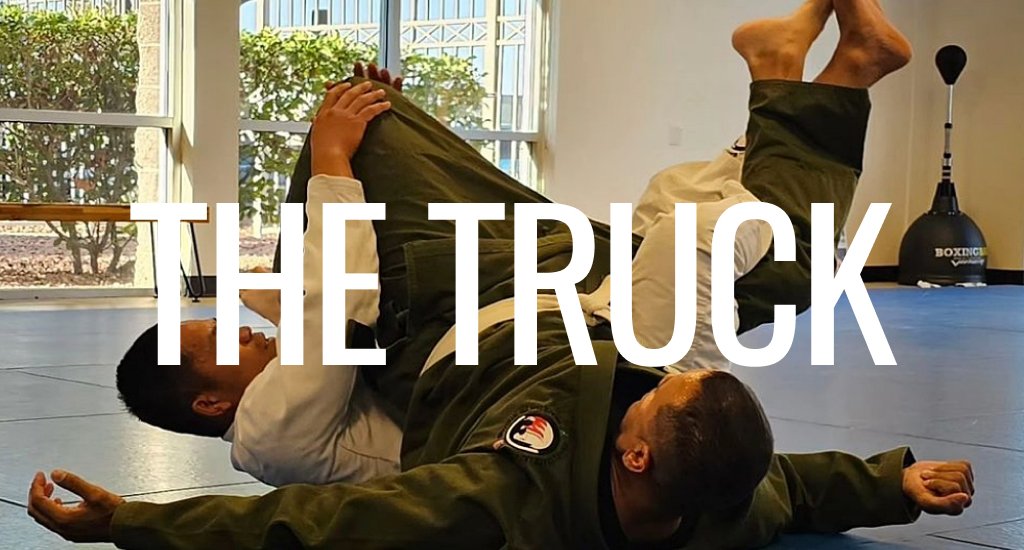
The truck is one of the strangest-looking positions in grappling. It is also one of the most dangerous. You are not on your opponent's back, and you are not passing their guard either. You are parked to the side of their hips, controlling one trapped leg, with a clean shot at their spine, their calf, or a full back take.
Eddie Bravo popularized the position through his 10th Planet system. For years it had a reputation as a no-gi novelty. That reputation is long gone. Today, world champions like Geo Martinez, Ryan Hall, and the Mendes brothers all use the truck. They use it to shut down turtled opponents and turn stalling into finishes.
This guide covers what the truck is and where it comes from. It walks through the best ways to enter it, the three attacks you can launch once you're there, and how to escape if you end up on the wrong side.
What Is the Truck?
The truck is a control position, not a submission. You trap one of your opponent's legs in a figure-four lock with your own legs. It's similar to the hooks you'd use to control someone's back. Your arms wrap around their waist or far hip instead of their chest.
The result is an odd angle. You sit behind your opponent, but off to one side rather than square on their back. That sideways position is what makes the truck so useful. Your opponent cannot turn to face you, because you control their hips, which is their only rotation point.
Evolve MMA describes the position as a fork in the road. Once you're parked there, three paths open up at once: take the back, attack the trapped leg, or attack the spine. Your opponent has to defend all three. Defending one usually opens up another.
Where the Truck Comes From
The truck traces back to a wrestling move called the wrestler's guillotine. Wrestlers used it as a leg-trapping ride to control opponents on the mat. Eddie Bravo adapted the same leg control for jiu-jitsu. He realized something wrestlers never needed: if you can pin one leg this tightly, you can also crank the spine or slice the calf while you're at it.
The name itself is simple marketing. Bravo wanted something that sounded heavy and hard to escape. "Truck" stuck.
Top 3 Entries to the Truck
You can reach the truck from almost any spot where your opponent turns away from you. Three entries account for most of the truck positions you'll actually land in.
1. The Twister Roll (From Turtle)
This is the highest-percentage entry, and the one most schools teach first. When your opponent turtles up to survive a guard pass:
- Insert a hook inside their near leg, the same way you'd start setting up a back take.
- Roll forward over their shoulder, tucking your head and rolling underneath their body.
- As you come out the other side, extend your legs and catch their trapped hip. You land directly in the truck.
The roll feels awkward the first dozen times you drill it. Commit to the roll fully rather than stopping halfway. A half-committed roll is what gets you stacked instead of landing in position.
2. From Top Side Control
If you're already in top side control and your opponent turns away to protect their neck:
- Step your near leg over their top leg, blocking it from following your hips.
- Sit back toward their hips, dragging their trapped leg into your lap as you go.
This entry is slower than the twister roll, but it's lower risk. You never leave your base to commit to a roll.
3. From Deep Half Guard
Playing deep half guard gives you a third route in. Elevate your opponent off balance the way you would for a standard deep half sweep. Then transition out the back door instead of finishing the sweep. Done right, you come up directly into the truck rather than on top in side control.
The Trinity of Attacks
Once you've parked the truck, you have three options on the table. Which one you take depends on how your opponent reacts.
1. The Twister
The twister is the move that made the 10th Planet system famous. You control the trapped leg with your lower body. At the same time, you crank your opponent's neck and shoulders in the opposite direction, attacking the spine directly.
The twister is banned in most gi competitions. It's illegal for lower belts almost everywhere. It stays legal in advanced no-gi divisions and in MMA, where the spinal crank has ended more than a few fights outright.
2. The Calf Slicer
The calf slicer is a compression submission rather than a joint lock. You pull the trapped foot down while driving your shin bone into your opponent's calf muscle, compressing it between bone and bone.
Most federations restrict this one too. Under IBJJF rules, the calf slicer is usually off-limits for white and blue belts. It only opens up at brown and black belt.
3. The Back Take
If neither submission is there, the truck still leaves you in a great spot. Extend your legs, pull your opponent's hips toward you, and slide directly into standard back control. This is usually the right call against an opponent who defends the leg lock and neck crank well, but has nothing left to stop the back take.
Counters & Defenses
Getting caught in the truck is not a reason to panic. The escape windows are there if you move early.
- Extend the trapped leg. Straightening your leg with force, rather than trying to wiggle it free, is what actually breaks a figure-four lock. A bent leg gives your opponent leverage. A straight one takes it away.
- Fight the hands before they reach your head. The twister only works once your opponent controls your head and shoulders. Keep your hands active and your head out of reach, and the crank never gets started.
- Kick forward hard. As Bernardo Faria's guest Joshua You demonstrates, a hard forward kick with your free leg can unravel the entire position. It often hands you the back take instead.
Conclusion
The truck rewards grapplers who like to attack from angles other players ignore. It shuts down turtling, punishes opponents who turn away from pressure, and turns an old stalling position into a live threat with three finishes attached to it.
Start with the twister roll from turtle. It's the highest-percentage entry. Once it feels automatic, the calf slicer, the twister, and the back take all become live options from the exact same spot.
Tagged with:#the truck#twister#calf slicer#10th planet#no-gi#back take
Frequently Asked Questions
Is the truck legal in IBJJF competition?
The position itself is legal at every belt level. The submissions that come from it are restricted separately: the twister is banned across most gi divisions, and the calf slicer is off-limits for white and blue belts.
Can you use the truck in the gi?
Yes. The Mendes brothers often combine a truck entry with the berimbolo to take the back in gi competition, and the leg control works the same whether or not your opponent is wearing a jacket.
Is the truck safe to train?
The position itself carries low risk, since it's built on control rather than a joint lock. The danger comes from the twister and calf slicer attached to it, both of which can come on fast, so tap early rather than testing how much pressure you can take.
What is the difference between the truck and back control?
Back control sits you squarely behind your opponent with both hooks in. The truck sits you off to one side with one leg trapped, which trades a strong back-take grip for a direct shot at the spine and calf instead.
Sources & Further Reading
About the Author
Mohsin AyubBJJ practitioner, 6 years — Gracie Barra
Founder & Editor, BJJ Sportswear
Mohsin has trained Brazilian Jiu-Jitsu for six years at Gracie Barra and has competed at IBJJF-affiliated tournaments. He writes about competition, gear, and athlete careers, and founded BJJ Sportswear to help grapplers find equipment and information they can trust.
- Six years training Brazilian Jiu-Jitsu at Gracie Barra
- Competed at IBJJF-affiliated tournaments
- Writes on BJJ competition, gear testing, and athlete careers
This article was last reviewed and updated on 2026-08-17.