
On This Page
Editorial Standards
Reviewed by the BJJ Sportswear Editorial Team for technical accuracy and kept current.
How to Tie a BJJ Belt (Gi Belt Knot, Step-by-Step)
A belt that keeps coming undone mid-roll is one of the most common (and most fixable) beginner problems in BJJ. Here is a method that actually holds.
If your belt keeps coming untied during rolls, you are not alone — it is one of the most common frustrations for new students, and it almost always comes down to technique, not the belt itself. This guide covers the standard way to tie a BJJ (or "gi") belt, the doubled knot that actually holds under grip pressure, a simpler version for kids, and the small mistakes that cause a belt to come loose mid-round.
"BJJ belt," "gi belt," and "jiu-jitsu belt" all mean the same thing — the thick cotton belt that closes your gi jacket and shows your rank. The tying method below works for all of them.
The Standard Method (Step-by-Step)
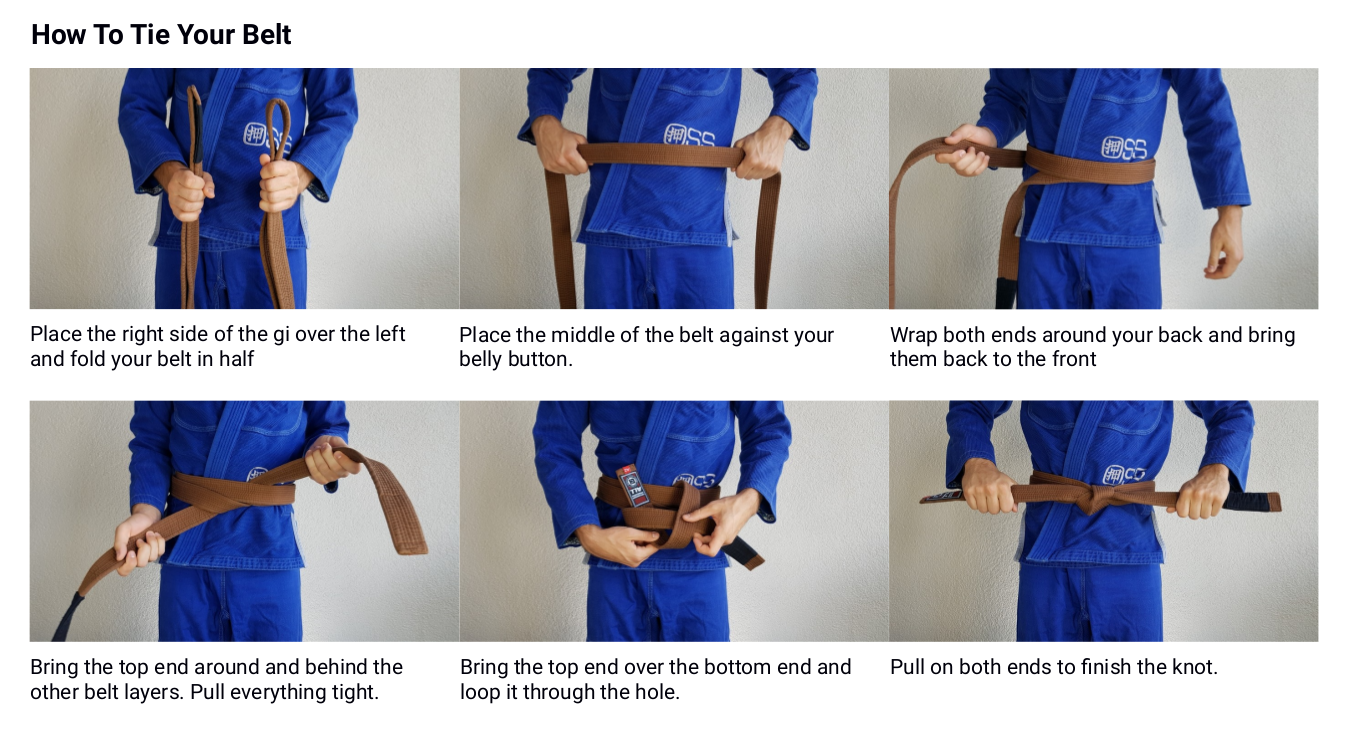
- Find the middle of your belt and place it against your stomach, over the closed gi jacket, with an even length hanging on each side.
- Wrap both ends around your back, crossing them so they come back to the front.
- Cross the right end over the left, then tuck it up and under both layers of belt at your stomach, pulling it through.
- Take that same end and cross it back over to the other side.
- Tie a standard double knot — cross the ends, loop one under, and pull tight, then repeat the same cross-and-loop a second time for a locked knot.
- Adjust so both ends are roughly even in length and the knot sits flat against your stomach, not off to one side.
That doubled knot in step 5 is the part most beginners skip, and it is the single biggest reason belts come untied — a single overhand knot has nothing to bite against once you start gripping and scrambling.
Why Belts Actually Come Loose
- The knot was only tied once instead of doubled — a single overhand knot slips under grip pressure almost immediately.
- The belt was wrapped too loosely to begin with, leaving room for it to shift during scrambles.
- The gi jacket itself is loose, so the belt has nothing firm to anchor against.
- The belt is old and worn soft — a stiffer, newer belt holds a knot better than one that has gone limp from years of washing.
A Tip That Actually Fixes It
Pull the belt significantly tighter than feels comfortable while standing still. Once you start moving and rolling, the gi settles and loosens slightly — belts that feel "just right" standing in front of a mirror are almost always too loose five minutes into live sparring.
How to Tie a Jiu-Jitsu Belt Knot for Kids
Kids often struggle with the "tuck it under both layers" step in step 3, since it takes some finger dexterity. A simplified version that still holds:
- Center the belt on the stomach and wrap both ends around the back, same as the adult method.
- Cross the ends in front once, without tucking under the wrap — just a simple cross.
- Tie one basic knot (cross, loop under, pull tight).
- Tie a second knot directly on top of the first, in the same direction, to double it up.
It is not quite as flat or clean as the full adult method, but the doubled knot is what matters for holding through a class, and it is much easier for small hands to repeat on their own. Once a young student is comfortable with this version, they can move on to the full tuck-and-cross method above.
Two small details are worth teaching alongside the knot itself: the left side of the gi jacket should close over the right (right over left is reserved for wrapping a body in a funeral shroud in Japanese tradition, so it's avoided in most martial arts), and if the belt has a colored rank bar sewn near one end, that bar should end up sitting on the left side once the belt is tied.
The Superlock Knot (A Tighter Alternative)
Once the standard doubled knot feels natural, some practitioners switch to a "superlock" variation for extra hold during hard rolling or competition:
- Wrap the belt as usual, crossing and tucking one end under both layers at the stomach.
- Instead of a simple cross-and-loop, wrap the working end fully around the standing end a second time before pulling it through — effectively adding an extra loop inside the knot itself, not just a second knot stacked on top.
- Pull both ends tight so the extra loop cinches down against the base of the knot.
- Finish with the same doubled knot as the standard method.
The superlock takes a little more practice to tie smoothly than the standard double knot, but it resists loosening under sustained gripping better, which is why some competitors prefer it for matches.
Competition Note: The 20-Second Retie Rule
If you plan to compete, know that IBJJF rules give you only 20 seconds to retie your belt if it comes undone mid-match — the match continues while you do it, and taking longer can draw a penalty. This is the main reason competitors practice a fast, reliable knot (the standard double knot or superlock above) instead of experimenting with a new method on match day. See the current IBJJF rulebook for the full competition ruleset.
Common Mistakes When Tying a Gi Belt
- Wrapping too loosely. If you can slide a flat hand between the belt and your stomach after wrapping, it is too loose before you even reach the knot.
- Only crossing, not tucking. Step 3 (tucking the end up and under both layers) is what anchors the whole belt to your body — skipping it turns the belt into a loose loop that a knot alone cannot fully secure.
- Tying the second knot in the wrong direction. The second knot needs to lock against the first, not just sit next to it — if it comes apart with one light tug, it was tied backward.
- Uneven ends. A belt with one end twice as long as the other is more likely to work loose on that side first, since the tension across the knot is uneven.
Belt Care: Why an Old Belt Comes Loose More Often
A brand-new belt is stiff, which actually helps it hold a knot — the fibers grip against themselves rather than sliding. Years of washing soften and thin the material, and a belt that has gone limp will not hold as tight a knot as one still close to new, no matter how well you tie it. A few care habits that keep a belt performing longer:
- Wash it as little as possible — most practitioners never machine wash a belt at all, since it does not get directly against skin the way a rash guard does, and frequent washing is what breaks down the stiffness fastest.
- If it does need cleaning, spot-clean with a damp cloth rather than a full wash cycle.
- Air dry only — a dryer's heat accelerates the fibers softening and the stitched rank bar loosening.
- Replace a belt once it is visibly fraying at the edges or the stitching on the rank bar has come loose, since a badly frayed belt can also violate competition uniform rules.
Belt Width and Material: Does It Affect How Well It Ties?
Most adult BJJ belts run close to 1.6"–1.8" wide in a mid-weight cotton, and that standard width is part of why the tying method above is fairly universal across brands. A few differences worth knowing:
- Thicker, stiffer belts (often paired with heavier A0-style or "gold weave" gis) hold a knot slightly better initially, since there is more surface friction, but take a bit longer to break in for a comfortable fit against the stomach.
- Thinner, lighter belts (paired with lightweight competition gis) are more prone to loosening and benefit the most from the doubled knot in this guide, since they have less inherent grip to fall back on.
- Belt length matters more than width for a clean knot — a belt sized correctly for your waist should leave both ends long enough to tie a full doubled knot with roughly even tails; an oversized belt (common when a belt is sized to match gi size rather than waist) leaves excess length that is harder to manage cleanly.
If You Are Brand New
Tying a belt smoothly takes a few tries to feel natural, and no one expects a white belt to nail it on day one. If you have not been to your first class yet, our beginner's guide to your first BJJ class covers everything else you will want to know before you step on the mat, and our belt system guide explains what that belt color actually represents once it is tied — a system whose adult promotion minimums are set by the IBJJF.
Frequently Asked Questions
How do you tie a gi belt? Center the belt against your stomach over the closed gi jacket, wrap both ends around your back and bring them to the front, cross the right end over the left and tuck it up and under both layers at your stomach, then cross that end back over and tie a doubled knot — cross, loop under, pull tight, then repeat once more.
How do you tie a jiu-jitsu belt so it does not come undone? Use a doubled knot instead of a single overhand knot, wrap the belt snugly enough that there is no slack before you tie it, and pull the final knot tighter than feels comfortable while standing still — gis loosen slightly once you start moving.
What is the jiu-jitsu belt knot called? It does not have a formal name outside BJJ gyms — most practitioners just call it a "double knot" or "square knot," since it is essentially a reef knot tied twice for extra hold.
How do you tie a BJJ belt for a kid? Use the same wrap-around-the-back method, but skip the tuck-under step in the middle if it is too fiddly for small hands — a simple cross followed by two stacked basic knots holds well enough for a kids' class and is far easier to repeat independently.
Is tying a jiu-jitsu belt different from a karate or judo belt? The core wrap-and-cross method is similar across most martial arts, but BJJ belts are typically tied with a firmer double knot since live sparring puts far more stress on the knot than static drilling.
What is a superlock belt knot? A tighter variation on the standard double knot where the working end is wrapped fully around the standing end a second time before being pulled through, adding an extra loop inside the knot itself. It takes more practice but resists loosening better under hard gripping, which is why some competitors use it.
How long do you have to retie your belt in a BJJ competition? Under IBJJF rules, 20 seconds — the match keeps running while you retie, so competitors practice a fast, reliable knot ahead of time rather than figuring it out under the clock.
Tagged with:#belt tying#beginners#gi#gi belt#kids bjj#superlock
Frequently Asked Questions
Why does my BJJ belt keep coming untied?
Almost always because the knot was tied only once instead of doubled, or the belt was wrapped too loosely to begin with. A tight double knot, pulled firmer than feels natural while standing still, holds through a full round.
How do you tie a gi belt?
Center the belt against your stomach over the closed gi jacket, wrap both ends around your back and bring them to the front, cross the right end over the left and tuck it up and under both layers at your stomach, then cross that end back over and tie a doubled knot.
Is tying a BJJ belt different from a karate or judo belt?
The core wrap-and-cross method is similar across most martial arts, but BJJ belts are typically tied with a firmer double knot since live sparring puts far more stress on the knot than static drilling.
What kind of knot is used to tie a BJJ belt?
A doubled square knot — cross the ends, loop one under and pull tight, then repeat the same cross-and-loop a second time. The double layer is what actually holds under grip pressure; a single overhand knot slips within the first few minutes of rolling.
How tight should a BJJ belt be tied?
Tighter than feels comfortable while standing still. Gis settle and loosen once you start moving, so a knot that feels "just right" in the mirror is usually too loose five minutes into live sparring. Pull it snug against your stomach before you step on the mat.
Do you tie a gi belt the same way as tying it on a jacket over regular clothes?
Yes, the wrap-and-cross method is the same — the only difference is that a gi jacket's thicker, stiffer fabric gives the belt more to grip against, so the knot tends to hold a little more securely than it would over a thin t-shirt.
How do you tie a jiu-jitsu belt for kids?
Use the same wrap-around-the-back method as adults, but a simplified knot works fine: cross the ends once in front, tie one basic knot, then stack a second knot directly on top in the same direction. It is easier for small hands to repeat and still holds through a class.
What is the jiu-jitsu belt knot called?
It does not have an official name — most practitioners simply call it a "double knot" or "square knot," since it is a reef knot tied twice for extra hold under grip pressure.
What is a superlock belt knot?
A tighter variation on the standard double knot where the working end wraps fully around the standing end a second time before being pulled through, adding an extra loop inside the knot itself rather than just stacking a second knot on top. It holds better under hard gripping once you have the standard method down.
How long do you have to retie your belt in a BJJ competition?
Under IBJJF rules, 20 seconds — the match continues while you retie it, and taking longer can draw a penalty, which is why competitors practice a fast, reliable knot ahead of time.
Sources & Further Reading
About the Author
Mohsin AyubBJJ practitioner, 6 years — Gracie Barra
Founder & Editor, BJJ Sportswear
Mohsin has trained Brazilian Jiu-Jitsu for six years at Gracie Barra and has competed at IBJJF-affiliated tournaments. He writes about competition, gear, and athlete careers, and founded BJJ Sportswear to help grapplers find equipment and information they can trust.
- Six years training Brazilian Jiu-Jitsu at Gracie Barra
- Competed at IBJJF-affiliated tournaments
- Writes on BJJ competition, gear testing, and athlete careers
This article was last reviewed and updated on 2026-08-23.