
On This Page
Editorial Standards
Reviewed by the BJJ Sportswear Editorial Team for technical accuracy and kept current.
BJJ vs. Kung Fu: Which Should You Train?
BJJ and Kung Fu train for combat in almost opposite ways. One tests everything live against a resisting partner. The other leans on forms and tradition — and that difference matters more than most comparisons admit.
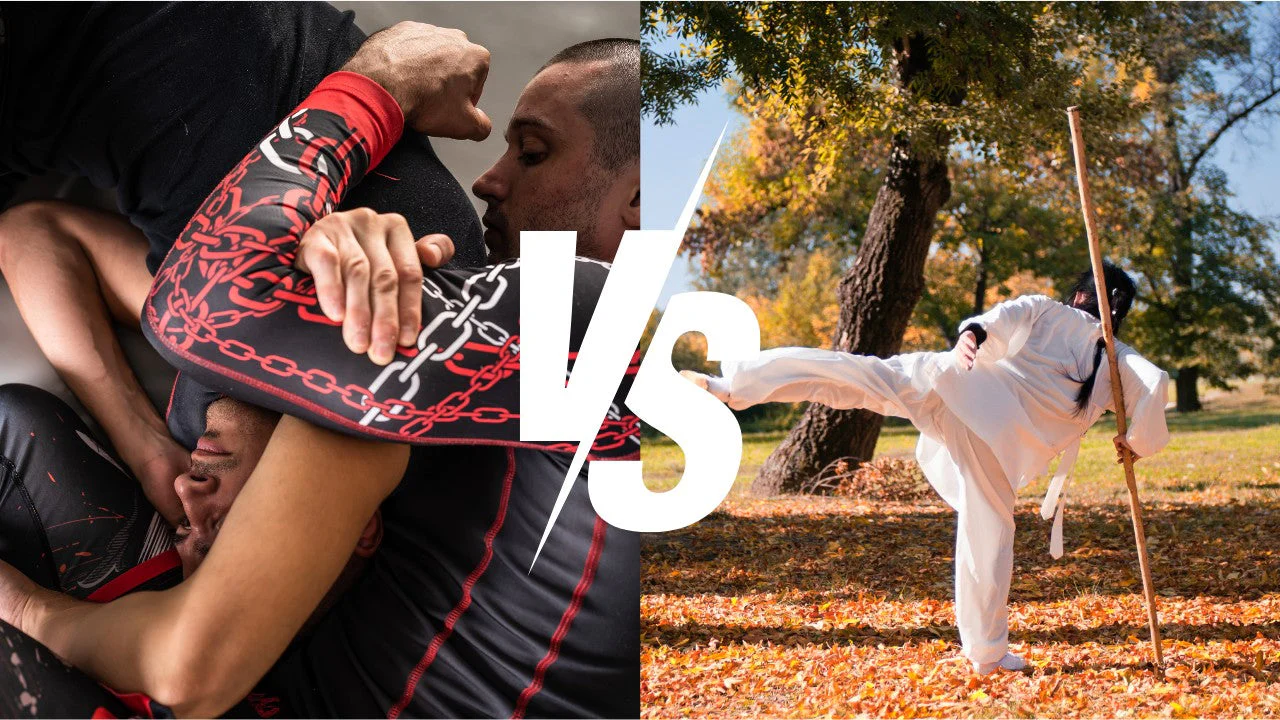
BJJ and Kung Fu are both martial arts, but they train for combat in very different ways. BJJ is a grappling art built entirely around live, resisting practice. Kung Fu is an umbrella term for hundreds of Chinese striking styles, many built around forms and tradition first. That single difference in training method — live resistance vs. choreographed practice — matters more than almost anything else in this comparison.
Quick Comparison
| Aspect | Brazilian Jiu-Jitsu | Kung Fu |
|---|---|---|
| Primary focus | Ground grappling, submissions | Striking, forms, traditional technique |
| Training method | Live sparring (rolling) most classes | Forms and partner drills; live sparring varies a lot by school |
| Combat range | Close range — clinch and ground | Medium to long range — striking |
| Belt/rank system | Standardized globally | Varies by school and lineage |
| Competition scene | Large, standardized (IBJJF, ADCC) | Smaller and fragmented, varies by style |
What Is Brazilian Jiu-Jitsu?
BJJ is a grappling-based martial art. It centers on ground fighting, positional control, and submissions — chokes and joint locks — using leverage and technique rather than size or strength. That's what lets a smaller, technical practitioner consistently compete with a bigger, stronger one, and it's why the IBJJF's competition rules put so much weight on positional control, not just striking power.
The defining feature of BJJ training is live sparring, called rolling. Nearly every class ends with rounds of real resistance against a partner who is actually trying to stop you. That constant pressure-testing is what BJJ people mean when they say "it's proven" — not because the art is inherently superior, but because bad technique gets exposed in training, not just in a real fight.
What Is Kung Fu?
Kung Fu isn't one style. It's an umbrella term for hundreds of Chinese martial arts, each with its own techniques and training method. Wing Chun focuses on close-range striking. Shaolin styles lean heavily on traditional forms. Sanda is a full-contact Chinese kickboxing style with real live sparring. Tai Chi trains slow, internal movement. Because of that range, "how effective is Kung Fu" has no single honest answer. It depends on the specific style. It depends just as much on the specific school.
Traditional Kung Fu training typically includes stance work, solo forms — choreographed movement sequences called katas — and partner drills. How much live sparring you get depends heavily on the school. Sanda gyms treat sparring as central, so they train closer to how BJJ trains. Schools built mainly around form preservation often don't spar much at all.
The Real Difference: Live Resistance
This is the crux of the comparison, and it's worth being direct about it. A martial art that regularly tests techniques against a fully resisting opponent tends to build more reliable real-world skill. One that mostly drills cooperative patterns does not. That's not a BJJ-specific claim. It's the same reason boxing and wrestling also produce fighters who perform well under pressure. Kung Fu styles with real sparring — Sanda, some Wing Chun schools — don't have this gap. Styles built mainly around forms often do. That's a legitimate, well-documented criticism inside the martial arts world, not just from outsiders.
Combat Range
Kung Fu generally operates at striking range: punches, kicks, palm strikes, footwork, and angles, with an emphasis on avoiding the clinch. BJJ operates at the opposite end. It wants the clinch and the ground, where striking becomes far less useful. Neither range is "better" in the abstract. A fight that stays standing and at distance favors a striker. A fight that closes to the clinch or goes to the ground favors a grappler. And a large share of real physical altercations end up in a clinch within seconds — part of why BJJ's self-defense reputation runs so strong.
Self-Defense
BJJ has a real, practical edge here, for one specific reason. Most physical confrontations end up in a clinch or on the ground, whether either person wants that or not. BJJ is the art most directly built for that exact scenario. A BJJ practitioner who gets grabbed or taken down still has a full toolkit. A striking-focused martial artist in that same spot often doesn't.
That said, a good Kung Fu school still teaches something real. Sanda, or a pressure-tested Wing Chun program, builds useful distance management and striking defense. BJJ doesn't cover that at all. The honest answer: BJJ covers the more common real-world scenario better. That doesn't mean Kung Fu offers nothing.
MMA Effectiveness
BJJ shows up constantly in modern MMA. It's a foundational skill for nearly every serious fighter — both for finishing submissions and for not getting finished on the ground yourself. Traditional Kung Fu rarely shows up directly in MMA competition. Why? MMA rewards exactly the live-resistance training that many traditional Kung Fu schools skip. Sanda is the exception. Its full-contact format transfers into MMA striking reasonably well, and some MMA strikers do have a Sanda or kickboxing background with Chinese martial arts roots.
Which Should Beginners Choose?
BJJ suits you if you want a training method built entirely around pressure-tested skill, you're drawn to grappling and ground problem-solving, or self-defense against a grab, tackle, or clinch is your main concern.
Kung Fu suits you if you're drawn to striking and stand-up combat, you want the aesthetic, philosophical, and disciplinary tradition many styles offer, and — this part matters — you carefully pick a school that actually spars, not just drills forms. If you go this route, ask directly during a trial class how much live sparring students do; the answer tells you almost everything about how functional that specific school's training will be.
Can You Train Both?
Yes, and it's not unusual. Kung Fu's striking and footwork can genuinely complement BJJ's grappling, especially in a style that trains real sparring. The main practical tension is time — both arts reward serious weekly volume, and splitting your training between two systems slows progress in each individually. Most people are better served getting a real foundation in one before layering in the other.
The Bottom Line
BJJ's advantage isn't that grappling beats striking in some abstract sense — it's that BJJ's training method guarantees pressure-tested skill by design, while Kung Fu's effectiveness depends heavily on which specific style and school you walk into. If you pick a serious, sparring-focused Kung Fu program, that gap mostly closes. If you don't check first, you might be training beautiful forms that have never once been tested against real resistance.
Tagged with:#comparison#kung fu#self-defense
Frequently Asked Questions
Is BJJ more effective than Kung Fu for self-defense?
Generally yes, mainly because most real physical confrontations end up in a clinch or on the ground, which is exactly where BJJ specializes. This depends on the specific Kung Fu style and school, though — a sparring-focused program like Sanda closes much of that gap.
Why does Kung Fu rarely show up in MMA?
Most traditional Kung Fu schools emphasize forms and cooperative drills over live sparring, and MMA rewards pressure-tested skill above all else. Sanda, a full-contact Chinese kickboxing style, is the exception and does transfer reasonably well into MMA striking.
Can you train both BJJ and Kung Fu?
Yes — Kung Fu striking and footwork can complement BJJ grappling well, especially from a sparring-focused Kung Fu style. The main tradeoff is time, since splitting training between two systems slows progress in each. Most people benefit from a solid foundation in one before adding the other.
What is the main difference between Kung Fu and Jiu-Jitsu?
Kung Fu is primarily a standing striking art — punches, kicks, and throws — while BJJ is a specialized ground-grappling art built around control and submissions. The bigger practical difference is training method: BJJ tests nearly everything through live sparring from day one, while many traditional Kung Fu schools lean more on cooperative forms.
Sources & Further Reading
About the Author
Mohsin AyubBJJ practitioner, 6 years — Gracie Barra
Founder & Editor, BJJ Sportswear
Mohsin has trained Brazilian Jiu-Jitsu for six years at Gracie Barra and has competed at IBJJF-affiliated tournaments. He writes about competition, gear, and athlete careers, and founded BJJ Sportswear to help grapplers find equipment and information they can trust.
- Six years training Brazilian Jiu-Jitsu at Gracie Barra
- Competed at IBJJF-affiliated tournaments
- Writes on BJJ competition, gear testing, and athlete careers
This article was last reviewed and updated on 2026-08-18.