
On This Page
Editorial Standards
Reviewed by the BJJ Sportswear Editorial Team for technical accuracy and kept current.
Jujutsu vs. Brazilian Jiu-Jitsu: What Is the Real Difference?
They share a name and real ancestry, but Jujutsu and BJJ train for almost opposite scenarios. One prepares you for a battlefield with weapons. The other perfects one-on-one ground control. Here is the real difference.
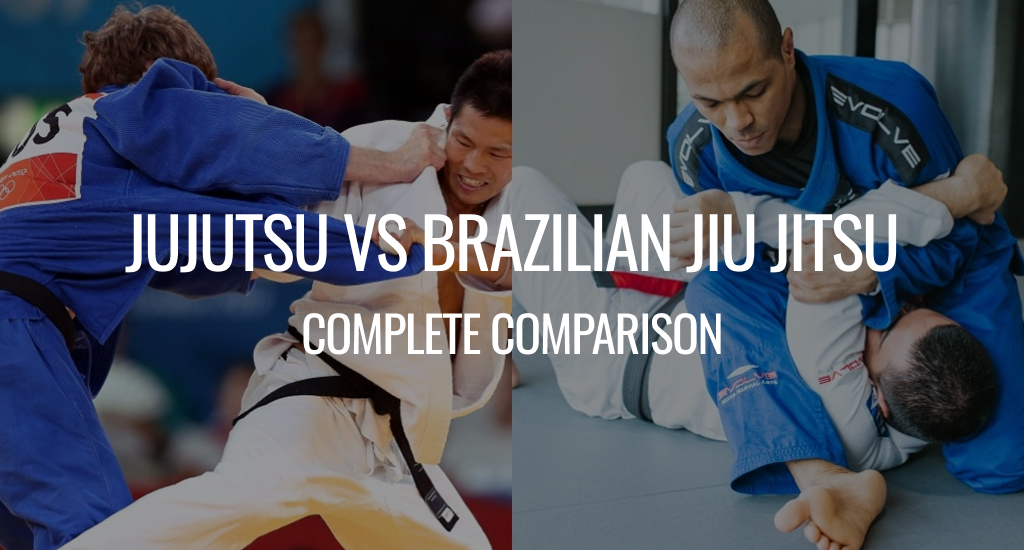
Jujutsu and Brazilian Jiu-Jitsu share real ancestry. They also train for almost opposite situations. Traditional Jujutsu developed as a battlefield system for armored samurai facing multiple armed opponents. BJJ evolved a world away and a century later, as a specialized one-on-one ground-fighting sport. Same family tree, very different tools.
This guide covers where each art came from, how their training actually differs, and which one fits your goals better.
Where Each Art Came From
Jujutsu traces back to feudal Japan. Its first formal school is often dated to 1532, founded by the tactician Takenouchi Hisamori. It was built for real battlefield combat. Samurai carried weapons, wore armor, and often faced more than one opponent at once. Grappling mattered because a sword or spear could be lost or broken mid-fight. Punches did little against armor. Techniques leaned toward joint locks, throws, strikes at armor gaps, and weapon defenses, taught largely through kata — pre-arranged forms practiced repetitively.
One branch of that lineage matters a lot here. In 1882, Jigoro Kano studied traditional Jujutsu extensively. He adapted it into Judo, founding the Kodokan in Tokyo. Judo shifted the emphasis from battlefield survival toward sport and education. Judo's ground-fighting component, newaza, is the direct ancestor of what became BJJ.
BJJ itself starts in 1920s Brazil — see our full history of who actually invented BJJ for the longer version. Mitsuyo Maeda, a Japanese judoka, taught Judo and Jujutsu to Carlos and Helio Gracie. Helio was notably smaller and less physically powerful than most training partners. He adapted what he learned — stripping out techniques that relied on strength, leaning hard into leverage and timing. He also developed the guard position, a genuinely novel contribution that let a smaller person control a larger one from the bottom. The art got pressure-tested constantly in real challenge matches. Then Royce Gracie went on to dominate the early UFC events in the 1990s. BJJ's ground-fighting effectiveness became impossible to ignore, and the sport exploded globally from there.
The Technical Split: Standing vs. Ground
The clearest practical difference between the two arts is simple: where the fight happens.
Jujutsu is built mostly around standing exchanges: strikes, throws, standing joint locks, and weapon defenses, with only a limited ground component. The logic is battlefield-driven. Going to the ground against multiple attackers is dangerous, so Jujutsu trains to finish a confrontation quickly and stay on your feet.
BJJ flips that ratio almost entirely. The overwhelming majority of BJJ technique lives on the ground: guard work, passing, submissions, and escapes, with only basic takedowns and essentially no striking at all. BJJ's whole approach assumes a one-on-one, unarmed scenario. Taking the fight to the ground and controlling it safely is the goal.
Training Methodology: Forms vs. Live Sparring
This difference matters as much as the technical one, maybe more.
Traditional Jujutsu leans heavily on kata — pre-arranged, cooperative drilling where technique is practiced with precision in a controlled setting. Live sparring exists in many schools, but it's often limited compared to BJJ's approach.
BJJ trains almost the opposite way. Live sparring, called rolling, happens from day one at most academies and makes up the core of nearly every class. Every technique gets pressure-tested against a partner who's actually trying to stop you, every session. That constant resistance is a big part of why BJJ ground skills transfer so reliably to real scrambles — the technique either works against real resistance, or it gets exposed and fixed in training.
Which Is Better for Self-Defense?
It depends heavily on the scenario, and being honest about that matters more than picking a side.
For a one-on-one, unarmed confrontation — by far the most common real-world self-defense situation — BJJ's live-tested ground control and submissions tend to hold up very well. A BJJ practitioner who ends up in a clinch or on the ground, which happens often in real altercations, still has a full toolkit to work with.
For scenarios involving multiple attackers or weapons, Jujutsu has the edge. That's its original design purpose. The standing-focused, quick-finish approach has real logic behind it. Staying on the ground against a second or third attacker is genuinely dangerous — a risk BJJ's sport-oriented rule set doesn't have to account for.
Neither art fully covers the other's strongest scenario. A well-rounded self-defense plan benefits from elements of both — reliable ground control from BJJ, awareness of multiple-attacker and weapon-adjacent risk from Jujutsu's original toolkit.
Which Should You Choose?
BJJ suits you if you want a heavily pressure-tested skill set. It also suits you if you're drawn to technical, chess-like ground problem-solving, or your main self-defense concern is a one-on-one grab, tackle, or clinch — by far the most common real-world scenario.
Jujutsu suits you if you're drawn to a broader standing toolkit that includes strikes and throws. It also suits you if you value traditional forms and discipline as part of training, or if multiple-attacker and weapon-awareness scenarios are a specific priority for you.
Body type and fitness goals matter too. BJJ's leverage-based approach is famously friendlier to smaller or less athletic practitioners facing bigger opponents. Jujutsu's broader, more athletic standing curriculum suits practitioners who want a wider technical range from day one — at some cost to how deeply any single area gets trained.
Can You Train Both?
Yes, and the skill sets genuinely complement each other — Jujutsu's standing and weapon-awareness training fills gaps BJJ doesn't touch, while BJJ's live-resistance ground game gives Jujutsu's often lighter sparring culture a serious pressure test. The main constraint is time: both arts reward real weekly volume, and splitting training between two systems slows progress in each. Most people are better served building a real foundation in one before layering in the other.
Frequently Asked Questions
Is Jujutsu the same as Brazilian Jiu-Jitsu? No. They share historical roots — BJJ descends from Judo, which itself descends from traditional Jujutsu — but they train for different scenarios today. Jujutsu is a broad standing system built for battlefield combat; BJJ is a specialized ground-fighting sport built for one-on-one confrontations.
Which is more effective in a real fight? For the most common real-world scenario, a one-on-one unarmed confrontation, BJJ's live-tested ground skills tend to hold up better. For multiple-attacker or weapon-adjacent scenarios, Jujutsu's original design has a real edge BJJ doesn't cover.
Is Jujutsu older than BJJ? Yes, considerably. Jujutsu's roots trace back to 1532 in Japan, making it roughly 490 years old. BJJ developed in 1920s Brazil, making it around a century old.
The Bottom Line
Jujutsu and BJJ share a real family tree, but they solve different problems. Jujutsu was built to keep a samurai alive against multiple armed opponents. BJJ was built to let one person control another, safely and reliably, on the ground. Neither is strictly "better" — the right choice depends on which scenario you're actually training for.
Tagged with:#comparison#jujutsu#history
Frequently Asked Questions
Is Jujutsu the same as Brazilian Jiu-Jitsu?
No. They share historical roots — BJJ descends from Judo, which descends from traditional Japanese Jujutsu — but they train for different scenarios. Jujutsu is a broad standing system built for battlefield combat, while BJJ is a specialized ground-fighting sport built for one-on-one confrontations.
Which is better for self-defense, Jujutsu or BJJ?
For the most common real-world scenario, a one-on-one unarmed confrontation, BJJ's live-tested ground control tends to hold up better. For scenarios involving multiple attackers or weapons, traditional Jujutsu's standing-focused design has a real advantage.
Can you train both Jujutsu and BJJ?
Yes, and the two complement each other well — Jujutsu's standing and weapon-awareness training fills gaps BJJ doesn't cover, while BJJ's live-resistance ground game pressure-tests skills many Jujutsu schools spar less intensively. Most people benefit from a solid foundation in one before adding the other.
Is "jujutsu" and "jujitsu" the same word spelled differently?
Yes — jujutsu, jiu-jitsu, and jujitsu are all Romanizations of the same Japanese term, just transliterated differently over time. "Brazilian Jiu-Jitsu" uses the older spelling convention, while "jujutsu" is the more common modern Romanization for the traditional Japanese art specifically.
About the Author
Mohsin AyubBJJ practitioner, 6 years — Gracie Barra
Founder & Editor, BJJ Sportswear
Mohsin has trained Brazilian Jiu-Jitsu for six years at Gracie Barra and has competed at IBJJF-affiliated tournaments. He writes about competition, gear, and athlete careers, and founded BJJ Sportswear to help grapplers find equipment and information they can trust.
- Six years training Brazilian Jiu-Jitsu at Gracie Barra
- Competed at IBJJF-affiliated tournaments
- Writes on BJJ competition, gear testing, and athlete careers
This article was last reviewed and updated on 2026-08-18.