
On This Page
Editorial Standards
Reviewed by the BJJ Sportswear Editorial Team for technical accuracy and kept current.
BJJ vs. Wrestling: Which Should You Train?
BJJ finishes fights with submissions. Wrestling wins them with pins and control. Here is how the two arts actually differ, and why the best grapplers eventually train both.
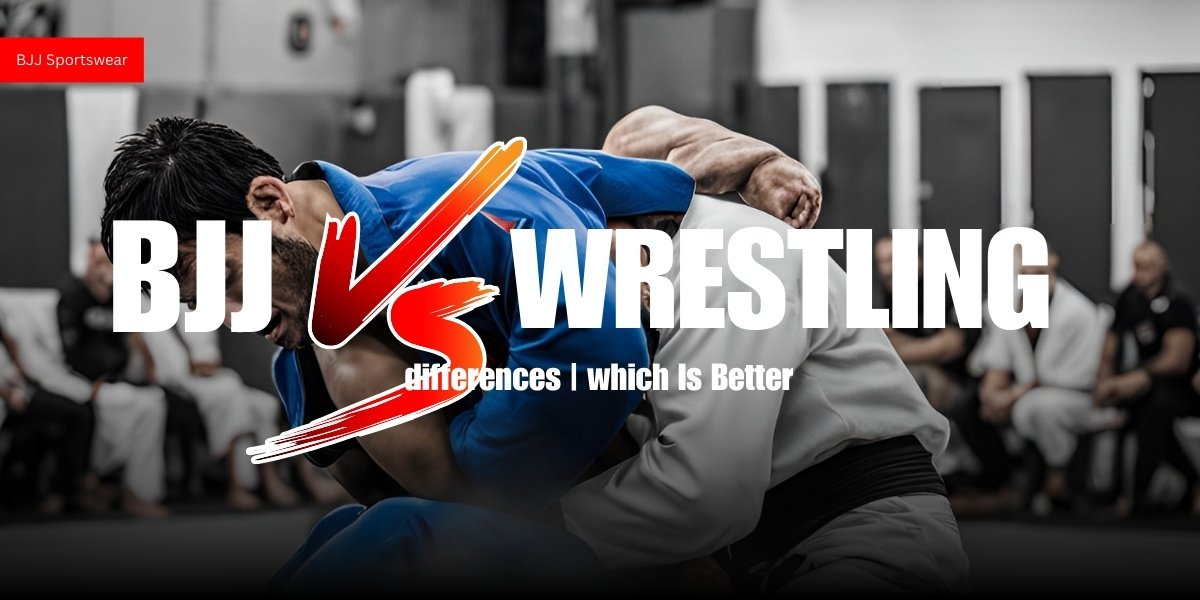
BJJ and wrestling are both grappling arts. They solve the same problem in different ways. BJJ finishes a fight with a submission. Wrestling wins by dominating position and pinning. Neither approach is wrong. They're just built for different goals. Understanding the difference helps you pick the right one to start with — or know why so many serious grapplers end up training both.
Quick Comparison
| Aspect | Brazilian Jiu-Jitsu | Wrestling |
|---|---|---|
| Primary focus | Ground submissions, guard work | Takedowns, top control, pins |
| Objective | Submit the opponent or win on points | Pin the opponent or score points |
| Pace | Methodical, strategic | Fast, explosive, aggressive |
| Fighting from your back | A real offensive position | Avoided at all costs |
| Submissions | Central focus | Not allowed |
| Belt/rank system | Standardized globally | No standardized system |
| Athleticism required | Moderate — technique over strength | High — explosive power matters a lot |
What Is Brazilian Jiu-Jitsu?
BJJ is a submission-focused grappling art. It centers on ground fighting, guard positions — controlling an opponent from your back — and joint locks or chokes that force a tap. The core idea is leverage over strength. A technically sharper, smaller practitioner can beat a bigger, stronger one. BJJ rewards technique and position, not raw power.
Training usually moves through three stages: technique drilling, then positional sparring focused on one scenario, then live rolling at the end of class. It's a slower, more thinking-heavy pace than most people expect walking in. Core submissions include the rear naked choke, triangle choke, armbar, and guillotine. Core guard positions include closed guard, butterfly guard, and half guard.
What Is Wrestling?
Wrestling is an explosive grappling sport. It's built around takedowns, top control, and pins. BJJ treats the back as a workable position. Wrestling treats it as the position to avoid entirely — being pinned ends the match. Athleticism, explosive power, and constant pressure matter far more here than in BJJ.
There are three main styles recognized by United World Wrestling, the sport's international governing body. Folkstyle is the American collegiate version. Freestyle is Olympic, and the style most transferable to MMA. Greco-Roman is also Olympic, but bans leg attacks. Training is fast-paced and conditioning-heavy: explosive drilling at speed, live wrestling at full intensity, and serious strength work layered on top.
The Core Differences
Submission vs. pin. BJJ's whole goal is to force a tap through a choke or joint lock. Wrestling's goal is to pin the opponent's shoulders to the mat or win on points — submissions aren't legal, and the two sports simply end differently.
Fighting from your back. In BJJ, guard is offensive. You can sweep, control, and submit from underneath. In wrestling, your back is the losing position, full stop — wrestlers train hard to never end up there and to scramble out immediately if they do.
Pace. Wrestling runs fast and explosive, with a referee actively pushing the action and short bursts of maximum effort. BJJ runs slower and more strategic — practitioners take time to think, bait a reaction, and set up a submission methodically.
Technique vs. athleticism. BJJ leans on technique and leverage to let smaller people compete with bigger ones. Wrestling leans harder on athleticism — explosive power and speed are a much bigger part of winning.
Culture. Wrestling tends to run like a traditional competitive sport: score points, win the match, team-based structure, often tied to school programs. BJJ carries more of a martial-art identity: an individual belt progression system, a self-defense framing, and a slower-burn community culture.
Which Wins in MMA?
Neither — they're complementary, and nearly every serious modern MMA fighter trains both. Wrestling brings elite takedowns and the ability to decide where a fight happens: on the feet or on the ground, on top or underneath. That's a massive tactical advantage on its own. BJJ brings the finishing tools once the fight hits the ground, plus a genuine defensive game if a wrestler ends up on their back unexpectedly.
A wrestler with no ground submissions can control a fight but struggles to finish it. A BJJ practitioner with no wrestling can finish a fight but might never get it to the ground on their own terms. Combine both, and you get a fighter who can dictate where the fight happens and finish it once it's there — which is exactly why wrestling-heavy fighters cross-train BJJ, and why BJJ gyms are full of practitioners drilling takedowns.
Which Is Better for Self-Defense?
Both hold up, but they solve different self-defense problems. Wrestling gets you to top position fast and keeps you there — useful for controlling an aggressor without striking. BJJ adds something wrestling doesn't: a real plan if you end up on your back, which happens more often than anyone would like in an actual altercation. For that reason, a lot of self-defense-focused instructors consider BJJ's back-position game a meaningful edge, without discounting how effective a strong wrestling base is on its own.
Which Should Beginners Start With?
Honestly, either is a reasonable starting point, and the choice comes down to your goals and your body more than which is "better."
Wrestling suits you if you want to build explosive athleticism fast, you're younger or have a strong athletic background already, and you're drawn to a hard-nosed, high-intensity training culture.
BJJ suits you if you want a sport you can train long-term regardless of size or athleticism, you're drawn to the technical, chess-like problem-solving side of grappling, or self-defense is a bigger priority than competition.
If you can only pick one and your long-term goal includes MMA, starting wrestling young and adding BJJ later is a common, proven path — but plenty of elite grapplers went the other way and did fine. Consistency beats which one you start with.
Should You Train Both?
If your schedule allows it, yes. Wrestling sharpens your takedowns and top-position control — two things a lot of BJJ practitioners are genuinely weak at, since so much BJJ training starts from the knees or on the ground already. BJJ sharpens your submissions and your back game, two things most wrestlers have never needed and often lack entirely. Together, they cover each other's biggest gaps.
The Bottom Line
BJJ and wrestling aren't competing answers to the same question — they're two different tools. Wrestling wins with speed, power, and control. BJJ wins with leverage, patience, and the finish. If you're choosing where to start, pick based on what excites you and what your body is built for; if you stick with either one long enough, you'll probably end up drawn to the other eventually anyway.
Tagged with:#comparison#wrestling#mma
Frequently Asked Questions
Is wrestling or BJJ better for MMA?
Neither alone — they are complementary. Wrestling provides elite takedowns and control over where a fight happens, while BJJ provides finishing submissions and a real defensive game from the back. Most top MMA fighters train both.
Can a BJJ practitioner beat a wrestler in a real match?
It depends heavily on the ruleset and the individual. Under BJJ rules (submissions legal, no pins), a skilled BJJ practitioner has the advantage. Under folkstyle or freestyle wrestling rules (no submissions, pins win), a skilled wrestler has the advantage, since the win conditions favor their specific skill set.
Should a beginner learn wrestling or BJJ first?
Either is a reasonable starting point. Wrestling builds explosive athleticism and takedown skill quickly and suits a harder, high-intensity training culture. BJJ builds technical, leverage-based skill that works regardless of size and suits a more methodical, long-term training style.
Is grappling the same thing as wrestling?
No — grappling is the broader umbrella term for any close-contact art focused on clinching, takedowns, and ground control, including wrestling, BJJ, judo, and sambo. Wrestling is one specific grappling discipline within that category, defined by its own rules around pins and no submissions.
Sources & Further Reading
About the Author
Mohsin AyubBJJ practitioner, 6 years — Gracie Barra
Founder & Editor, BJJ Sportswear
Mohsin has trained Brazilian Jiu-Jitsu for six years at Gracie Barra and has competed at IBJJF-affiliated tournaments. He writes about competition, gear, and athlete careers, and founded BJJ Sportswear to help grapplers find equipment and information they can trust.
- Six years training Brazilian Jiu-Jitsu at Gracie Barra
- Competed at IBJJF-affiliated tournaments
- Writes on BJJ competition, gear testing, and athlete careers
This article was last reviewed and updated on 2026-08-18.