On This Page
Editorial Standards
Reviewed by the BJJ Sportswear Editorial Team for technical accuracy and kept current.
Bow and Arrow Choke: The Best Gi Choke From Back Control
The bow and arrow choke turns your legs, back and collar grip into one strangle. Here is the setup from back control, the finish, and the defense that still works.
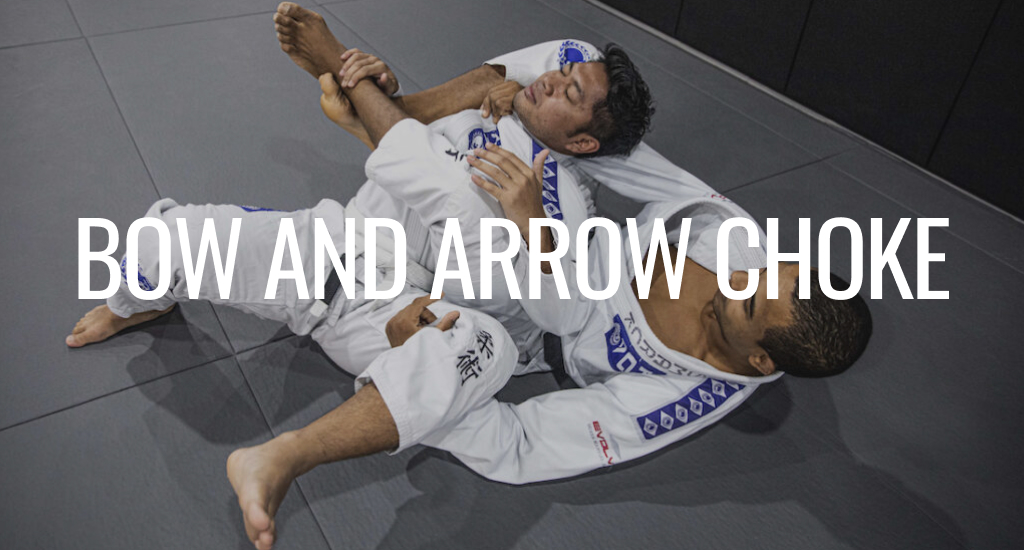
The bow and arrow choke is the most powerful gi submission in Brazilian jiu-jitsu. It recruits your legs, your back and both grips at the same moment, which is why a smaller grappler can finish a considerably heavier opponent with it.
Judo calls this family of collar strangles okuri eri jime. Brazilian jiu-jitsu borrowed one version, added a pant grip and a side angle, and turned it into a black belt staple. Competitors like Marcus "Buchecha" Almeida and the Miyao brothers have finished world titles with it, and the same leverage still works at white belt on your first day.
What Makes It Different From a Rear Naked Choke
The rear naked choke closes around the neck with your arms, so the finish depends on positioning and arm strength. The bow and arrow closes with your entire body instead.
You take a collar with one hand and a pant leg with the other, then lean back and extend. Your opponent's spine stretches away while the collar shortens around their neck. There is nothing to muscle out of, because your legs generate far more force than any neck can resist.
Like every collar attack, this is a blood choke. It compresses the carotid arteries on both sides of the neck and interrupts blood flow to the brain, so the airway is never the target.
The Bow and the String
The name explains the mechanics better than any long paragraph.
- The bow is your opponent's body. Your pant grip and your legs bend it.
- The string is their collar. Your gripping hand pulls it tight.
- The draw is you leaning back. Both forces load at once.
That combination is why the choke feels so different from the inside. Your opponent has to fight the strangle and their own stretched posture simultaneously, and defending either one usually makes the other worse.
When to Hunt For It
Look for it whenever you hold back control with a seatbelt grip. It is also the perfect punishment for somebody who defends the rear naked choke well, because a hand busy protecting a chin is a hand that cannot protect a lapel.
Turtle position works equally well. If your opponent turtles up and you already own a collar, you can slide straight to the finishing angle without ever inserting your hooks.
Step by Step From Back Control
- Set your seatbelt. One arm over the shoulder, one arm under the armpit, chest glued to their back.
- Feed the collar. Use your over arm. Thumb goes inside the lapel and travels as deep as you can reach, past the collarbone, toward the back of the neck.
- Grab the pants. Use your under hand to grip the outside of their far knee. If the pants are out of reach, hook the leg or grab the thigh.
- Change the angle. Let the hooks go and slide your hips out toward your collar-gripping side. You want to sit roughly at ninety degrees to their body.
- Bring the leg over. Throw your top leg across their chest or over their shoulder. This stops them from sitting up and closes the escape route.
- Trap the far side. Your other leg stays across their hips or under their armpit, so they cannot spin back in.
- Draw the bow. Lean back, extend both legs, and pull the collar down toward your own hip. Elbow to hip, not hand to face.
The finish should feel slow and steady rather than explosive. If you find yourself yanking on the collar, one of the first six steps is missing.
Details That Decide the Finish
- Depth beats strength. A shallow collar grip never finishes, however hard you pull, so feed the hand completely before your hips move anywhere.
- Keep the elbow tight. Your choking elbow belongs against your ribs, because a flared elbow hands your opponent a convenient handle.
- Do not rush the angle. Move your hips only after both grips are established, since abandoning the hooks early simply returns their back.
- Pull with your back. Imagine a rowing motion rather than a bicep curl.
Bow and Arrow vs Sliding Collar Choke
People mix these two up all the time, and the difference is simply where you sit.
- Sliding collar choke: you stay behind them and finish with a second lapel grip. Your hooks stay in.
- Bow and arrow choke: you move to the side and finish with a pant grip and your legs. Your hooks come out.
Use the sliding collar when you want to protect the position and stay comfortable on points. Switch to the bow and arrow the moment they begin escaping, or whenever you need extra finishing leverage against a stronger opponent. Both attacks begin from an identical deep collar grip, so you rarely have to commit early. Our cross collar choke guide covers the front-side member of the same family.
Why It Fails
- The grip is too shallow. Fix: thumb in, deep, before anything else moves.
- You give up the pant grip. Without it their hips are free and the bow never bends. Fix: grip the knee, not the ankle.
- Your leg never crosses. They sit up and turn in. Fix: throw the top leg over the shoulder early.
- You pull with the arm only. Fix: extend your legs and lean back at the same moment.
How to Defend the Bow and Arrow Choke
Defending this choke is entirely about early recognition. Once your spine has been stretched, the submission is usually finished.
- Guard the collar. The second you feel a hand near your lapel, pull down on that forearm with both of yours, because two arms always beat one.
- Chase the elbow. As they slide toward your side, capture the choking elbow and drive it over your head. Clearing your head under their armpit puts you safely out of danger.
- Turn toward them. Never pull away, since pulling away creates exactly the stretch they want. Turn inward and work to flatten your shoulders on the mat.
- Kill the pant grip. Strip the hand controlling your knee and their leverage disappears immediately.
- Tap on time. This choke tightens quickly and offers very little warning.
Our back escape guide covers the earlier half of this exchange, before any grip reaches your collar.
Gi and No-Gi
This remains a gi technique. The collar is the string, so no genuine no-gi version exists. The closest equivalent is a rear naked choke from the same seatbelt, or a crucifix attack that borrows the same side angle.
Collar chokes are legal at every belt level and age division under IBJJF rules, so you can compete with this one from your very first tournament.
How to Drill It
Start completely static. Have your partner sit in front of you while you establish the collar grip, the pant grip and the angle without any resistance, until you recognise exactly where your hips belong.
Then introduce movement. Let your partner defend the rear naked choke properly, and take the collar instead of forcing the strangle. That switch, from arm to lapel, is the genuine skill behind the technique.
Master the transition from back control to the side angle and you own a finish that works at every belt level, in every division, against opponents of any size. Our back control guide covers the position that feeds it.
Tagged with:#bow and arrow choke#collar choke#back control#gi#submissions
Frequently Asked Questions
Why is it called the bow and arrow choke?
Because the finish looks like drawing a bow. Your opponent's body is the bow, their collar is the string, and leaning back with a pant grip draws both at once.
Is the bow and arrow choke legal in IBJJF competition?
Yes. It is a collar choke, so it is legal at every belt level and age division under IBJJF rules, including white belt, as long as you are wearing a gi.
Can you do a bow and arrow choke in no-gi?
No. The choke needs a collar to act as the string. In no-gi the same back control and side angle set up a rear naked choke or a crucifix attack instead.
What is the difference between the bow and arrow and the sliding collar choke?
The sliding collar keeps you behind your opponent with your hooks in and finishes with a second lapel grip. The bow and arrow moves you to their side and uses a pant grip plus your legs for leverage.
Why does my bow and arrow choke keep slipping off?
Almost always a shallow collar grip. Feed your thumb deep past the collarbone before you move your hips, and keep the pant grip on the knee so their hips cannot escape.
Sources & Further Reading
About the Author
Mohsin AyubBJJ practitioner, 6 years — Gracie Barra
Founder & Editor, BJJ Sportswear
Mohsin has trained Brazilian Jiu-Jitsu for six years at Gracie Barra and has competed at IBJJF-affiliated tournaments. He writes about competition, gear, and athlete careers, and founded BJJ Sportswear to help grapplers find equipment and information they can trust.
- Six years training Brazilian Jiu-Jitsu at Gracie Barra
- Competed at IBJJF-affiliated tournaments
- Writes on BJJ competition, gear testing, and athlete careers
This article was last reviewed and updated on 2026-08-17.