
On This Page
Editorial Standards
Reviewed by the BJJ Sportswear Editorial Team for technical accuracy and kept current.
Peruvian Necktie: BJJ Front Headlock Guide
The Peruvian necktie catches an arm and a neck in the same trap, straight from a scramble. Here is the setup, the finish, and the line it cannot cross.
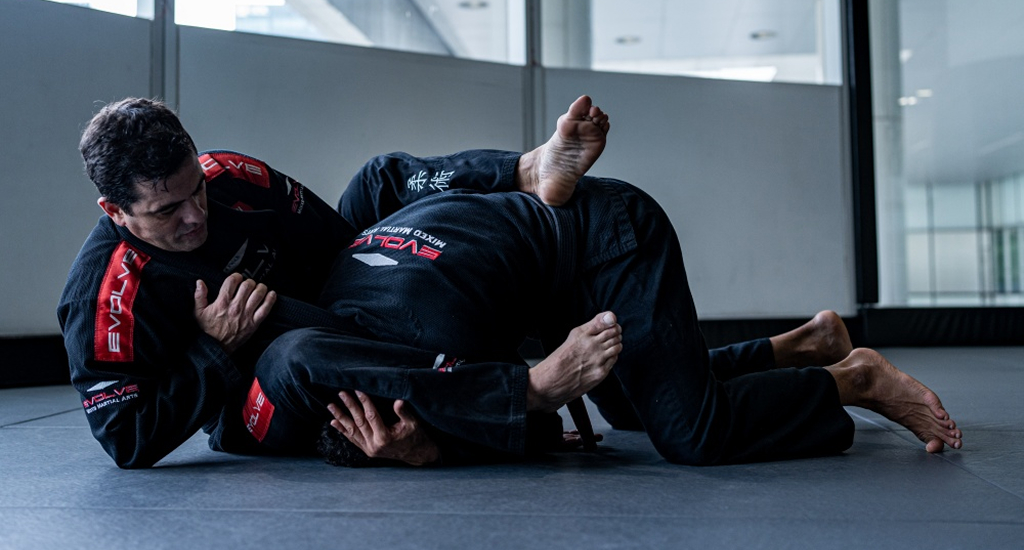
What the Peruvian Necktie Does
The Peruvian necktie is a front-headlock submission that traps one of your opponent's arms alongside their neck, then finishes by dropping your weight and rotating — choking the neck while the trapped arm has no room to defend it. It belongs to the same front-headlock family as the d'arce choke and anaconda choke, but the finishing mechanic is distinct from both.
The Setup
- From a front headlock or turtle scramble, trap one of your opponent's arms against the side of their head rather than threading it through like a d'arce or anaconda grip.
- Wrap your arm around the back of their neck, locking their head and the trapped arm together.
- Sit through to the opposite side, dropping your hips and rotating your body away from your opponent.
- The rotation and body drop apply the finishing pressure — this is a body-weight throw into the choke, not a static squeeze.
Why It Finishes Fast
Because the trapped arm sits directly alongside the neck rather than being isolated separately, your opponent has almost no way to create the space needed to defend the choke without also freeing the arm — and vice versa. Both problems have to be solved with the same movement, which is exactly what makes escapes so difficult once the position is fully locked.
Where the Line Is: Choke, Not Crank
Applied correctly, the Peruvian necktie is a genuine blood choke, finishing through compression on the neck rather than through spinal or joint rotation. Competition rules that restrict neck cranks are aimed at techniques that twist or hyperflex the cervical spine — a clean Peruvian necktie applied as a strangle does not cross that line, but a version cranked purely on the neck's rotation without real choking pressure can. Drill the choking mechanic specifically, not a twisting substitute.
Common Mistakes
- Isolating the arm and the neck as two separate problems instead of trapping them together in one motion.
- Squeezing with the arms alone instead of using the sit-through and body drop to generate the actual finishing pressure.
- Cranking the neck's rotation instead of committing to the choke, risking both an ineffective finish and an unsafe technique for your training partner.
Defending the Peruvian Necktie
Fight to keep your trapped arm's elbow tucked to your body before the setup locks in — once your arm is pinned alongside your head, options narrow fast. If the grip is already on, turning into your opponent rather than away reduces the angle they need to finish the sit-through.
Where It Fits
The Peruvian necktie is a real alternative to the d'arce and anaconda chokes from the exact same scrambles and turtle exchanges, worth learning alongside both rather than as a replacement for either.
Tagged with:#peruvian necktie#front headlock#no-gi#submissions
Frequently Asked Questions
What is a Peruvian necktie in BJJ?
A front-headlock submission that traps an opponent's arm alongside their own neck, finishing through a sit-through and body drop rather than arm strength, choking the neck while the trapped arm has no room to defend it.
Is the Peruvian necktie legal in competition?
Applied as a genuine choke through compression, it is treated as a standard submission. It can cross into an illegal neck crank if applied as pure rotational or hyperflexion pressure without real choking pressure, so drill the choking mechanic specifically.
How is the Peruvian necktie different from a d'arce or anaconda choke?
All three come from front-headlock scrambles, but the Peruvian necktie traps the arm alongside the head rather than threading it through separately, and finishes with a sit-through and body drop instead of a figure-four arm squeeze.
How do you defend the Peruvian necktie?
Keep your trapped arm's elbow tucked to your body before the setup fully locks in. If the grip is already on, turn into your opponent rather than away to reduce the angle they need for the finishing sit-through.
About the Author
Mohsin AyubBJJ practitioner, 6 years — Gracie Barra
Founder & Editor, BJJ Sportswear
Mohsin has trained Brazilian Jiu-Jitsu for six years at Gracie Barra and has competed at IBJJF-affiliated tournaments. He writes about competition, gear, and athlete careers, and founded BJJ Sportswear to help grapplers find equipment and information they can trust.
- Six years training Brazilian Jiu-Jitsu at Gracie Barra
- Competed at IBJJF-affiliated tournaments
- Writes on BJJ competition, gear testing, and athlete careers
This article was last reviewed and updated on 2026-08-18.