
On This Page
Editorial Standards
Reviewed by the BJJ Sportswear Editorial Team for technical accuracy and kept current.
Rubber Guard: Eddie Bravo's BJJ System
Rubber guard trades traditional grips for pure flexibility, locking an opponent's posture down with your own leg instead of your hands. Here is how the system works.
What Rubber Guard Is
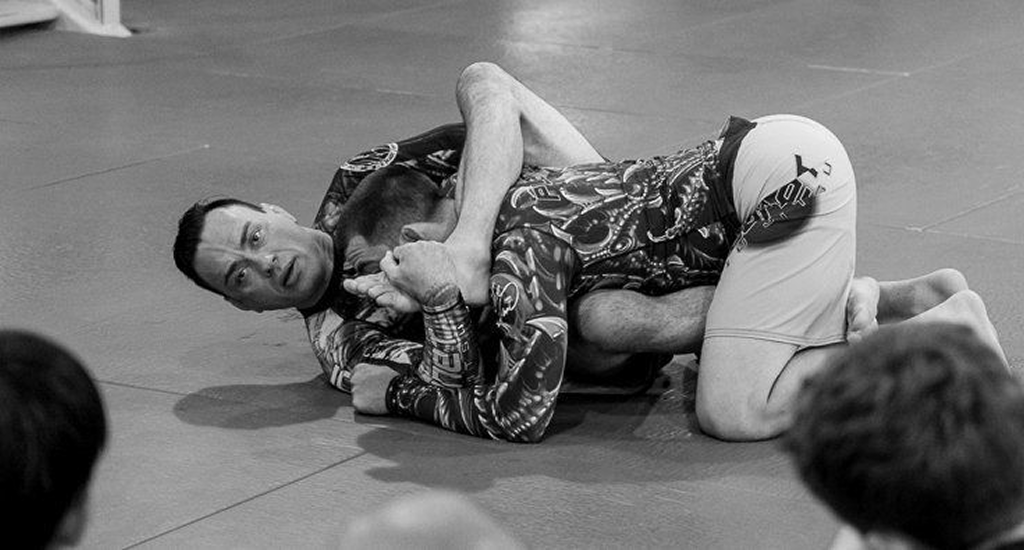
Rubber guard is a closed-guard system built around controlling your opponent's posture with your legs instead of your hands, popularized by Eddie Bravo through his 10th Planet system. Instead of relying on grips that can be stripped, you use your own hip and hamstring flexibility to lock an opponent's head and one arm in place, freeing both hands to attack.
Mission Control
Mission control is the foundational grip of the system: you pull one of your opponent's arms across your body and trap it there with your leg, while your other leg controls their head and posture. With their posture locked down by your legs rather than a hand grip, they cannot simply strip a hand free to escape the way they could against a standard closed guard.
Why It Demands Real Flexibility
Rubber guard only works if you can actually get your leg high enough to control your opponent's head and shoulder — for most grapplers, that means training hip and hamstring flexibility specifically, not just BJJ technique. This is the single biggest barrier to entry for the system, and it is why rubber guard remains a specialist's tool rather than a fundamental every grappler adds early.
What It Sets Up
- The gogoplata. With an opponent's posture broken down and their head controlled, sliding your shin across their throat for a gogoplata choke is the signature finish of the system.
- Omoplata. Once mission control traps an arm, the same leg position often converts directly into an omoplata attempt.
- Triangle setups. A trapped arm and broken posture are the same ingredients a triangle choke needs, and rubber guard frequently transitions straight into one.
Common Mistakes
- Attempting the system without the flexibility to actually reach mission control, which just leaves your legs high and exposed instead of controlling anything.
- Forgetting to attack once posture is broken — rubber guard is a control system meant to open submissions, not a stalling position.
- Losing the leg control the moment your opponent postures hard, since the system depends entirely on maintaining that leg-based grip.
Defending Rubber Guard
Fight the leg control early, before your head and posture are fully locked down — once mission control is established, options narrow fast. Posturing up hard and stripping the trapped arm the moment it is grabbed is the most reliable early defense.
Where It Fits
Rubber guard connects most naturally to the same submissions closed guard already opens up once posture breaks — the triangle and the omoplata both live at the end of this system too, just reached through flexibility instead of a grip fight.
Tagged with:#rubber guard#10th planet#closed guard#flexibility
Frequently Asked Questions
What is rubber guard in BJJ?
A closed-guard system popularized by Eddie Bravo that controls an opponent's posture with your legs instead of your hands, using hip and hamstring flexibility to lock their head and one arm in place.
What is mission control in rubber guard?
The foundational grip of the system — pulling one of your opponent's arms across your body and trapping it with your leg, while your other leg controls their head and posture.
Do you need to be flexible for rubber guard?
Yes, significantly. Reaching mission control requires real hip and hamstring flexibility, which is the biggest barrier to entry and why most grapplers who use the system train flexibility specifically for it.
What submission does rubber guard set up?
The gogoplata is the system's signature finish, though a trapped arm and broken posture from mission control also convert naturally into an omoplata or a triangle choke.
About the Author
Mohsin AyubBJJ practitioner, 6 years — Gracie Barra
Founder & Editor, BJJ Sportswear
Mohsin has trained Brazilian Jiu-Jitsu for six years at Gracie Barra and has competed at IBJJF-affiliated tournaments. He writes about competition, gear, and athlete careers, and founded BJJ Sportswear to help grapplers find equipment and information they can trust.
- Six years training Brazilian Jiu-Jitsu at Gracie Barra
- Competed at IBJJF-affiliated tournaments
- Writes on BJJ competition, gear testing, and athlete careers
This article was last reviewed and updated on 2026-08-18.