
On This Page
Editorial Standards
Reviewed by the BJJ Sportswear Editorial Team for technical accuracy and kept current.
Scissor Sweep: Complete Closed Guard Guide
The scissor sweep is one of the first sweeps you learn and one of the last you stop using. Here is the detail most people get wrong.
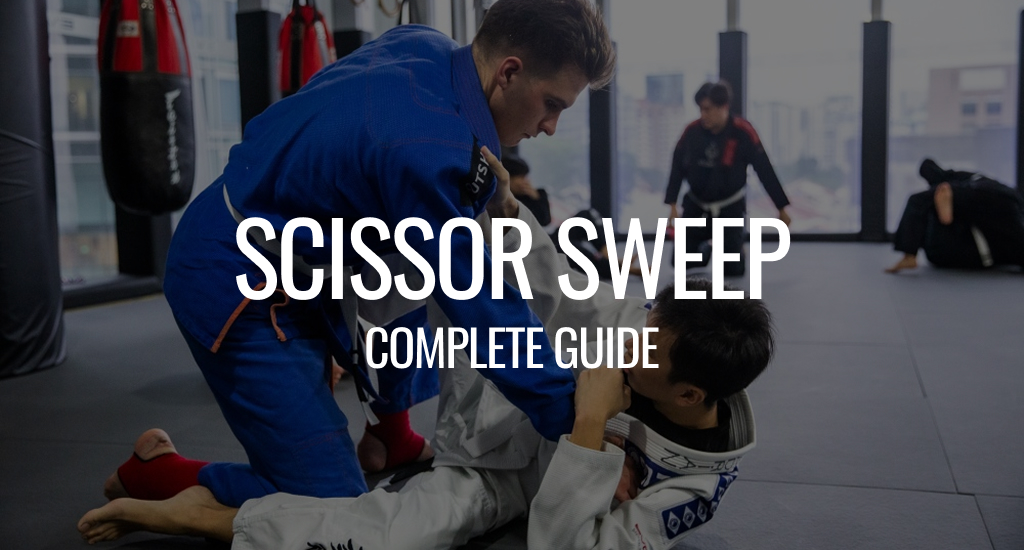
What the Scissor Sweep Is
The scissor sweep is one of the first sweeps most white belts learn. You lie in closed guard and scissor your legs while pulling your opponent off balance. One shin cuts across their belt line. The other leg chops low at their base.
It stays effective at black belt too. The mechanics scale well once your timing sharpens.
Step-by-Step Execution
- Grip their collar with one hand and their sleeve with the other.
- Open your guard and slide your shin across their stomach.
- Drop your other leg flat and low, across their shin.
- Pull with your grips while scissoring your legs in opposite directions.
- Roll them over and settle into mount.
The Detail That Makes It Work
Your bottom leg must stay flat on the mat. If it lifts, your opponent simply steps over it. That flat leg is the block. The top shin is the push. You need both parts working at once.
Variations
John Danaher teaches a 2-on-1 grip version that removes one of your opponent's posts. In no-gi, you replace collar and sleeve grips with a collar tie and wrist control. The leg mechanics stay identical.
Common Mistakes
- Lifting the bottom leg, which lets your opponent step over the block.
- Pulling with your arms only, without the scissoring leg action.
- Failing to break posture first, so they stay too upright to move.
Our closed guard guide covers the position this sweep comes from. For the submission that pairs best with a failed scissor sweep, see our triangle choke guide.
Tagged with:#scissor sweep#closed guard#sweeps#beginners
Frequently Asked Questions
Why does my scissor sweep keep failing?
The most common cause is lifting your bottom leg off the mat. That leg is the block that stops your opponent from stepping over. It has to stay flat for the sweep to work.
Does the scissor sweep work in no-gi?
Yes. Replace the collar and sleeve grips with a collar tie and wrist control. The scissoring leg mechanics do not change at all.
Is the scissor sweep good for beginners?
Yes. It is one of the first sweeps most white belts learn, since it teaches the core idea of off-balancing with your legs while gripping from closed guard.
How do I defend the scissor sweep?
Keep your posture strong and your base wide so it is harder for your opponent to break you down, and if your knee gets trapped, post your far hand to stop the roll before it fully commits.
Sources & Further Reading
About the Author
Mohsin AyubBJJ practitioner, 6 years — Gracie Barra
Founder & Editor, BJJ Sportswear
Mohsin has trained Brazilian Jiu-Jitsu for six years at Gracie Barra and has competed at IBJJF-affiliated tournaments. He writes about competition, gear, and athlete careers, and founded BJJ Sportswear to help grapplers find equipment and information they can trust.
- Six years training Brazilian Jiu-Jitsu at Gracie Barra
- Competed at IBJJF-affiliated tournaments
- Writes on BJJ competition, gear testing, and athlete careers
This article was last reviewed and updated on 2026-08-01.