
On This Page
Editorial Standards
Reviewed by the BJJ Sportswear Editorial Team for technical accuracy and kept current.
Toe Hold in BJJ: Setup, Finish & IBJJF Legality
The toe hold attacks the foot with the same figure-four grip as a kimura, and it is legal earlier than most people assume. Here is how it works.
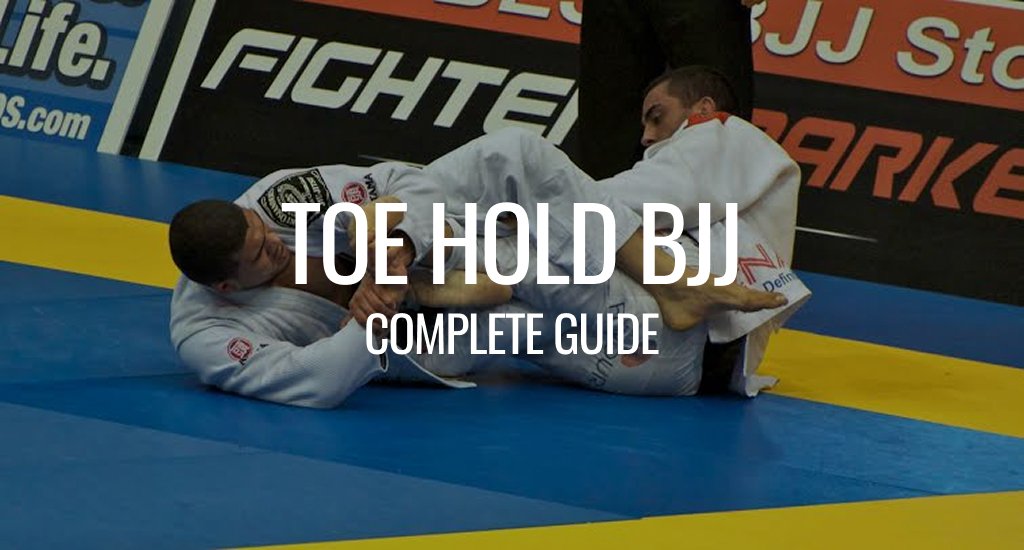
What a Toe Hold Does
A toe hold grabs the foot and rotates it, twisting the ankle and knee together through the foot's own limited range of motion. Mechanically it is close cousin to a kimura, just applied to the foot instead of the wrist and shoulder — the same figure-four grip principle, aimed at a joint with far less room to move before something gives.
The Setup
- Control your opponent's foot with a figure-four grip: one hand grips the foot, the other grabs your own wrist, forming a closed loop around the top of the foot.
- Trap their leg against your body or between your legs so they cannot simply pull it free while you set the grip.
- Rotate the foot while keeping the leg pinned, twisting through the ankle and knee at the same time.
- Finish with a slow, controlled turn rather than a fast crank — like most small-joint attacks, the foot gives very little warning before something tears.
Where It Comes Up
Toe holds appear constantly in leg-lock exchanges, particularly from 50/50 guard and other tangles where a foot is already isolated for a straight ankle lock or heel hook attempt. If an opponent defends one of those attacks by rotating their foot a certain way, they can hand you a toe hold instead — it is often the submission you end up with rather than the one you originally hunted.
Common Mistakes
- Losing the leg pin mid-rotation, which lets your opponent simply pull the foot free.
- Cranking fast instead of slow, risking real injury to a training partner who has little warning before the joint gives.
- Fighting the grip instead of the position — securing the figure-four matters less than making sure the leg cannot escape while you set it.
Defending the Toe Hold
Point your toes and turn your foot in the direction it is being rotated rather than resisting straight against the pressure, and tap early — the small-joint warning window here is short, closer to a wristlock than to a slower submission like an armbar.
Is the Toe Hold Legal in Competition?
Under IBJJF rules, toe holds are illegal at white, blue, and purple belt in the gi. In no-gi specifically, toe holds become legal starting at purple belt. Brown and black belts have it available in both gi and no-gi. Always confirm the exact ruleset before a specific tournament, since sub-only and other no-gi promotions frequently allow it earlier than IBJJF does. See our complete IBJJF rules guide for the full illegal-technique breakdown by belt.
Tagged with:#toe hold#leg locks#submissions
Frequently Asked Questions
Is the toe hold legal in IBJJF competition?
It is illegal at white, blue, and purple belt in the gi. In no-gi, it becomes legal starting at purple belt, and brown and black belts have it available in both gi and no-gi.
Is a toe hold the same as a heel hook?
No. A toe hold rotates the foot itself through a figure-four grip, closer in mechanics to a kimura applied to a smaller joint. A heel hook rotates the heel to twist the knee, and the two have separate legality rules at most belt levels.
Why is the toe hold considered dangerous?
Like most small-joint attacks, the foot gives very little warning between discomfort and real injury, so a fast crank carries more risk than a slower submission like an armbar or a choke.
What position do toe holds usually come from?
50/50 guard and other leg entanglements are the most common entries, often appearing as a natural follow-up when an opponent defends a straight ankle lock or heel hook by rotating their foot a certain way.
Sources & Further Reading
About the Author
Mohsin AyubBJJ practitioner, 6 years — Gracie Barra
Founder & Editor, BJJ Sportswear
Mohsin has trained Brazilian Jiu-Jitsu for six years at Gracie Barra and has competed at IBJJF-affiliated tournaments. He writes about competition, gear, and athlete careers, and founded BJJ Sportswear to help grapplers find equipment and information they can trust.
- Six years training Brazilian Jiu-Jitsu at Gracie Barra
- Competed at IBJJF-affiliated tournaments
- Writes on BJJ competition, gear testing, and athlete careers
This article was last reviewed and updated on 2026-08-18.