
On This Page
Editorial Standards
Reviewed by the BJJ Sportswear Editorial Team for technical accuracy and kept current.
What Is the IBJJF? Rules, Scoring & How to Compete
The IBJJF sets the rules almost every gi competitor plays by. Here is what it actually is, how scoring works, which techniques are legal at your belt, and how to register for your first event.
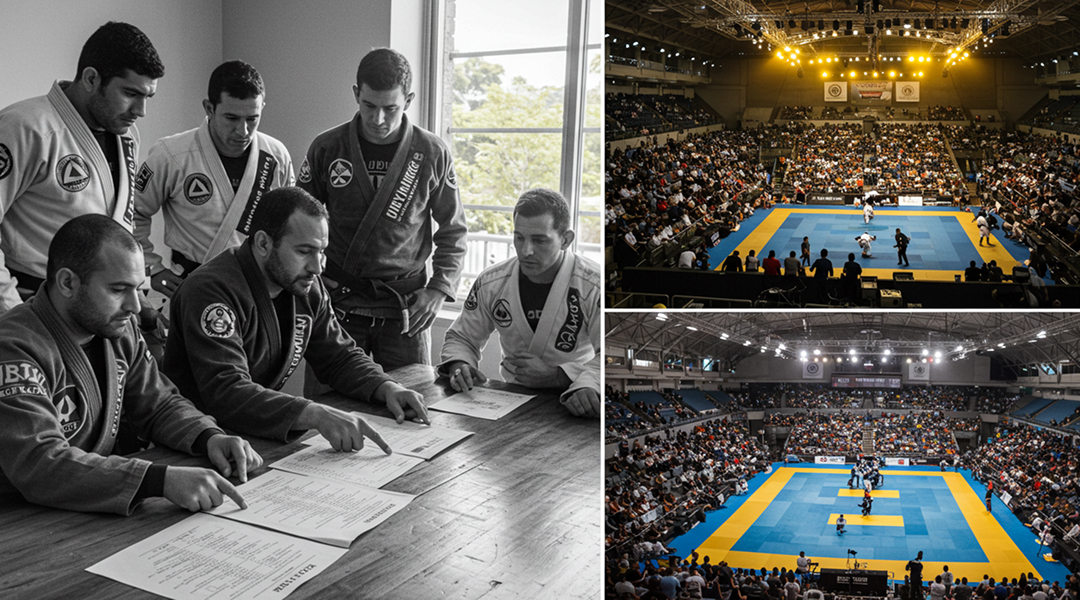
If you plan to compete in gi BJJ, or you just want to follow the sport seriously, you need to understand the IBJJF. It sets the rules nearly every major gi tournament runs on. This guide covers what it is, how scoring actually works, which techniques are legal at your belt, and how to register for your first event.
What Is the IBJJF?
The International Brazilian Jiu-Jitsu Federation was founded in 1994 by Carlos Gracie Jr. — son of BJJ pioneer Carlos Gracie, and founder of Gracie Barra, one of the largest BJJ academies in the world. Its original goal was simple: standardize rules, belt promotion requirements, and tournament structure for a sport that was spreading fast beyond Brazil.
Today, the IBJJF runs over 100 tournaments a year across more than 50 countries. It maintains the sport's main global ranking system. It sets the rulebook that governs belt promotions at affiliated academies. And it organizes the four Grand Slam events — the most prestigious gi tournaments in the sport.
It isn't the only major organization in BJJ. ADCC, UAEJJF, and NAGA all run significant events too. But IBJJF is the standard reference point for competitive gi jiu-jitsu worldwide. Most academies are either IBJJF-affiliated, or they follow IBJJF rules as a baseline even without formal affiliation.
The Four Grand Slam Events
The IBJJF Grand Slam is four major gi tournaments that form the backbone of the competitive calendar. Winning them, especially Worlds, defines a competitor's legacy in the sport.
European Championship (January, Lisbon) kicks off the competitive year, typically drawing 6,000+ competitors from across Europe and beyond.
Pan-American Championship (March, Florida), known simply as "Pans," is one of the largest tournaments in the world by competitor count and carries serious ranking weight — generally considered the second most prestigious event after Worlds.
Brazilian Nationals (April–May, São Paulo), the Brasileiro, carries particular cultural weight since Brazil remains the sport's spiritual home. Completing all four Grand Slams in one year earns a competitor the Grand Slam title, one of the most respected achievements in the sport.
World Championship (May–June, Long Beach, California), the Mundials, is widely considered the most prestigious gi tournament in the world. A black belt world title is the defining achievement of a competitive BJJ career.
How IBJJF Scoring Works
This is the part most guides skip, and the part every competitor actually needs. Matches are won by submission, points, or advantage count.
| Action | Points |
|---|---|
| Takedown (standing to ground, with control) | 2 |
| Sweep (reversing top/bottom from guard) | 2 |
| Knee on belly (held 3 seconds) | 2 |
| Guard pass (to side control, held 3 seconds) | 3 |
| Mount (full mount, held 3 seconds) | 4 |
| Back control (hooks in, held 3 seconds) | 4 |
Points only count once the position is held for the required time. A guard pass that lasts two seconds scores nothing. A mount you immediately lose scores nothing. The 3-second rule catches a lot of beginners off guard.
Advantages are tiebreakers, not points. They're awarded for near-submissions, almost-completed guard passes, and near-sweeps. If points are tied at the end, advantages decide the winner. If advantages are tied too, the referee makes a judgment call based on who was more aggressive.
Match length by belt (adult divisions): black belt 10 minutes, brown 8, purple 7, blue 6, white 5. Masters divisions typically run 5–6 minutes.
A match ends immediately on a tap, a verbal submission, or a referee stoppage for safety. Otherwise, points decide, then advantages, then referee judgment. Knowing the scoring math mid-match — down 3 points with two minutes left means you need a sweep plus a guard pass, not just one or the other — is a real competitive edge.
Illegal Techniques by Belt Level
This is the most practically important section for competitors — getting it wrong risks disqualification, penalty points, or a real injury.
White belt is the most restricted: heel hooks, knee reaping, neck cranks, slams, kneebars, and toe holds are all illegal. Straight ankle locks are legal.
Blue and purple belt carry all white belt restrictions forward. Toe holds become legal at purple belt in no-gi specifically. Kneebars and inside heel hooks stay illegal in gi at every belt below black.
Brown and black belt (gi) finally opens up straight ankle locks, kneebars, and toe holds. Inside and outside heel hooks, cervical locks, and slams stay illegal in gi at every belt, including black.
No-gi has its own rule: heel hooks become legal at purple belt and above, a meaningful difference from the gi ruleset and part of why many athletes find no-gi more technically demanding at higher belts.
The penalty system escalates fast. A first illegal-technique attempt gets a verbal warning plus an advantage to your opponent. A second gets 2 points to your opponent. A third gets disqualification. Attempting a heel hook at white belt, even by accident, can cost you the match before any submission happens.
Belt Promotion Requirements
IBJJF also standardizes belt timelines at affiliated academies:
| Belt | Minimum Age | Minimum Time at Previous Belt |
|---|---|---|
| Blue | 16 | No minimum from white |
| Purple | 16 | 2 years at blue |
| Brown | 18 | 1.5 years at purple |
| Black | 19 | 1 year at brown |
These are minimums, not targets — most practitioners spend meaningfully longer at each belt in practice. Instructors at IBJJF-affiliated academies can't promote faster than these minimums, regardless of skill level. See our belt system guide for the full picture of what each rank actually requires.
How to Register for Your First IBJJF Event
You need an active IBJJF membership to compete at any IBJJF event. There's no way around it. Registration follows roughly the same pattern every time. Create an account on the official IBJJF site. Pay the annual membership fee. Register for the specific tournament and weight division before the deadline closes. Deadlines matter — IBJJF events routinely sell out specific belt/weight brackets weeks in advance, so registering early is a real practical concern, not just a formality.
On competition day, expect an official weigh-in shortly before your match, in your full competition gi. Not the day before. Not in your underwear. Bring a spare gi if you have one. A failed gi inspection — wrong color, non-compliant patches, damaged fabric — can cost you your match slot if you can't fix it in time.
Frequently Asked Questions
Is the IBJJF the same as the UFC for BJJ? Not quite. The IBJJF runs the competitive gi calendar and belt-promotion standards most academies reference, but it isn't a for-profit league the way the UFC is. ADCC is closer to the "biggest stage" comparison for no-gi grappling specifically.
Do I need to be IBJJF-affiliated to compete in an IBJJF event? No — your academy doesn't need to be formally affiliated for you to register and compete as an individual, though affiliated academies get some administrative benefits.
What happens if I use an illegal technique by accident? The penalty system is progressive: a first offense is a warning plus an advantage to your opponent, a second is 2 points, and a third is disqualification. Even an accidental attempt at an illegal technique triggers the penalty.
The Bottom Line
The IBJJF is the closest thing gi BJJ has to a single rulebook — scoring, legal techniques by belt, and promotion standards all trace back to it, even at academies that aren't formally affiliated. Understanding the scoring math and the belt-level technique restrictions before your first tournament is the single highest-leverage thing you can do to avoid an avoidable loss or disqualification.
Tagged with:#IBJJF#competition#rules
Frequently Asked Questions
What does IBJJF stand for?
IBJJF stands for the International Brazilian Jiu-Jitsu Federation, the largest and most influential governing body in competitive gi BJJ, founded in 1994 by Carlos Gracie Jr.
How does IBJJF scoring work?
Matches are won by submission, points, or advantage count if points are tied. Points are awarded for takedowns and sweeps (2), guard passes (3), and mount or back control (4), each only after the position is held for 3 seconds.
What techniques are illegal at white belt in IBJJF competition?
Heel hooks, knee reaping, cervical locks (neck cranks), slams, kneebars, and toe holds are all illegal at white belt. Straight ankle locks are the main leg attack legal at this level.
How much does IBJJF membership cost?
Adult annual membership runs roughly $40-55 USD, though it varies slightly by region and is billed on top of individual tournament registration fees. Always check ibjjf.com directly for current pricing before registering.
Does IBJJF have age divisions for masters competitors?
Yes — IBJJF runs seven masters divisions (Masters 1 through 7) starting at age 30 and increasing in five-year brackets up to 60+. Weight limits match the adult divisions; only the age requirement and match length change.
Sources & Further Reading
About the Author
Mohsin AyubBJJ practitioner, 6 years — Gracie Barra
Founder & Editor, BJJ Sportswear
Mohsin has trained Brazilian Jiu-Jitsu for six years at Gracie Barra and has competed at IBJJF-affiliated tournaments. He writes about competition, gear, and athlete careers, and founded BJJ Sportswear to help grapplers find equipment and information they can trust.
- Six years training Brazilian Jiu-Jitsu at Gracie Barra
- Competed at IBJJF-affiliated tournaments
- Writes on BJJ competition, gear testing, and athlete careers
This article was last reviewed and updated on 2026-08-18.