
On This Page
Editorial Standards
Reviewed by the BJJ Sportswear Editorial Team for technical accuracy and kept current.
Arm Drag in BJJ: Setup, Mechanics & Follow-Ups
The arm drag turns a stronger opponent's own arm into the thing that beats them. Here is the mechanics, the setups, and where it leads.
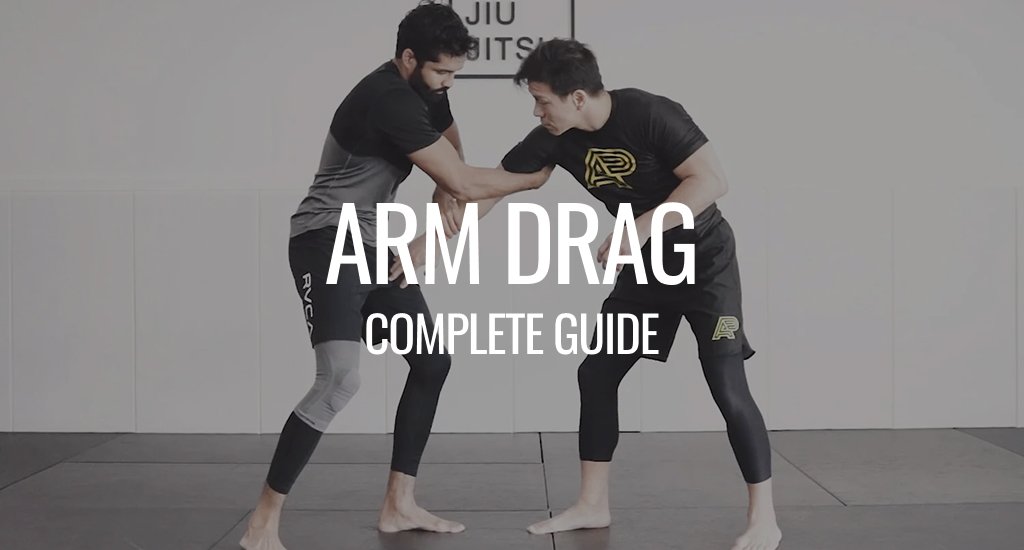
What the Arm Drag Does
An arm drag pulls your opponent's arm across the centerline of their own body instead of attacking it directly. That single motion turns their shoulders away from you and opens their back — the position every grappler wants — without needing a takedown, a sweep, or any real strength advantage. It is one of the few fundamentals that works identically standing, seated, and from the bottom of a guard.
The Core Mechanics
- Secure a grip on your opponent's wrist or sleeve, palm up if possible, since that grip angle gives you more pulling leverage than palm down.
- Pull their arm firmly across their own centerline, toward your same-side hip, while stepping or shifting your own body to the outside of that arm.
- As their shoulder turns away from you, move to their exposed side or back before they can square back up.
- Secure a seatbelt grip, an underhook, or a hook, depending on whether you are standing, in butterfly guard, or already seated.
The angle does the work, not your grip strength. A hard pull with no accompanying step just tugs on their sleeve; the step is what actually gets you around their turned shoulder.
From Standing
Marcelo Garcia and countless wrestlers use the arm drag as a takedown setup, pairing it with a snap down or a level change fake to draw a reaction before shooting. Our double leg takedown guide covers one of the most common finishes that follows an arm drag once you are past their arm.
From Butterfly Guard
Sitting in butterfly guard, an arm drag grip does double duty — it can convert straight into a sweep by loading your opponent's weight onto your hook, or into a back take if they post their weight forward to stop the sweep and hand you the angle instead.
Common Mistakes
- Pulling straight back instead of across the centerline, which just drags them toward you rather than turning their shoulders.
- Forgetting to move your own body during the pull, so the grip alone does nothing once they square back up.
- Grabbing too high near the shoulder instead of the wrist or sleeve, losing most of the leverage the drag depends on.
Defending the Arm Drag
Keep your elbows tight to your ribs so there is no space for an opponent to get a clean grip on your arm in the first place. If the drag connects, turn to face your opponent immediately rather than letting your shoulders stay turned away — the moment you square back up, the angle they gained disappears.
Why It Shows Up Everywhere
The same mechanics recur across the front-headlock family of chokes. A shallow arm in a d'arce choke or anaconda choke attempt is exactly the opening an arm drag needs, which is why coaches drill defending the drag alongside defending those chokes rather than as a separate skill.
Tagged with:#arm drag#wrestling#back takes#fundamentals
Frequently Asked Questions
Does the arm drag work in the gi and no-gi?
Yes. It works with a sleeve grip in the gi or a bare wrist grip in no-gi, and the underlying mechanics — pulling across the centerline and stepping to the exposed side — stay identical in both.
What is the best follow-up after a successful arm drag?
Taking the back is the highest-value follow-up whenever it is available, since the arm drag already turns your opponent's shoulders away from you. A takedown or a sweep are the next most common options depending on whether you started standing or seated.
Why does my arm drag not work even with a good grip?
Almost always because the pull is not paired with a step or shift of your own body. A strong grip that pulls straight back instead of across the centerline just tugs on the sleeve without actually opening the angle.
Is the arm drag effective against bigger opponents?
Yes — it is one of the few fundamentals that relies on angle and timing rather than strength, which is a large part of why Marcelo Garcia built so much of his game around it against much larger competitors.
About the Author
Mohsin AyubBJJ practitioner, 6 years — Gracie Barra
Founder & Editor, BJJ Sportswear
Mohsin has trained Brazilian Jiu-Jitsu for six years at Gracie Barra and has competed at IBJJF-affiliated tournaments. He writes about competition, gear, and athlete careers, and founded BJJ Sportswear to help grapplers find equipment and information they can trust.
- Six years training Brazilian Jiu-Jitsu at Gracie Barra
- Competed at IBJJF-affiliated tournaments
- Writes on BJJ competition, gear testing, and athlete careers
This article was last reviewed and updated on 2026-08-18.