

Scissor Sweep: Complete BJJ Closed Guard Technique Guide
By BJJ Sportswear Editorial Team
Reviewed by competitive black belts specializing in closed guard systems and fundamental sweep mechanics | Last Updated: January 28, 2026
The scissor sweep is Brazilian Jiu-Jitsu’s foundational sweep. It’s a closed guard technique that uses a scissoring motion with your legs to unbalance and sweep opponents. This demonstrates how BJJ uses leverage to move larger, stronger people. What makes the scissor sweep essential for white belts is universality. This is the first sweep most beginners learn. It teaches fundamental mechanics of grip control, hip movement, and off-balancing that apply to every other sweep in Brazilian Jiu-Jitsu.
According to Evolve MMA, the scissor sweep is a great option for newbies because it starts by first establishing good control of your opponent’s posture. A typical scissor sweep starts from the closed guard. This guard relies on cross collar and sleeve control. The reliance on grips makes it easier for beginners to transition to an attack.
BJJ Graph emphasizes John Danaher’s teaching: “The scissor sweep is the most fundamental and highest-percentage sweep from closed guard”. The key is understanding the precise coordination between upper body control and leg scissor motion. The push-pull action with the grips must be perfectly timed with the leg scissor to create irresistible force.
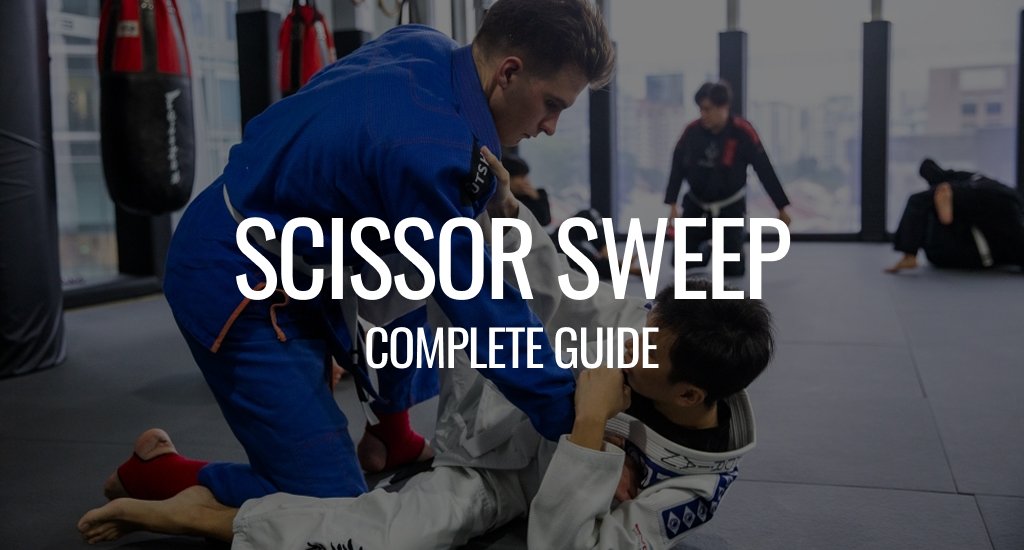
Table of Contents
What Is the Scissor Sweep?
The scissor sweep is a closed guard sweep where you control your opponent’s posture with collar and sleeve grips. You open your guard to create a scissor-like position. One leg goes across their torso. One leg blocks their base. Then you execute a coordinated push-pull motion to topple them sideways. You follow to mount position.
Core mechanics:
- Start from closed guard position
- Use collar and sleeve grips for control
- Open guard to scissor position
- One leg across torso (high point)
- One leg blocks base (low point)
- Push-pull with grips
- Scissor motion with legs
- Kuzushi (off-balancing) is essential
- Land in mount position
Lucas Lepri teaches basics: To successfully hit the scissor sweep, you need two grips on your opponent. Grab your opponent’s lapel with one hand and sleeve with the other. One leg stays planted to the mat. The other is across your opponent’s back. Load your opponent (pull them up towards you). Create a cutting or “scissor” motion with your legs.
Understanding closed guard fundamentals helps because the scissor sweep builds directly on closed guard control. It teaches how to transition from static control to dynamic attacking.
The Basic Scissor Sweep Step-by-Step
Evolve MMA teaches fundamentals with a proven method.
Step 1: Establish grips from closed guard
Start in closed guard with your legs locked. Grab a cross collar grip (opposite lapel). Grab sleeve grip (same side as collar). Maintain strong control. Lucas Lepri emphasizes: Grab your opponent’s lapel with one hand and sleeve with the other.
Step 2: Open guard and hip escape
Evolve MMA describes: You need to first open your guard. Shift towards a hip. Place a knee on your opponent’s torso. Block the other knee with your foot. Maintain control of your grips throughout.
Open your closed guard. Hip escape to one side. Turn your body sideways. Create an angle. Keep your grip control throughout. Lucas Lepri adds: Hip escape and turn your body to the side.
Step 3: Position legs in scissor formation
Your high leg (knee on torso) goes across opponent’s chest. Your shin is parallel to their body. This creates a high point of leverage under their armpit. Your low leg (blocking base) blocks their knee or hip with your foot. This is the low point of leverage. It prevents their base and creates the scissor.
Scissor mechanics video teaches: I need to have a high point being under her armpit and a low point being at her base. Those two are going to be as far away from each other as possible to sweep her.
Step 4: Create kuzushi (off-balance)
Evolve MMA emphasizes: You need to unbalance your opponent (kuzushi) by pulling the torso towards your head. This makes the body lighter.
Pull the collar toward your head. “Load” your opponent onto your knee. Lift them forward. Their weight comes off their base. This creates vulnerability. Lucas Lepri describes: Load your opponent (pull them up towards you).
Step 5: Execute scissor motion and sweep
Evolve MMA completes technique: From here, you use your knee to dump the opponent towards one side while making a scissor motion with your legs. You should be able to go to mount easily if done correctly.
Pull with your collar grip. Push with your sleeve grip. Your top leg cuts across. Your bottom leg extends (kicks out). Use the scissor motion. Your opponent topples sideways. Follow to mount. Lucas Lepri emphasizes: Create a cutting or “scissor” motion with your legs.
Critical Details That Make It Work
Detail 1: Turn the wrist
Evolve MMA teaches key detail: BJJ World Champion Teco Shinzato demonstrates how to execute the scissor sweep. Note that the key detail of this sweep is to load the opponent’s weight to your knee. An effective way to do this is to turn your wrist as you pull the arm (similar to how you’d look at your watch).
This creates a better angle. It’s easier to load weight. You get a stronger pull. It creates more effective kuzushi. This gives you a higher percentage sweep.
Detail 2: Keep bottom leg down
Chewy Jiujitsu emphasizes: This outside leg again has to be flat. If it’s up even a small inch then you can’t finish the scissors sweep properly. We keep it flat on the mat.
Your bottom leg must be flat on the mat. NOT elevated. This is critical for scissor action. It’s a common beginner mistake. Keep it down until the sweep. Scissor mechanics video confirms: I only drop it to the mat at the final instant right before sweeping.
Detail 3: Grind hips up
Chewy teaches adjustment: Simple things like turning the wrist over, grinding the hips up rather than simply coming up to the knees in mount have really helped.
Don’t just come to your knees. Grind your hips forward. Consolidate your position. Secure mount. This is an advanced detail.
Detail 4: High and low points
Scissor mechanics video emphasizes: Don’t go low and low or high and high—low and high.
Your top leg = HIGH (armpit). Your bottom leg = LOW (base). Create maximum distance between them. This creates the strongest lever. This gives you the most effective sweep.
Scissor Sweep Variations
2-on-1 grip variation (John Danaher)
Evolve MMA teaches Danaher method: John Danaher shows a variation of the scissor sweep from a 2 on 1 grip. This is especially useful when your opponent grabs your lapel in an attempt to open the closed guard.
When your opponent grabs your lapel, establish a cross sleeve grip. Grab near their tricep on the same side. This controls one side of their body. Place your knee at an angle toward their chest. Block their opposite hip with your foot. Bring your knee forward. Unbalance your opponent. Complete the sweep.
Overhook variation
Evolve MMA describes: BJJ black belt Jason Scully demonstrates the overhook scissor sweep in detail.
Establish an overhook on one arm. Move your hips slightly to the side. Get a cross lapel grip. Lift your elbow. Place your knee at an angle on their torso. Your opponent tilts to the side. Use the same scissoring motion. This is a strong variation.
No-gi scissor sweep
Evolve MMA teaches no-gi adaptations: Jordan Hix shows a couple of simple scissor sweeps without the gi.
For 2-on-1 grip (no-gi), establish the grip and keep your elbow close to your body. Put your knee toward their sternum. Block their knee with your foot. Elevate and sweep. For armdrag grip, drag their arm to your chest center. Loop your arm through. Use an RNC-style grip on their elbow. Execute the sweep.
Common Scissor Sweep Mistakes
Mistake 1: No kuzushi (off-balance)
The problem is not loading your opponent. You don’t pull them forward. Your opponent stays balanced. The sweep fails. The fix is to pull the collar toward your head. Load them onto your knee. Create kuzushi first. Then sweep. Chewy explains: If I can just bring him up to where his base is now off, his center of gravity is no longer loaded up under his hips, very easy.
Mistake 2: Bottom leg not flat
The problem is your bottom leg is elevated. You lose scissor mechanics. You can’t generate power. The sweep fails. The fix is to keep your bottom leg FLAT on the mat. Only lift it at the final moment. This is a critical detail.
Mistake 3: High and high or low and low
The problem is both legs at the same height. You have no leverage. The sweep is weak. It’s easy to defend. The fix is top leg HIGH (armpit) and bottom leg LOW (base). Create maximum separation. This creates a strong lever.
Mistake 4: Poor grip control
The problem is losing grips during the sweep. You have no push-pull. Your opponent escapes. The technique fails. The fix is to maintain grips throughout. Turn your wrist (Teco detail). Keep strong collar control. Use coordinated push-pull.
Defending the Scissor Sweep
BJJ Graph lists counters that opponents commonly use.
Common defenses include: Base wide (widen stance early, prevents scissor effectiveness, 45% success rate). Grip break (break collar or sleeve, neutralizes control, 40% success rate). Drive forward (pressure forward to pass before sweep executes, 35% success rate). Post hand (post hand to prevent rollover, quick reaction needed, 50% success rate).
Scissor Sweep Combinations
Chewjitsu teaches combinations: It utilizes the motion of the scissor sweep to setup the triangle choke. Because most white belts spend a ton of time drilling scissor sweeps.
If the scissor sweep is defended, transition to triangle choke. You can also set up armbar. Or flow to other sweeps like butterfly sweep. These combinations keep constant pressure on your opponent.
Training the Scissor Sweep
BJJ Graph explains why this is taught first. It’s often the first sweep taught in beginner curriculum. It’s a drilling foundation. It develops sweep timing. It integrates into flow training. It prepares you for competition. It’s a technical mastery benchmark.
Eddie Bravo quote: “The scissor sweep is the foundation that all other closed guard techniques build upon”. I teach it as the first sweep because mastering its mechanics teaches students proper grip control, hip movement, and the timing required for all guard work.
Drilling protocol:
For solo drilling, practice hip escape movements, leg positioning, and scissor motion practice. Do 50 reps daily. For partner drilling, start cooperative (no resistance). Add light resistance (25%). Progress to moderate resistance (50%). Finally integrate into live rolling.
Advanced application:
Evolve MMA addresses misconceptions: While it may be a great technique, many think it is only a move best used by and on white belts. This is incorrect. Most “beginner” techniques don’t work as effectively on experienced grapplers because they know the counters to them.
To make it work on higher belts, set traps. Work combinations. Mask the technique. Use setups. Modify entries. Try different grip variations. Evolve MMA concludes: Doing a scissor sweep without any setup on a purple belt simply won’t work. You can also slightly modify the technique depending on the entry and initial grip.
Conclusion
From Rickson Gracie’s fundamental teaching to Teco Shinzato’s world championship application and John Danaher’s systematic breakdown, the scissor sweep represents Brazilian Jiu-Jitsu’s most foundational sweep technique. What makes mastering this technique essential for white belts is transferability. The grip control, hip movement, and timing learned here apply to every other closed guard attack in your arsenal.
BJJ Graph emphasizes John Danaher’s teaching: “The key is understanding the precise coordination between upper body control and leg scissor motion”. The push-pull action with the grips must be perfectly timed with the leg scissor to create irresistible force that makes defense nearly impossible.
The scissor sweep proves a fundamental grappling truth: simple mechanics executed perfectly beat complex techniques done poorly. While beginners rush to learn flashy moves, experienced grapplers master basic sweeps. They use setups, combinations, and variations to make “white belt techniques” work at every level.
Whether you’re learning your first sweep as a white belt or refining championship-level variations, mastering the scissor sweep gives you the fundamental movement pattern that makes your entire closed guard game more effective. For more techniques, check our complete technique section and BJJ belt system guide.