
On This Page
Editorial Standards
Reviewed by the BJJ Sportswear Editorial Team for technical accuracy and kept current.
Open Guard Concepts: A Complete Guide to BJJ’s Most Dynamic Position
Open guard is where most modern sweeps, leg entries, and back takes begin. It also gets passed the moment you lose structure. These are the concepts that hold it together.
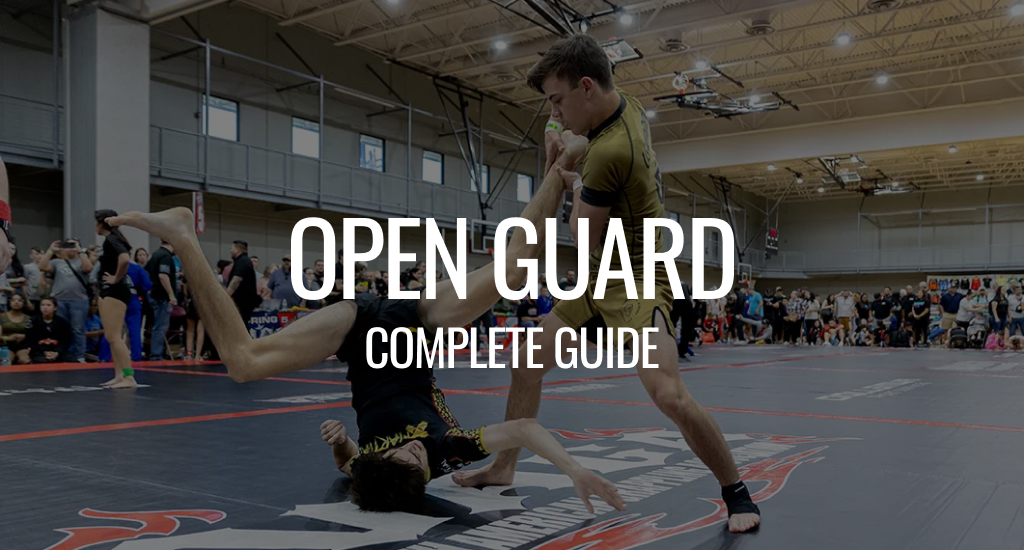
Closed guard is safe, but open guard is where the game happens. Once your legs are no longer locked you can sweep, attack the legs, take the back, and stand up, but you also lose the friction that held closed guard together. That means open guard runs on principles rather than grips.
This guide covers the concepts that every open guard variation shares, and the individual guards, such as spider, de la Riva, and butterfly, become much easier once you understand them.
The Three Pillars of Open Guard
Every good open guard has three things happening at once, and losing any one of them means you are about to get passed.
1. Connection
You cannot control what you do not touch, so aim for at least three points of contact at all times, such as two hands and one foot, or two feet and one hand. Each contact point lets you push, pull, or feel what your opponent is about to do.
2. Distance Management
You must decide the range, not them. There are three ranges to know:
- Long range. Feet on their hips or biceps. This keeps them away and buys time.
- Close range. Hooks under their legs, as in butterfly or X-guard. This is where you lift and sweep.
- The danger zone. The space in between. Too far to hook, too close to push. Guards get passed here.
If you feel yourself drifting into the middle, either pull them in or push them out. Do not sit there.
3. Off-Balancing
A still guard is a passed guard, so use your connection points to keep them adjusting their base. Pull a sleeve as you push a hip, or lift a leg as you drag an arm, because if they are busy staying upright they are not passing.
Seated vs Supine
There are two ways to play open guard, and both matter.
- Seated guard. You are sitting up, weight on your hands and feet. It is mobile and aggressive. You can wrestle up, snap them down, or enter leg positions. It is the default start in no-gi.
- Supine guard. You are on your back. It usually happens because they pushed you there. It opens the underneath game, such as X-guard and deep de la Riva. It is also where inversion lives.
Good players move between the two, and if you get pushed flat there is no need to panic: frame, shrimp, and sit back up.
The Major Open Guard Styles
Open guard is a family, not one position. These are the styles you will meet most:
- Spider guard. Feet on the biceps with sleeve grips. Stretches your opponent out and kills their strength.
- De la Riva guard. An outside hook around their lead leg. Excellent for off-balancing and back takes.
- Butterfly guard. Hooks inside the thighs. The base for the butterfly sweep.
- Collar and sleeve. The fundamental gi guard. Controls posture and takes away a posting hand.
- Single leg X and X-guard. Underneath positions that lead to sweeps and leg attacks.
- Half guard. Technically its own family, but it shares every principle here.
Guard Retention
Retention is the skill of not getting passed, and it matters more than any single sweep. Use the frames and hips idea:
- Frame. Never let them control your head. Keep stiff arms on their shoulders, hips, or collar.
- Pummel. When they push your legs to one side, circle your feet back inside. Legs on the inside always beat legs on the outside.
- Hip movement. Shrimp away from pressure and square back up.
- Inversion. As you advance, rolling upside down lets you recover when they get to your side.
If your legs do get bypassed, you are in survival mode. Our side control escape guide covers what comes next.
Common Mistakes
- Reaching for grips before setting your feet. Feet first, then hands.
- Playing flat on your back with no frames.
- Chasing one sweep while ignoring the danger zone.
- Letting them grip your pants or ankles without stripping the grip.
How to Build Your Open Guard
Pick one style and stay with it for a few months, learning its main sweep, its main back take, and how it connects to one other guard before you add the next style. A small, connected system beats a long list of half-learned positions.
Tagged with:#open guard#guard retention#fundamentals
Frequently Asked Questions
What is open guard in BJJ?
Any guard where your legs are not locked around your opponent. It includes spider, de la Riva, butterfly, X-guard, and collar-and-sleeve guard. It relies on connection, distance control, and off-balancing rather than friction.
Should beginners play open guard?
Yes, but start simple. Learn seated guard with feet on the hips, work on retention, and add one style such as butterfly or collar-and-sleeve. Closed guard is safer, but open guard is where most sweeps and attacks live.
How do I stop my open guard getting passed?
Keep three points of contact, stay out of the middle range, and keep your opponent off balance. When they push your legs aside, circle your feet back inside and frame against their shoulders. Movement and frames beat strength.
What is the difference between seated and supine open guard?
Seated guard has you sitting upright, mobile and aggressive, and is the default in no-gi. Supine guard has you on your back, which opens the underneath game such as X-guard and deep de la Riva.
Does open guard work in the gi?
Yes, and several open guard styles such as spider and collar-and-sleeve rely specifically on gi grips. No-gi players lean more on butterfly, X-guard, and wrist control instead.
About the Author
Mohsin AyubBJJ practitioner, 6 years — Gracie Barra
Founder & Editor, BJJ Sportswear
Mohsin has trained Brazilian Jiu-Jitsu for six years at Gracie Barra and has competed at IBJJF-affiliated tournaments. He writes about competition, gear, and athlete careers, and founded BJJ Sportswear to help grapplers find equipment and information they can trust.
- Six years training Brazilian Jiu-Jitsu at Gracie Barra
- Competed at IBJJF-affiliated tournaments
- Writes on BJJ competition, gear testing, and athlete careers
This article was last reviewed and updated on 2026-08-16.
Related Reading
Technique Library
Spider Guard: Complete BJJ Guide
Technique LibraryDe La Riva Guard: Sweeps, Berimbolo & Back Takes
Technique LibraryButterfly Sweep: Complete BJJ Guide (Marcelo Garcia Method)
Technique LibraryHalf Guard BJJ: Sweeps, Variations & Passing Guide
Technique LibrarySide Control Escape: The Complete Defense Guide
Technique LibraryClosed Guard BJJ: Posture, Sweeps & Submissions
Related Reading
Technique Library