Spider Guard BJJ: Sweeps, Submissions & Variations
The spider guard is one of the most technically rich positions in all of BJJ.
No other open guard gives you simultaneous control over both of your opponent’s arms while your legs do the work. You can sweep in multiple directions, submit with the triangle, armbar, or omoplata, and transition between guard variations seamlessly — all from the same foundational grip configuration.
Romulo Barral used it to win five world championships. Michael Langhi, Leandro Lo, Cobrinha, and Andre Galvao all built signature games around it. It remains one of the most studied and effective guard systems in gi BJJ competition today.
Position fact: The spider guard is exclusively a gi position in its standard form — sleeve grips are essential. However, a no-gi adaptation using wrist grips exists and is used by practitioners who prefer the spider guard control system without the gi.

Table of Contents
What is the spider guard?
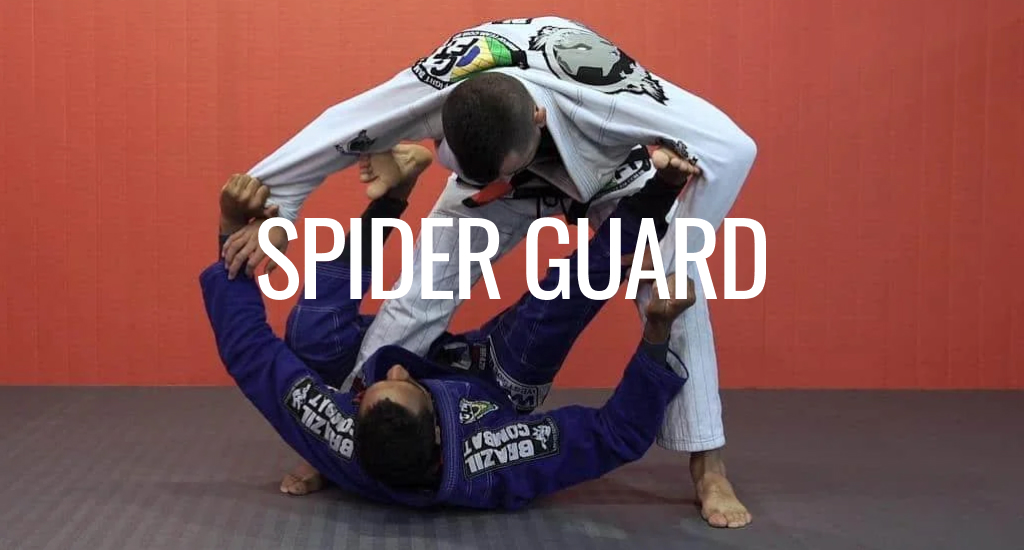
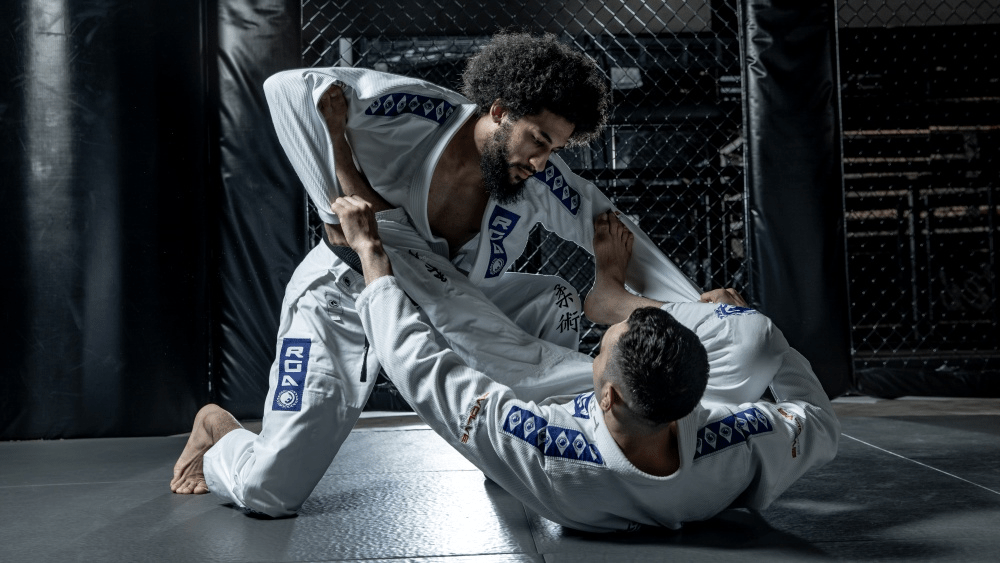
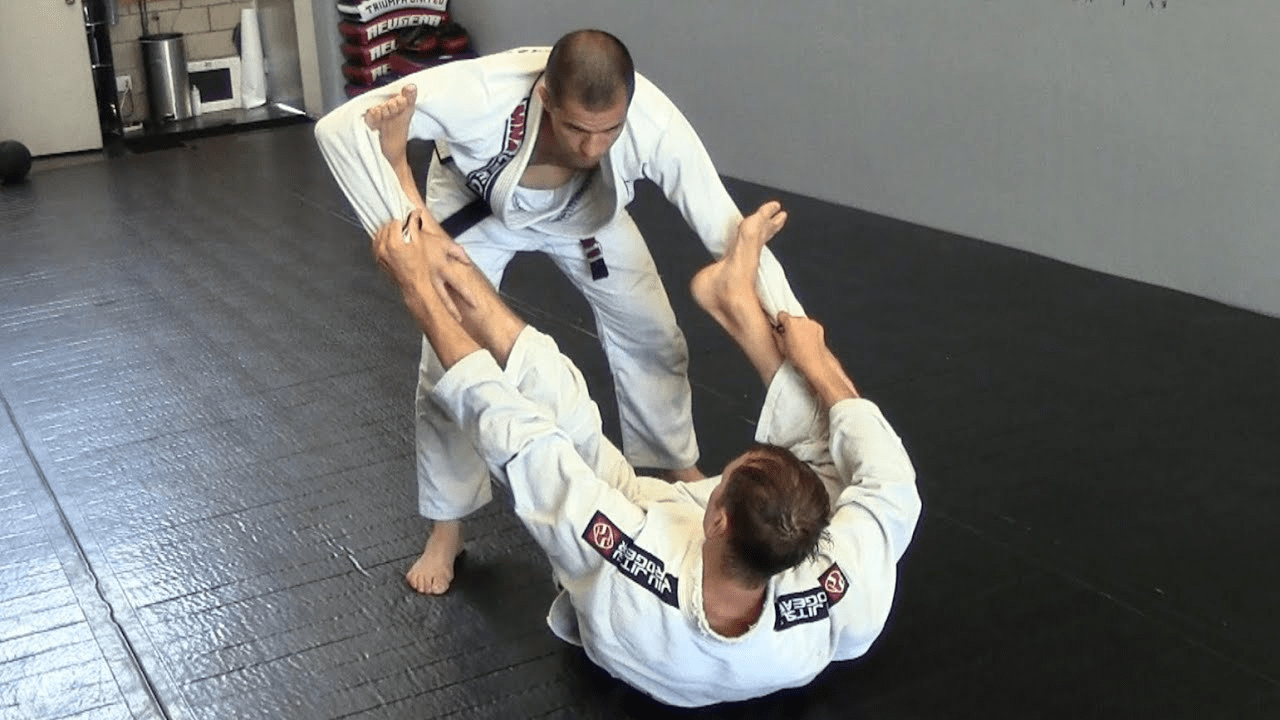
The spider guard — known as guarda aranha in Portuguese — is an open guard position where the bottom player grips both of their opponent’s sleeves and places the soles of their feet on the opponent’s biceps.
This creates a unique control structure. Your hands grip the sleeves and your feet push the biceps — creating a pushing and pulling tension that controls the opponent’s arms, breaks their posture, and limits their ability to pass or strike. Your legs act like shock absorbers and levers simultaneously — pushing the opponent away when they drive forward, pulling them into submission range when they back away.
The name comes from the visual — a spider weaving a web. Your limbs extend in different directions, creating a web of tension and control that your opponent must fight through just to move. Every direction they try to move, you have an attack ready.
The spider guard is primarily an offensive position. Unlike the closed guard which is more defensive-neutral, spider guard players are almost always attacking. The position punishes passive opponents with sweeps and active opponents with submissions.
History — Tinguinha and the world champions
The spider guard developed organically in Brazilian BJJ during the 1980s and has no single inventor. Early forms of foot-on-bicep control appeared in Kosen Judo decades earlier — practitioners there used their feet on opponents’ arms to hunt for armlocks from the bottom. Brazilian grapplers adapted and refined this concept for the gi-based open guard game.
According to BJJ Heroes, Mauricio “Tinguinha” Mariano is widely credited as one of the earliest innovators of the spider guard in BJJ competition. As a smaller practitioner regularly facing larger opponents, Tinguinha began using sleeve grips and foot-on-bicep control as a solution for keeping bigger grapplers at a manageable distance while attacking. He used the position to neutralise strength and size advantages — which is exactly the BJJ philosophy in practice.
Through the 1990s and 2000s, spider guard spread throughout competitive BJJ as practitioners discovered its offensive potential. By the time competitors like Romulo Barral, Michael Langhi, Leandro Lo, Cobrinha, and Andre Galvao were dominating world championships in the 2000s and 2010s, the spider guard had become one of the most recognised and feared positions in gi competition.
Each champion contributed distinct innovations. Leandro Lo used spider guard as a hub to transition seamlessly between open guard variations. Cobrinha combined it with De La Riva guard to create hybrid positions that were almost impossible to pass. Andre Galvao used it as a platform for back takes and leg attack entries. The position continues to evolve at the highest levels today.
Sleeve grips — how to hold them correctly
The sleeve grip is the foundation of the entire spider guard system. Without strong, correctly positioned grips, the guard collapses under any passing attempt. Most practitioners who struggle with spider guard have a grip problem — not a technique problem.
The four-finger grip
Curl all four fingers inside the sleeve fabric — not around the outside. This creates a deeper, stronger grip than an outside grip and is much harder for the opponent to strip. Your fingers should be fully inside the sleeve, with your knuckles pressing against the fabric.
Rolling the sleeve
Before gripping, roll the sleeve inward slightly — toward the opponent’s body. This creates a thicker, tighter fabric pocket for your fingers. A rolled sleeve grip is significantly harder to peel than a flat sleeve grip.
Wrist position
Keep your wrists mobile — they need to flex and rotate as you manipulate the arms. Stiff wrists reduce the pushing and pulling range you can generate. Think of your wrists as the connection point between your grip and the arm control — they need to be strong but not rigid.
Grip fighting
Your opponent will try to break your grips constantly. When they grab your wrist to peel, circle your wrist outward — rotating away from their grip direction. When they push your elbow to break the grip, move your elbow with the push rather than fighting it, and redirect to re-establish the sleeve grip. Never fight a grip break with raw tension alone — always redirect.
Grip rule: You cannot attack from spider guard without your grips. Before attempting any sweep or submission, confirm both grips are secure. Attempting attacks with loose or partial grips is the most common reason spider guard attacks fail.

Foot placement — the most important detail
The foot placement on the bicep determines the quality of your control. Wrong placement — even by a few centimetres — reduces your leverage significantly.
The correct position is the sole of your foot in the crook of the elbow — the inside of the arm where the bicep meets the forearm. Your foot sits in this natural groove. Toes point slightly toward the opponent’s elbow — not straight out.
Two common placement errors:
- Too high (on the shoulder): You lose the bicep control and the opponent can easily lower their elbow to remove your foot. You also lose the leverage needed for the kite sweep.
- Too low (on the forearm or wrist): The forearm is much stronger than the bicep for resisting your push. You tire your legs quickly and generate less balance disruption.
The foot configuration also matters. Keeping your toes slightly curled — like a claw — into the bicep creates more friction and prevents your foot from sliding off during active scrambles. A flat foot slips more easily.
How to establish spider guard
- Get sleeve grips first. From closed guard or sitting guard, grip both sleeves with four-finger grips — rolling the fabric slightly for a tighter pocket. Get both grips before opening your guard.
- Open guard and place feet on hips. Open your guard and place both feet on the opponent’s hips briefly. Use this moment to assess their posture and choose which arm to attack first.
- Transfer one foot to the bicep. Push one foot from the hip up to the crook of the elbow on that side. Keep the sleeve grip on that arm tight — do not let it loosen as you transfer the foot. Extend the leg to push the arm away.
- Transfer the second foot. Bring the second foot from the hip to the crook of the other elbow. You now have both feet on the biceps with both sleeve grips — full spider guard established.
- Get to your hip and create tension. Roll to one hip and begin pushing and pulling to create continuous tension. Attack from here.
Hip position — never stay flat
This is the most critical body position principle in spider guard. You must never lie flat on your back.
A flat back in spider guard creates three problems: your hips cannot generate power for sweeps, your inside space is exposed for your opponent to stack and pass, and you cannot create the angular leverage needed for triangle or omoplata entries.
Stay on one hip at all times. The hip on the ground, the shoulder on that same side, and the knee on that side all stay close together — protecting your inside space. Your top leg extends with the foot on the bicep. Your bottom leg adjusts based on the attack.
When you switch your attack from one side to the other — roll from one hip to the other. This hip-to-hip movement keeps you active, mobile, and generating power throughout.
Constant tension — the core principle
Spider guard is not a static position. The moment you stop creating tension, your opponent can pass.
Constant tension means continuously pushing and pulling — extending one leg while pulling that sleeve toward your chest, then switching to the other side. This back-and-forth motion keeps the opponent off-balance and prevents them from settling into a stable passing structure.
Think of it like keeping a kite in the air. The moment you stop adjusting the tension on the string, the kite falls. Spider guard works the same way — constant micro-adjustments of push-pull tension keep your opponent constantly reacting to you instead of attacking your guard.
Position-based gameplan
Your attack from spider guard should depend on how your opponent postures. Different body positions from the top player open different attacks from the bottom.
Opponent on both knees
Primary attack: kite sweep. Secondary: triangle choke when they lift one arm. Tertiary: armbar when they straighten an arm to defend.
Opponent with one knee up
Hook the standing leg with your lower foot. Extend the upper foot to stretch the arm. Combine to sweep them over the posted knee.
Opponent standing on both legs
Balloon sweep — extend one leg on bicep, hook the near ankle with your other foot, and pull them forward to sweep. Or transition to De La Riva guard.
Having a clear plan for each of these three positions eliminates hesitation. When your opponent moves, you immediately know which attack applies — rather than improvising under pressure.
Kite sweep — the primary spider guard sweep
The kite sweep is the foundation of the spider guard attack system. Every practitioner who plays spider guard learns this first. It works consistently at every belt level and every competition level.
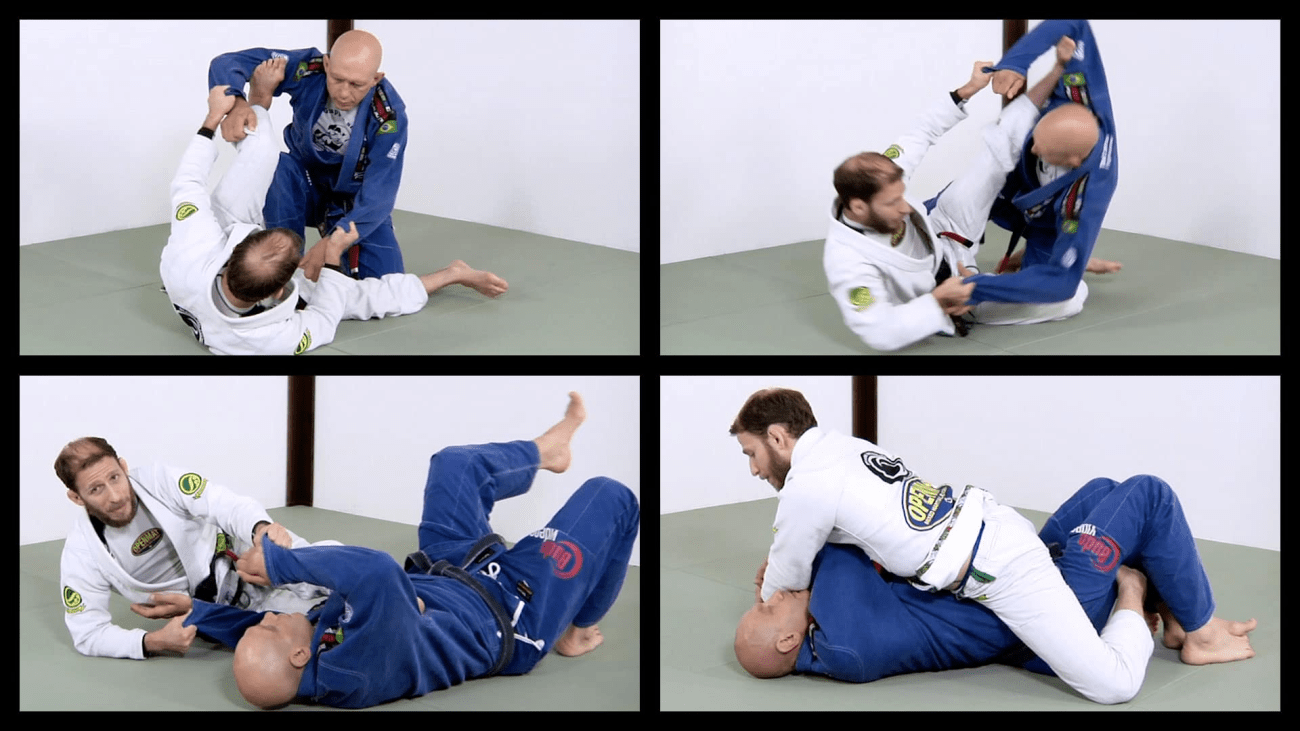
- Establish double spider hooks. Both feet on the biceps, both sleeve grips tight.
- Roll to one hip. Choose the side you want to sweep toward.
- Extend your top leg fully. Push the arm on the top side all the way out — stretching their arm and disrupting their base on that side.
- Simultaneously pull the other sleeve. Pull the bottom arm toward your chest and retract that leg. This creates the scissors motion — one arm going out, one arm coming in.
- Pull the far pant leg. With your bottom hand, reach and grab your opponent’s far pant leg. This prevents them from stepping over to base out and completes the off-balancing force.
- Follow to top position. As they fall to the swept side, follow their movement and land in side control or mount.
Kite sweep key detail: The scissors motion — extend one leg, retract the other — must happen simultaneously, not sequentially. One-at-a-time movement gives the opponent time to base out and stop the sweep. Simultaneous motion is what creates the unresistable off-balance.
Balloon sweep — against a standing opponent
When your opponent stands up inside your spider guard, your standard kite sweep becomes less effective — they now have two feet on the ground for base. The balloon sweep adapts to this situation.
- From spider guard, your opponent stands up on both legs.
- Maintain one sleeve grip and one foot on the bicep. With your other foot, reach forward and hook behind the opponent’s near ankle.
- Extend the bicep leg hard — pushing that arm and their upper body backward.
- Simultaneously pull the ankle hook — lifting their leg forward.
- The combination of the backward upper body push and the forward ankle lift topples them. They fall backward. Follow and land on top.
The balloon sweep is named for the way the opponent seems to float up and over — lifted by the ankle hook while the arm push creates the rotation.

Spider-De La Riva sweep
The De La Riva hook combines beautifully with spider guard. When your opponent stands and steps one foot forward, hook that leg with a De La Riva hook (your leg wraps around the outside of their lead leg, hooking behind the knee). Maintain one sleeve grip and one foot on the bicep on the opposite side.
From this hybrid position, drive your DLR hook leg and extend your spider foot simultaneously — the opponent’s base collapses on the DLR side and they fall. This combination is used heavily by Cobrinha and Leandro Lo in high-level competition.
Triangle choke from spider guard
The spider guard triangle is one of the highest-percentage triangle entries in all of BJJ. The sleeve grip already has one arm controlled — the triangle setup is right there.
- From spider guard, extend one foot on a bicep to stretch that arm.
- Use the other spider hook (foot on bicep) to bridge your hips up — creating space under your body.
- Shoot that second leg behind the opponent’s armpit — bringing your knee toward their neck on the stretched arm side.
- Lock the triangle choke. Cut to 90 degrees. Hide the shoulder. Finish.
The spider guard triangle is deceptive because the leg that shoots for the triangle looks identical to the leg position for the kite sweep. Your opponent cannot distinguish between the two attacks until the triangle is already locking — by which point it is too late to defend.
Omoplata from spider guard
The spider guard omoplata is Clark Gracie’s signature entry and one of the most effective omoplata setups in gi competition.
- From double spider hooks, use one spider foot to stretch an arm fully outward.
- Retract that leg slightly and shoot it under the opponent’s armpit and over their shoulder in one sharp motion.
- As the leg goes over, pivot your hips 90 degrees toward them.
- Establish far hip control with your inside arm. Sit up and finish the omoplata.
The stretched arm from the spider hook makes the omoplata entry faster and more deceptive than from closed guard. By the time the opponent realises the omoplata is coming, the leg is already over their shoulder.
Armbar from spider guard
When your opponent straightens one arm to defend the kite sweep or triangle, the armbar becomes available directly.
- You have one spider hook (foot on bicep) with the arm stretched.
- Pull that sleeve toward your chest and pivot your hips 90 degrees.
- Swing your opposite leg over the opponent’s head.
- Pinch your knees, check the thumb direction, and extend your hips to finish the armbar.
The spider guard armbar is fast because the arm is already stretched and isolated by the sleeve grip and foot position. The entry from spider guard to armbar is often faster than from closed guard because the preliminary control work is already done.
Spider-lasso guard
The spider-lasso guard is a hybrid position that combines one standard spider hook with a lasso hook on the other arm. It is one of the most secure open guard configurations in gi BJJ.
How to establish the lasso
From spider guard with one foot on a bicep, take your other leg and thread it through the opponent’s arm — going between their arm and body, with your leg wrapping around their forearm from the outside. Your shin or calf sits inside their arm against their forearm. This is the lasso hook.
Why the lasso is so effective
A simple foot-on-bicep hook can be stripped relatively easily — the opponent pushes down on your shin and removes the foot. A lasso hook is wrapped around the arm — they cannot simply push it off. They must unravel the leg, which is much harder to do quickly. The lasso hook gives you one virtually unbreakable hook while you maintain the standard spider hook on the other side.
Attacks from spider-lasso
- Triangle choke — release the lasso and shoot the leg for the triangle while maintaining the spider hook’s arm control
- Omoplata — shoot the spider hook leg over the shoulder for the omoplata while the lasso maintains the other arm
- Lasso sweep — use the lasso to drag the arm down while pivoting to sweep toward the lasso side
- Back take — when the opponent drives forward, use the lasso control to sit up behind them
Guard retention — granby roll and hip escapes
Spider guard is not impenetrable. When your opponent begins to pass, you need reliable retention tools. Two are essential.
The granby roll
When your opponent pulls you to a sitting position or begins to move around your legs, post one hand on the mat on the opposite side of their pass direction. Maintain your sleeve grip on the same side as the pass. Roll over that posted-hand shoulder — performing a backwards shoulder roll. This reverses your orientation and puts you back in guard facing your opponent. It is one of the most used guard recovery tools in open guard BJJ.
Hip escape (shrimp)
When the opponent begins to pass to one side, shrimp your hips in the same direction they are passing — not away from them. Moving your hips toward the pass creates the space to reframe with your knee and re-establish your foot on the bicep. Fighting the pass by moving away from it often accelerates the guard pass completion.
Side-to-side switching
Never hold the same spider hook configuration for more than a second or two against an active passer. Switch your active foot from one bicep to the other continuously. This constant movement makes it very hard for the passer to establish a base — every time they move, the hooks switch and they face a new passing problem.
Passing the spider guard — top player concepts
The three most reliable spider guard passes all target the same foundational weakness: the grips.
Torreando pass
Grip both pant legs at the knees and push them sharply to one side while you move in the opposite direction. This is the fastest spider guard pass. See the full torreando pass guide for details. The key is breaking the sleeve grips first — or moving fast enough that the grip break and the pass happen in one continuous motion.
Leg drag
Strip one sleeve grip by pushing the opponent’s elbow down toward the mat. As the grip breaks, grab their leg and drag it across their body — collapsing the guard on that side. Complete the pass to side control while maintaining leg control. The leg drag is the most used pass against experienced spider guard players because it directly addresses the leg control rather than trying to navigate around it.
Knee slice
After stripping one grip, drive your free knee across the opponent’s thigh toward the mat — the same knee slice pass mechanics as from half guard. This works well when one arm is freed and the guard is temporarily half-broken. Complete the pass to side control while keeping the freed leg controlled.
Passing principle: You cannot pass spider guard without first addressing the grips. Trying to run around the legs without breaking the sleeve grips gives the guard player time to reset and re-establish full spider control. Break grips first, then pass.
Gi vs no-gi differences
In the gi: Full spider guard is available with sleeve grips. Every attack described above is accessible. Sleeve grips slow transitions and give you more time to set up attacks. Spider guard is at its most powerful in the gi.
In no-gi: No sleeve grips. Use a four-finger overhand wrist grip instead — wrap your fingers over the top of the opponent’s wrist and curl them inside. Roll the wrist inward to create a tighter pocket. The foot placement on the bicep is identical. No-gi spider guard requires faster reactions because wrist grips break more easily than sleeve grips. Many practitioners transition to butterfly guard or other no-gi open guard systems when the wrist grips are consistently stripped, and use spider guard selectively when opportunities arise.
Key no-gi adjustment: Establish the wrist grip first, then the foot — rather than both simultaneously. Securing the wrist before placing the foot prevents your opponent from pulling their arm away during the establishment phase.
Combo chains
The spider guard is a hub position — all attacks chain naturally into each other based on how the opponent responds.
- Kite sweep → Triangle: Attempt the kite sweep. Opponent postures up to prevent the fall → shoot the triangle leg. Their posturing action opens the triangle entry.
- Triangle → Omoplata → Armbar: The classic three-way chain. Triangle is defended → switch to omoplata. Omoplata is defended → switch to armbar. All three share the same arm isolation.
- Omoplata → Kite sweep: Attempt the omoplata. Opponent postures hard to prevent the shoulder lock → their posturing creates the kite sweep opportunity. Go for the sweep.
- Balloon sweep → Back take: Balloon sweep attempt. Opponent defends by pushing your ankle hook down → sit up using their forward energy and take the back. Attack the rear naked choke.
- Spider guard → De La Riva: When the opponent stands and steps one foot forward, transition to De La Riva hook on that leg and maintain one spider hook. Attack from the hybrid position.
Common mistakes
- Lying flat on the back. The most common and most damaging mistake. A flat back eliminates hip power, exposes the inside space, and makes every attack weaker. Always stay on one hip.
- Static hooks. Leaving the same hook configuration for too long allows the passer to find the correct passing angle. Switch your active foot side to side continuously.
- Attacking with loose grips. Attempting a kite sweep or triangle with a partially stripped grip almost always fails. Confirm both grips are fully secure before initiating any attack.
- Feet too high or too low on the arm. Too high (on the shoulder) loses the leverage. Too low (on the forearm) reduces control and tires the legs. The crook of the elbow is the correct position.
- Sequential rather than simultaneous scissor motion in the kite sweep. Extending one leg and then pulling the other gives the opponent time to base out. Both motions must happen at the same time.
- No plan for the opponent standing. Many beginners freeze when the opponent stands up in their spider guard. Have the balloon sweep or the DLR transition ready before they stand — not after.
- Fighting grip breaks with tension alone. Using raw grip strength to resist a strip tires your hands in minutes. Use circular wrist motions to redirect the strip instead.
Belt-level training guide
The BJJ belt system gives you clear milestones for where your spider guard should be.
White belt — grips and the kite sweep
Learn the four-finger sleeve grip and the correct foot placement. Drill the kite sweep exclusively. Do not try submissions yet. The grip and the sweep mechanics are enough to develop for the first months of spider guard training. See the white belt guide for the guard fundamentals that make spider guard easier to develop.
Blue and purple belt — the triangle chain and the lasso
Add the triangle from spider guard and drill the kite sweep to triangle chain until the transition is automatic. Add the spider-lasso variation. Develop the granby roll for guard retention. The spider guard should be creating sweep and submission opportunities in live rolling regularly.
Brown and black belt — the full system
Add the balloon sweep, the DLR hybrid, the armbar, and the omoplata. Develop a position-based gameplan that covers all three opponent postures (kneeling, one knee up, standing). For advanced study, the Grapplearts Spider Guard Masterclass with Elliott Bayev and Stephan Kesting covers 9.5 hours of complete system instruction — one of the most thorough spider guard resources available. Find it at grapplearts.com.
Champions built on spider guard
Andre Galvao: ADCC and IBJJF World Champion. Adapted spider guard for transitions to back takes and leg attacks — demonstrating the position’s role as a hub for an entire open guard system rather than a standalone position.
Romulo Barral: Five-time IBJJF World Champion. Built one of the most refined spider guard systems in competition history — using it to sweep and submit world-class opponents at multiple weight classes.
Michael Langhi: Multiple IBJJF World Champion. Known for exceptionally precise spider guard control — his ability to maintain grips and transition between spider guard attacks was considered elite even at black belt world championship level.
Leandro Lo: Multiple IBJJF World Champion at different weights. Used spider guard as a transitional hub — flowing between spider, De La Riva, and other open guard positions seamlessly to always stay one step ahead of the passer.
Cobrinha (Rubens Charles): Multiple ADCC and IBJJF World Champion. Combined spider guard with De La Riva and berimbolo to create one of the most feared guard systems of his era.

Frequently asked questions
What is the spider guard in BJJ?
The spider guard is an open guard position where the bottom player grips both opponent’s sleeves and places the soles of their feet on the opponent’s biceps. This controls the opponent’s arms and balance — creating a platform for sweeps, submissions, and guard transitions. It is primarily a gi position, though a no-gi version using wrist grips exists.
Who invented the spider guard in BJJ?
The spider guard developed organically in Brazilian BJJ during the 1980s with no single inventor. Mauricio “Tinguinha” Mariano is widely credited as one of the earliest innovators. Competitors like Romulo Barral, Michael Langhi, Leandro Lo, Cobrinha, and Andre Galvao later refined and popularised it at world championship level.
What is the correct foot placement in spider guard?
Place the sole of your foot in the crook of the elbow — the inside of the arm where the bicep meets the forearm. Toes point slightly toward the opponent’s elbow. Too high (on the shoulder) or too low (on the forearm) both significantly reduce control and leverage.
What is the kite sweep in spider guard?
The kite sweep is the primary sweep from spider guard. Extend one leg to push one arm outward while simultaneously pulling the other sleeve inward and retracting that leg. The scissors motion — like flying a kite — unbalances the opponent laterally. They fall to the swept side and you follow to land on top.
Can spider guard be used in no-gi BJJ?
Yes. Replace sleeve grips with a four-finger overhand wrist grip — rolling the wrist inward for a tighter pocket. The foot placement remains identical. No-gi spider guard requires faster reactions because wrist grips break more easily than sleeve grips. Practicing in the gi builds the positional understanding needed for the no-gi version.
What is the spider-lasso guard?
Spider-lasso combines one spider hook (foot on bicep) with a lasso hook on the other arm — the leg threads through the opponent’s arm and wraps around the forearm. The lasso hook is much harder to strip than a simple foot-on-bicep, making this one of the most secure open guard configurations in gi BJJ.
What are the most common spider guard passes?
The three most common passes are the torreando (pushing the legs to one side while moving around), the leg drag (stripping one grip and dragging the leg across the body), and the knee slice (after breaking one grip, driving the knee through to side control). All three are most effective after first breaking the sleeve grips.
Quick reference
| Element | What to do |
|---|---|
| Grip | Four fingers inside sleeve, rolled fabric, wrists mobile |
| Foot placement | Sole in crook of elbow — not shoulder, not forearm |
| Hip position | Always on one hip — never flat on back |
| Core principle | Constant tension — push and pull, never static |
| vs kneeling opponent | Kite sweep → triangle → armbar chain |
| vs standing opponent | Balloon sweep or De La Riva hybrid |
| Lasso advantage | One unbreakable hook — much harder to strip than foot-on-bicep |
| Guard retention | Granby roll + hip escape + side-to-side hook switching |
| Grip break counter | Circular wrist rotation — redirect, do not resist |
| Primary chain | Kite sweep → Triangle → Omoplata → Armbar |
The spider guard rewards consistent drilling more than most guard positions. The grip mechanics, foot placement, and timing of the kite sweep all require muscle memory that only comes from repetition. But once those foundations are automatic, the spider guard opens into one of the richest attacking systems in all of gi BJJ — sweeps from every direction, submissions from every defensive reaction, and transitions into every other open guard variation.
Start with the grips and the kite sweep. Add the triangle chain. Add the granby roll. Then build the lasso variation. Each layer adds options without replacing what came before. In twelve months of consistent drilling, the spider guard becomes one of the most reliable attacking positions in your gi game.
For more on guard systems, see our guides on the closed guard, half guard, and butterfly guard.
Mohsin has trained Brazilian jiu-jitsu for 6 years at Gracie Bara.
He has competed at IBJJF-affiliated tournaments and writes about BJJ
competition, gear, and athlete careers. He founded BJJ Sportswear
to help grapplers find quality equipment and information.