

Rear Naked Choke: The King of Submissions
By BJJ Sportswear Editorial Team | Reviewed by competitive black belts | Last Updated: January 12, 2026
The Rear Naked Choke (RNC), also called mata leão (“lion killer”) in Portuguese or hadaka jime in Judo, is Brazilian Jiu-Jitsu’s most effective submission. Applied from back control, this blood choke compresses the carotid arteries on both sides of your opponent’s neck, cutting blood flow to the brain and forcing unconsciousness in 5-10 seconds if they don’t tap.
According to Evolve MMA’s technical analysis, the RNC requires minimal strength and works on opponents of all sizes, making it ideal for smaller grapplers . Once fully locked, there’s virtually no defense .
Elite Sports emphasizes that unlike submissions like the armbar which opponents can resist with strength, the RNC offers no such escape once applied correctly . The submission proves a fundamental grappling principle: position before submission wins fights.

Table of Contents
What Is the Rear Naked Choke?
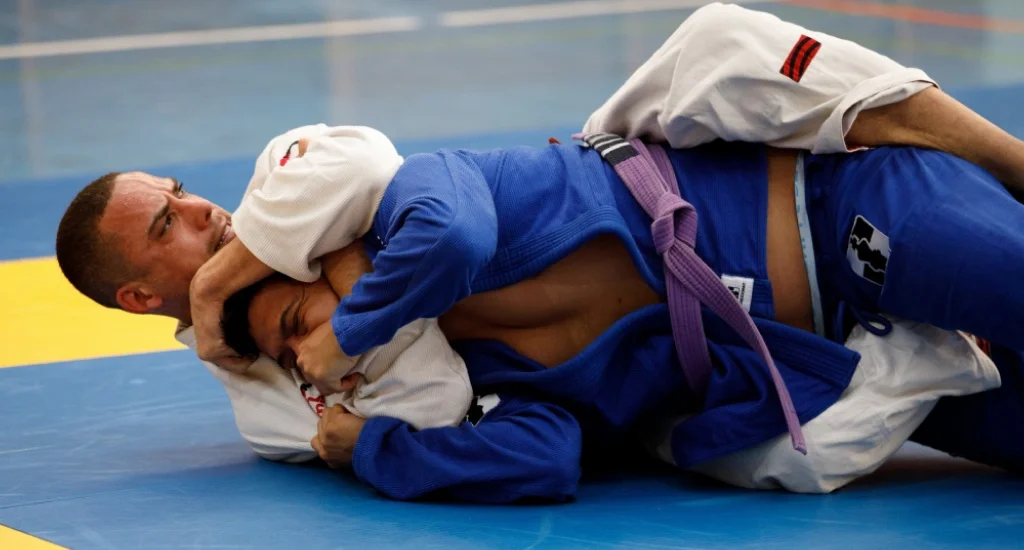
The RNC is a blood choke where you wrap your arm around your opponent’s neck from behind, compressing the carotid arteries and cutting blood flow to the brain rather than restricting airflow .
Core mechanics:
- Applied exclusively from back control position
- Choking arm slides under opponent’s chin
- Elbow aligns with their Adam’s apple/chin
- Choking hand grips bicep of opposite arm
- Non-choking hand positions behind opponent’s head
- Squeezing motion compresses both carotid arteries simultaneously
- Forces tap or unconsciousness in 5-10 seconds
Elite Sports explains the key distinction: “The aim is not to strangle by wrapping arms around the neck. The target is to halt blood circulation to the brain, which takes five to ten seconds” . This makes it far more effective than air chokes, which require several minutes.
Understanding what is guard in BJJ helps you appreciate the RNC’s value—you’ve passed their guard, taken their back, and can now finish immediately.
History and Origins
The RNC is one of grappling’s oldest techniques . In Judo it’s called hadaka jime (naked strangle), with “naked” meaning it requires no gi grips to apply . The technique appeared in catch wrestling before the Gracie family integrated it as a fundamental BJJ submission. Royce and Rickson Gracie played pivotal roles in popularizing the RNC through early UFC competitions .
According to Wikipedia’s BJJ ranking documentation, the RNC has become the most common MMA finish and remains championship-proven across all grappling arts.
Why the RNC Is Nearly Indefensible
Anatomical Mismatch
Evolve MMA explains the core principle: “The rear naked choke creates an anatomical mismatch—it pits one person’s arms against another person’s neck” . Your neck cannot generate enough force to resist properly positioned arms. Unlike an armbar where opponents can grip hands together and use strength, the RNC offers no such defensive options .
Back Control Advantage
The RNC’s effectiveness stems from the position itself. Evolve MMA notes that back mount is “widely considered the strongest position in BJJ” . From here your opponent can’t see you, has extremely limited escape options, and you can attack without fear of counterattacks. In IBJJF competition, back control alone is worth 4 points before the submission even begins.
Study our complete back control guide for detailed positional mastery.
Step-by-Step RNC Execution
Step 1: Achieve Back Control
Evolve MMA emphasizes the BJJ principle: “position before submission” . Common back-taking methods include crawling around from closed guard, capitalizing when opponents turn from mount, arm drags (Marcelo Garcia’s specialty), turtle attacks, and scramble opportunities.
Step 2: Establish and Maintain Back Control
Evolve MMA teaches: “To successfully apply a rear naked choke, it is necessary to obtain and maintain the back mount” .
- Upper body control: Use seatbelt grip (one arm over shoulder, one under armpit), squeeze around torso to prevent them turning to face you.
- Lower body control: Insert hooks (press calves against front of their thighs, heels into their legs) to control hips and make escape extremely difficult.
- Choose attacking side: Fall to the side of your choking arm for better leverage and finishing angle.
Step 3: Insert the Choking Arm
From back mount, your top hand grips their opposite shoulder while your arm slides under their neck . Create initial control with a palm-to-palm grip while your bottom arm remains under their armpit maintaining the seatbelt.
Step 4: Counter Hand Fighting
Evolve MMA teaches a critical detail: “Your opponent will likely attempt to remove the choking arm” . When they grab your forearm, unclasp your hands, reestablish the shoulder grip, and simultaneously shoot your opposite hand forward to remove their defending hand. This rapid sequence limits their ability to block the choke.
Elite Sports warns: “Leaving the arm unattended creates opportunity for escape” .
Step 5: Lock the Choke
After removing their defending hand, reestablish your palm-to-palm grip with minimal space around the neck . The lack of space prevents them from reestablishing their grip, and you’re now ready for the final lock.
Step 6: Finish the Submission
Position your non-choking hand behind their neck (not on top of their head), grip your own bicep with the choking hand, and squeeze your arms together . Elite Sports describes the mechanics: “Move the under-neck hand backward while moving the behind-head hand forward to create intense pressure” .
Advanced detail: Evolve MMA teaches that extending your legs and arching your back stretches your opponent’s body, combining with arm pressure to create extraordinary force .
Common RNC Mistakes
Leaving space at the neck: Any gap allows opponents to get their chin down and defend with hands . Eliminate all space before locking the final position.
Wrong elbow position: Elite Sports emphasizes that your elbow must align with their Adam’s apple, not your forearm across their trachea . Elbow position targets carotid arteries (blood choke); forearm position causes pain but not submission.
Not tucking the hand: Your non-choking hand must position behind their head (not on top) to create the proper finishing angle .
Sacrificing back control: Don’t abandon position for a rushed submission attempt. Back control is more valuable than a poorly executed choke .
Defending the Rear Naked Choke
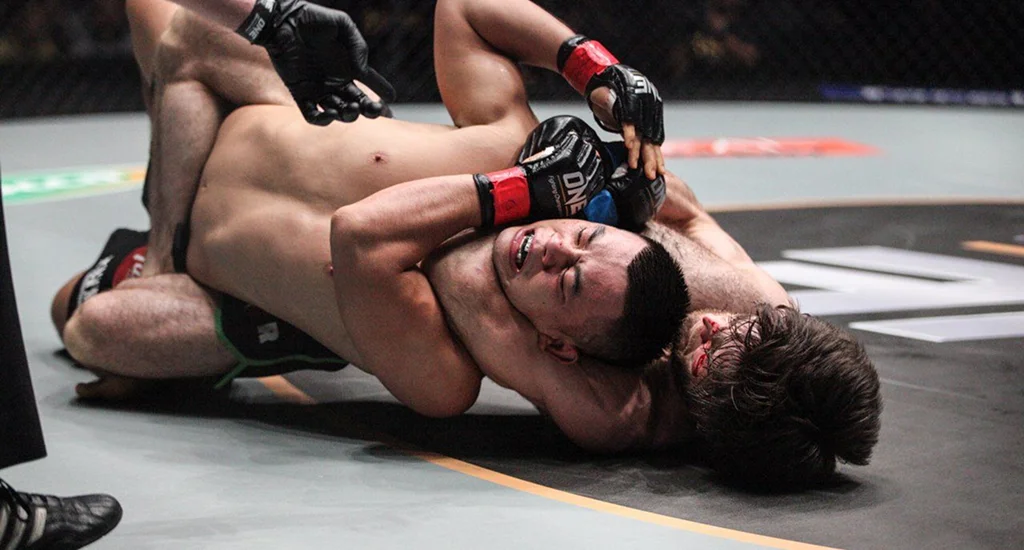
According to Stephan Kesting’s defensive guide, “The best defense against a choke is to prevent the choke” .
Defense priorities:
- Don’t turn your back: Prevention beats defense—never allow opponents behind you.
- Pull the arm and drop weight: Get the choking arm off your neck by crunching forward and pulling with full body weight.
- Get your chin down: Kesting warns this won’t stop the choke since it targets neck sides, but might buy 1-2 extra seconds .
- Grab fingers: Desperate technique to peel off the arm.
Last resort: If arched back, try running backward into a wall or crashing down on top of your opponent . Reality: once fully locked, the RNC is nearly indefensible.
Training by Belt Level
White belts: Master back control first, learn seatbelt grip mechanics, practice inserting your arm under the chin, and develop proper elbow positioning. See our white belt guide and first class expectations.
Blue/purple belts: Practice against resisting opponents, master hand fighting exchanges, study Marcelo Garcia’s back-taking systems, and develop invisible adjustments. Review blue belt development goals.
Brown/black belts: Develop signature back takes, perfect invisible RNC entries, master all finishing variations, and study championship footage. See our brown belt guide and black belt guide.
Competition and MMA Application
The RNC works equally well in IBJJF gi and no-gi competition, is legal at all belt levels, ends matches immediately, and requires no strength when executed properly. It’s the most common MMA finish and proven across decades of championship competition.
Elite Sports notes the RNC can even be applied from standing positions, making it versatile for self-defense scenarios .
Conclusion
From Judo’s hadaka jime to the Gracie family’s mata leão and countless MMA finishes, the rear naked choke represents grappling’s most effective submission. What makes it special isn’t complexity—it’s the principle of controlling the back, inserting your arm under the chin, and squeezing until they tap.
The RNC proves a fundamental truth: achieve dominant position, maintain control, then finish. No submission better demonstrates “position before submission” than the rear naked choke. For comprehensive position study, see our BJJ belt system guide and related technique section.