

The Complete Guide to Martial Arts Submissions: Mechanics, Techniques, and Strategy
By BJJ Sportswear Editorial Team
Reviewed by competitive black belts | Last Updated: February 4, 2026
If you have ever stepped onto a mat, you know the feeling. The adrenaline kicks in, your grips tighten, and the chess match begins. But the ultimate goal in grappling isn’t just to hold someone down—it is to finish the fight. This is where martial arts submissions come into play. Whether you are a white belt trying to survive or a competitor looking for gold, understanding submissions is the key to victory.
In this guide, we will break down the most effective martial arts submissions, how they work, and why they are the great equalizer in combat sports. We will explore chokes, joint locks, and the strategies that make them work against any opponent.

Table of Contents
What Are Martial Arts Submissions?
At their core, martial arts submissions are techniques designed to force an opponent to admit defeat. This is usually done by tapping out physically or verbally. These techniques rely on leverage, anatomy, and timing rather than brute strength. This makes them perfect for smaller fighters facing larger adversaries.
In Brazilian Jiu-Jitsu (BJJ), submissions generally fall into two main categories:
- Chokes: These cut off blood flow or air to the brain.
- Joint Locks: These isolate a joint and apply pressure against its natural range of motion.
Many of these techniques have their roots in traditional Kodokan Judo, where they are known as Shime-waza (chokes) and Kansetsu-waza (joint locks), a classification still used by the International Judo Federation (IJF). To become proficient, you cannot just learn the moves; you must understand the mechanics behind every successful finish.
The Mechanics of Control and Submission
Before you can apply martial arts submissions, you need control. As the famous saying goes, “Position before submission.” You cannot expect to finish a skilled opponent if you are losing the positional battle.
Effective submissions require three things:
- Isolation: separating a limb or the neck from the rest of the body.
- Control: Keeping the opponent from rotating or escaping.
- Leverage: Using your whole body against a weak part of their body.
Once you have these, you can apply martial arts submissions with high efficiency and low energy.

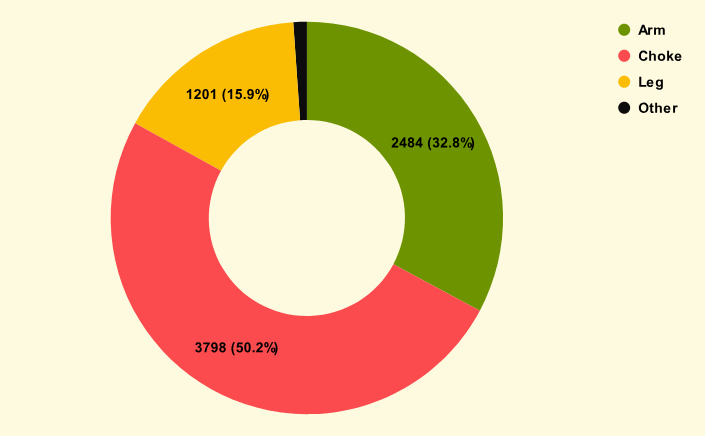
Top Upper Body Submissions You Must Know
The upper body offers the most targets for attacks. From the neck to the shoulders and wrists, there are countless ways to finish a fight. Here are the most essential upper body martial arts submissions.
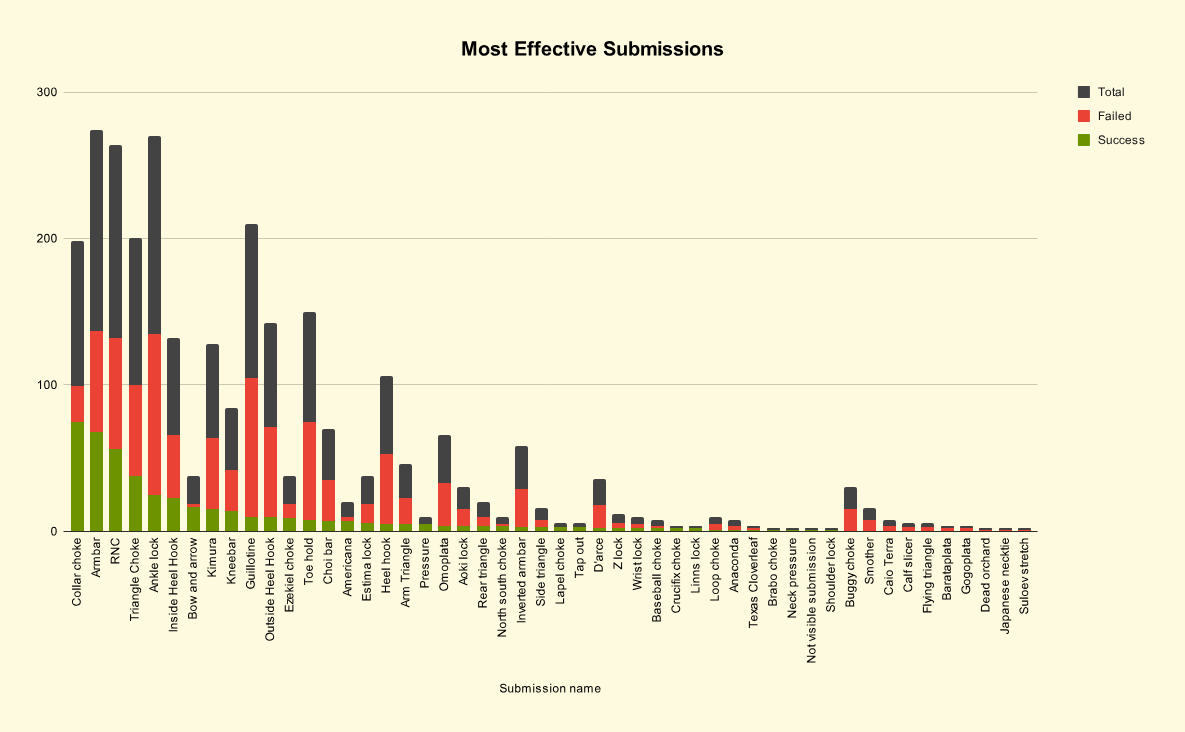
1. The Rear Naked Choke (RNC)
The Rear Naked Choke is the king of all submissions. It is simple, effective, and hard to escape once locked in. This choke constricts the carotid arteries, cutting off blood flow to the brain. It does not require a Gi, making it a staple in the UFC and other premier MMA organizations.
To finish this, you need to take the back. Once you have your hooks in, slip your arm under the chin and lock your hands. For a deep dive into the mechanics of this move, check out our Rear Naked Choke Complete Guide. It is one of the highest-percentage martial arts submissions in history.
2. The Armbar
The Armbar is a classic joint lock that hyperextends the elbow joint. It can be launched from almost anywhere: the mount, the guard, or even side control. The key is to pinch your knees and control the opponent’s thumb. If the thumb points up, the arm breaks; if it points down, they might escape.
Mastering the armbar takes time, but it is a tool every grappler needs. You can learn the finer details in our specific BJJ Armbar Guide.
3. The Triangle Choke
The Triangle Choke uses your own legs to strangle the opponent. It is unique because it traps the opponent’s arm across their own neck, cutting off blood flow on one side while your hamstring cuts it off on the other. This is one of the most versatile martial arts submissions from the bottom guard position.
Leg positioning is crucial here. If you struggle to finish this, our Triangle Choke Guide covers the angles that make the difference between a tap and a tired leg.
4. The Guillotine Choke
The Guillotine is often the first submission beginners learn, but it takes years to perfect. It applies pressure to the trachea or arteries depending on the grip. It is a powerful counter to a wrestling shot or a takedown attempt.
While it looks like a strength move, it is actually about closing space. To see how to apply this without burning out your arms, read our Guillotine Choke Complete Guide.
5. The Kimura and Americana
Shoulder locks are painful and effective. The Kimura attacks the shoulder by rotating the arm behind the back. It is a powerful grip that can also be used to sweep or transition to other martial arts submissions.
The Americana is its cousin, attacking the shoulder in the opposite direction. Both require establishing a “figure-four” grip on the arm. For tips on maximizing torque, visit our Kimura BJJ Complete Guide and our Americana Shoulder Lock Guide.
Dominating with Lower Body Submissions
For a long time, leg locks were considered “cheap” or dangerous. Today, they are essential. If you ignore 50% of the human body, you will get left behind. Modern martial arts submissions rely heavily on leg attacks.
1. The Straight Ankle Lock
This is the foundational leg lock. It puts pressure on the Achilles tendon or the top of the foot. Unlike twisting leg locks, it is generally legal for all belts in most competitions, including those sanctioned by the IBJJF (International Brazilian Jiu-Jitsu Federation). It is a great way to punish an opponent for leaving their feet dangling. Learn the proper grip in our Straight Ankle Lock Guide.
2. The Kneebar
Similar to an armbar, the kneebar hyperextends the joint—in this case, the knee. It requires you to isolate the leg and use your hips to drive through the joint. It is a powerful move often available during scrambles. Check out the Kneebar BJJ Leg Lock Guide to add this to your arsenal.
3. The Heel Hook
The Heel Hook is the most devastating of all leg locks. By twisting the heel, you create torque that tears the ligaments in the knee. Because there is very little pain before the damage occurs, it requires extreme care.
This is an advanced move, typically reserved for brown and black belts or No-Gi competitions. Safety is paramount when practicing this. Read our Heel Hook Safety Technique article before trying this on the mats.
Gi-Specific Submissions
While many martial arts submissions work without a uniform, the Gi offers unique handles. The lapels and collars become weapons.
- The Bow and Arrow Choke: This relies on feeding the collar and leveraging the opponent’s body angle. It is widely considered the most powerful choke in Gi BJJ. Read our Bow and Arrow Guide here.
- The Ezekiel Choke: This sneak attack uses your own sleeve to create pressure on the neck. It works from top mount or even inside someone’s guard. Master the Ezekiel Choke here.
- The Loop Choke: A sneaky variation that catches opponents off guard when they try to pass. See the Loop Choke Guide.
Understanding how to use the fabric increases your threat level significantly.
Defense: Surviving the Submission
You cannot discuss martial arts submissions without talking about defense. Escaping is a skill itself.
- Protect Your Neck: Always keep your chin tucked.
- Keep Elbows In: “T-Rex arms” prevent armbars and kimuras.
- Don’t Panic: Panic leads to mistakes. Breathe and assess.
If you find yourself stuck in a bad spot, you need technical escapes. We have guides on how to get out of the worst positions, such as our Mount Escape Survival Guide and Back Escape Defense Guide.
How to Improve Your Submission Rate
Knowing a move and hitting it in sparring are two different things. To land more martial arts submissions, follow these tips:
- Chain Attacks: Don’t just try one move. If the Armbar fails, switch to a Triangle. If the Triangle fails, switch to an Omoplata.
- Focus on Control: Do not rush the finish. Secure the position first.
- Drill Mechanics: Repetition builds muscle memory.
- Study Systems: Learn how moves connect rather than viewing them in isolation.
Consistently applying these principles will make your attacks sharper and harder to defend.
Safety and Etiquette on the Mats
Practicing martial arts submissions carries responsibility. We are training to break limbs and choke people unconscious. To keep training partners safe:
- Tap Early: There is no glory in a popped elbow. Tap today, train tomorrow.
- Respect the Tap: If your partner taps, release immediately. No exceptions.
- Flow Roll: Not every round needs to be a fight to the death. Move smoothly and experiment.
A good training environment allows everyone to learn martial arts submissions without fear of injury.
Conclusion
Martial arts submissions are the essence of Brazilian Jiu-Jitsu. They represent the triumph of technique over force. Whether you prefer the strangling power of the Rear Naked Choke or the surgical precision of a Heel Hook, there is a style for everyone.
Remember, the journey to mastery is a marathon, not a sprint. Start by picking one or two submissions and refining them. Use the resources linked in this guide to deepen your knowledge. The more you understand the mechanics, the more dangerous you will become.
Keep training, stay safe, and keep hunting for those taps.
Frequently Asked Questions (FAQs)
1. What is the most effective martial arts submission? Statistically, the Rear Naked Choke (RNC) is the most successful submission in MMA and submission grappling competition. It is high-percentage and low-risk for the attacker.
2. Can I learn martial arts submissions at home? You can study the mechanics through videos and guides like our BJJ Black Belt Guide, but you need a partner to practice resistance and feeling. Real-time feedback is crucial.
3. Are leg locks dangerous for beginners? Some leg locks, like the straight ankle lock, are safe for beginners. Rotational locks like the heel hook can be dangerous if applied or defended improperly, which is why safety education is vital.
4. How long does it take to get good at submissions? It takes months to understand the basics and years to master them. Consistency is key. A purple belt typically has a very dangerous submission game compared to a beginner.
5. What is the difference between a choke and a crank? A choke stops blood or air flow. A crank twists the spine or neck to cause pain. While both can force a tap, chokes are generally considered cleaner and more technical martial arts submissions.